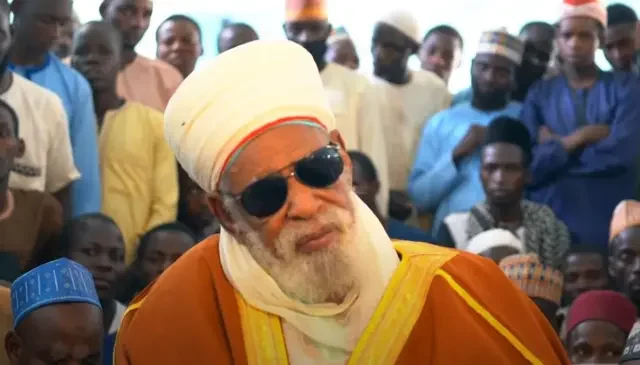
The passing of Sheikh Dahiru Usman Bauchi on November 26, 2025, at the age of 98, marks the end of an era for Nigeria’s Islamic scholarship and Sufi tradition. Born on June 29, 1927, in Nafada, Gombe State—then part of Bauchi Province—this revered leader of the Tijaniyyah Sufi order dedicated his life to spiritual guidance, education, and community service. His death, at his home in Bauchi following a brief illness, has elicited profound tributes from across the spectrum, underscoring a legacy that transcended religious boundaries.
As Nigeria mourns this colossal figure, this newspaper reflects on his enduring contributions, drawing heart-warming inspiration from a life that fostered unity in a diverse nation, and looks forward to how his teachings can guide future generations toward harmony and progress.
Sheikh Dahiru’s journey was rooted in early devotion. Under the tutelage of his father, Alhaji Usman Adam, he memorised the Qur’an as a child, embarking on a path of rigorous Islamic learning. He became a prominent scholar in the Tijaniyyahorder, a Sufi brotherhood emphasising spiritual purification and community welfare.
His scholarly pursuits took him across Nigeria and beyond, where he engaged in debates and teachings that promoted peaceful coexistence among sects. Notably, he performed the Hajj pilgrimage 55 times and Umrah 205 times, a testament to his unwavering faith.
The Sheikh philanthropy was equally remarkable; he provided 277 houses for the needy in Bauchi and Kaduna, offering shelter to the vulnerable and embodying the Sufi ethos of compassion. His family legacy is profound: among his 100 children, 406 grandchildren, and 100 great-grandchildren, nearly 300 from his bloodline became Huffaaz—memorisers of the Qur’an—while thousands of disciples carried forward his teachings.
The outpouring of tributes reveals the depth of his influence. President Bola Ahmed Tinubu mourned him as a “great icon of Islamic scholarship,” highlighting his role in promoting peace and knowledge. Former Vice President Atiku Abubakar described him as a “pillar of wisdom,” whose guidance shaped countless lives. Senate President Godswill Akpabio and Deputy Senate President Barau I. Jibrin led delegations to condole his family, praising his dedication to humanity. Speaker of the House Tajudeen Abbas paid glowing tributes, noting his legacy of service.
Even non-Muslim leaders, like Gbenga Olawepo-Hashim, hailed him as a “pillar of national unity,” praising his bridge-building across faiths. Vice President Kashim Shettima’s heartfelt tribute reminded Nigerians of leadership through selflessness. The Northern Elders Forum called his death an “irreplaceable loss,” praising his contributions to Islamic scholarship.
Bauchi state Governor Bala Mohammed expressed sorrow over the passing of a “spiritual giant.” These accolades paint a picture of a man whose wisdom transcended regional and sectarian lines, fostering a sense of shared humanity.
Philosophically, Sheikh Bauchi’s life embodies the Sufi principle of tawhid—unity—not just in faith but in society. In a Nigeria often divided by ethnic and religious tensions, his teachings promoted moderation and dialogue, countering extremism.
Reflectively, his engagement with diverse audiences, including political leaders, exemplified a philosophy of inclusivity, where spiritual enlightenment serves societal progress. Heart-warmingly, stories of his humility abound: he lived simply, dedicating resources to the poor, inspiring followers to prioritise community over self. In the face of Northern Nigeria’s challenges—poverty affecting 70 per cent of the population and insecurity displacing millions—his legacy offers a philosophical anchor: true progress stems from spiritual and moral integrity, fostering resilience amid adversity.
Analytically, Sheikh Bauchi’s impact extended to nation-building. Since the Tijaniyyah order’s establishment in Nigeria in the 19th century, it has promoted peaceful coexistence, a value he amplified through his engagements. His role in countering radicalism, as noted in scholarly works, provided a template for moderate Islam in a plural society. In Bauchi State, his influence helped stabilise communities, reducing sectarian frictions. Future-focused, his teachings encourage investment in education and welfare, aligning with Nigeria’s Sustainable Development Goals. By emphasising knowledge as a path to prosperity, he laid groundwork for a North where youth, often vulnerable to recruitment by extremists, find purpose in learning.
Sheikh Dahiru Usman Bauchi’s legacy is a beacon of hope for a united Nigeria. As we mourn, let us honour him by embracing his principles of compassion and dialogue, investing in education to uplift the North and nation. His life reminds us that from faith springs the strength to build a prosperous future.
We’ve got the edge. Get real-time reports, breaking scoops, and exclusive angles delivered straight to your phone. Don’t settle for stale news. Join LEADERSHIP NEWS on WhatsApp for 24/7 updates →
Join Our WhatsApp Channel