* Social media don’t win elections — Shettima
President Bola Tinubu, on Friday, warned the ruling All Progressives Congress (APC) that its current control of 28 States was not a guarantee of future victories, insisting the ruling party must deliberately build political structures in states where it has no governors or risk “diminishing returns” ahead of the 2027 general election.
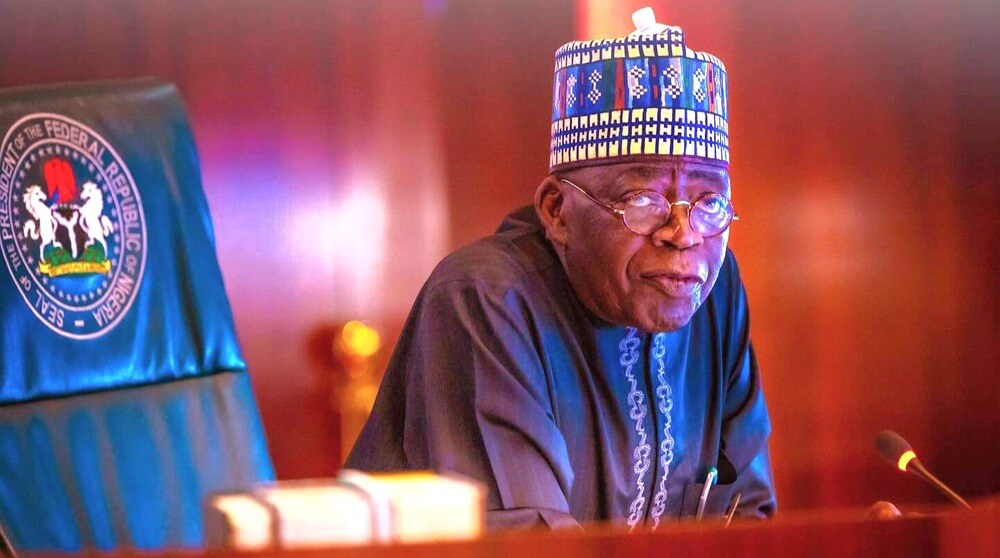
Tinubu spoke at the APC National Executive Committee (NEC) meeting held inside the Presidential Villa, Abuja on Friday, as Vice President Kashim Shettima, Senate President Godswill Akpabio and Speaker of the House of Representatives Tajudeen Abbas rallied party leaders around the President, urging unity, coalition discipline and stronger executive-legislative alignment for the next electoral cycle.
Tinubu said the party must be “vigilant” in states where it currently lacks power, stressing that winning governorships and sustaining electoral dominance required proper state-level structuring, not complacency.
“What about the states where we have no governors? The party must be vigilant and ready to produce governors,” he said.
“If the structure is not right, you won’t produce one, the law of diminishing returns will follow you.”
Elections are not won on Facebook — Shettima
VP Shettima, in a lengthy tribute to Tinubu’s political evolution, credited him with sustaining Nigeria’s opposition structures well before the 2013 merger that birthed the APC, arguing that the party’s expansion and national reach were rooted in resistance to one-party dominance and “the willingness of some leaders to organise when it was risky to do so.”
“Politics rewards memory, and today memory must begin with gratitude,” Shettima told NEC members.
“Nigeria’s opposition did not survive by accident. It survived because one man refused to surrender the political space.”
He dismissed the idea that social media agitation wins elections, saying outcomes are determined by coalitions and credibility.
“People do not cross over because of slogans,” he said.
“Elections are not won on Facebook or Twitter; they are won by coalitions, credibility and conviction.”
Shettima also warned that incumbency alone would not secure a second term, describing 2027 as a “responsibility” requiring discipline, organisation and an understanding of past lessons.
Electoral Act amendments by end of January — Akpabio
Senate President Akpabio pledged continued National Assembly backing for Tinubu’s reform agenda, saying lawmakers had processed executive bills and requests “timely” to stabilise governance.
Aligning himself with the presentations made by the APC National Chairman, the Progressive Governors’ Forum (PGF) and the Speaker, Akpabio said the documents would guide deliberations when the Senate reconvenes next week.
He urged governors to work more deliberately with legislators at state and federal levels, describing the legislature as closest to the grassroots and essential to democratic consensus.
“In democracy, the National Assembly becomes paramount and therefore needs to be consulted,” he said.
Akpabio also announced that amendments to the Electoral Act would be concluded before the end of January to provide clear timelines for congresses, primaries and the 2027 contest, adding that legislative adjustments must prevent pre-election administrative gaps.
He joined governors in endorsing a fresh vote of confidence in Tinubu, describing the President as navigating “difficult terrain” and insisting that reforms in the economy and security were beginning to show results.
APC risks fragmentation without internal discipline — Abbas
Speaker Abbas urged the party to deepen internal cohesion and treat governance “as a contract between the party and the Nigerian people,” arguing that while parties win elections, institutions deliver outcomes — and history will judge whether APC-led authorities connected the two.
He commended Tinubu’s willingness to pursue “difficult but necessary” reforms and said the House had tried to stabilise them through law, oversight and public representation.
Abbas cited House performance statistics, saying 2,263 bills were processed between June 2023 and June 2025, with 237 passed and 68 assented to — which he described as the most productive two-year stretch since 1999. He added that almost 80 per cent of enacted laws originated from private-member bills, a development he said reflected a cultural shift towards planning, discipline and prioritisation.
On oversight, he said interventions had recovered mismanaged funds and improved compliance among ministries and agencies, while inclusion efforts had expanded access for women, youth and persons with disabilities.
Turning to internal party management, Abbas warned that the APC “is not the same party it was in 2015, 2019 or 2023,” and said relations between founding and newer blocs must be handled as a strategic priority to avoid internal rupture.
“If not handled with sensitivity, fairness and institutional discipline, it can lead to fragmentation, a luxury the party cannot afford,” he said.
He proposed three mechanisms to protect cohesion: a quarterly governance-delivery dashboard; a legislative-executive programme grid tracking manifesto promises, bills and budget lines; and stronger internal dispute resolution. He also called for more rigour in candidate selection to avoid electoral liabilities.
APC a ‘beautiful bride’; reforms saved economy — Uzodimma
Earlier, Imo State governor and Chairman of the Progressive Governors’ Forum, Hope Uzodimma, led APC governors in passing a fresh vote of confidence on Tinubu, citing his economic reforms and describing the party as “a beautiful bride” ahead of future elections.
Uzodimma said governors “recall vividly” that Nigeria was “in a state of coma” when Tinubu assumed office in May 2023, citing empty coffers, an unsustainable petrol-subsidy regime and a foreign-exchange crisis driven by arbitrage.
He said Tinubu “took the bull by the horn” by removing subsidy and tackling currency racketeering, insisting the reforms were necessary to halt economic collapse, while accusing opposition politicians of hypocrisy for campaigning on similar reforms but now “weaponising” economic pain.
On insecurity, he claimed the President adopted a “fire-for-fire” approach, citing the swift rescue of kidnap victims in Kebbi, Kwara and Niger States.
Uzodimma further claimed inflation had dropped sharply and petrol prices had stabilised, adding that increased federal revenue was reaching states and local governments. He praised Tinubu for what he called “true fiscal federalism” and transparent oil-sector revenue, alleging crude-oil theft and illegal mining were being curtailed.
Responding to claims of religious persecution, he said detractors had pushed what he called “imported lies,” including an alleged fabrication of “a Christian genocide” narrative, which he said was dangerous and had even been dismissed by global religious authorities. He warned that ethnicity or religion would not be allowed to divide the country.
He also claimed reforms were now “visible with our own eyes in the market,” alleging food prices were falling, the naira was strengthening, and the gap between official and black-market exchange rates had been eliminated.
Declaring that the APC controls 28 of 36 states, Uzodimma said governors were ready “to marry more wives” by expanding the party’s political reach, and moved the formal vote of confidence, urging Tinubu to “keep his foot on the gas” and ignore “those who want us to return to the era of free money and fake exchange rates.” He said the Kaduna State governor seconded the motion on behalf of the PGF.
Uzodimma pledged support for Tinubu’s security initiatives and said governors would help identify those allegedly “hiding under politics at sub-national levels to fan the embers of insecurity,” insisting the party must take the message of recovery “to the last man on the street.”
Meanwhile, in what the report described as his clearest warning yet to governors and senior party leaders, Tinubu demanded compliance with the Supreme Court judgement on local government autonomy, declaring that direct funding to the nation’s 774 councils is now a constitutional duty his administration would enforce “if necessary.”
“Give them their money directly,” Tinubu warned.
“If you wait for my executive order, because I have the knife, I have the yam, I will cut it. We will do the arithmetic and send it. We must respect the judgment.”
Tinubu said governors who conduct local government elections, install council officials and supervise political structures cannot obstruct constitutionally guaranteed financing for the same councils, stressing that following the Supreme Court ruling, the issue is “implementation and compliance, not negotiation.”
He said any resistance — through bureaucracy, party manoeuvring or financial bottlenecks — would amount to sabotage of local governance, insisting councils must receive funds “fact after fact” to restore basic services and confidence at the grassroots.
Tinubu also warned APC leaders at state, local government and ward levels against turning the party into an exclusive club, urging accommodation of defectors, newcomers and minorities — particularly in states where APC lacks critical mass.
“If you have a huge living room, create a little room for the neighbour who is outside,” he said.
“The rain driving that neighbour will not kill him; it will only make him wet… Be accommodating. That is the only way we can be resilient.”
On security, Tinubu reaffirmed what he called an “irreversible” plan to introduce state policing and directed the National Assembly to summon the Inspector-General of Police and begin building legislative safeguards, accountability and operational control.
“We will arm the forest rangers. We will defeat those terrorists and bandits. We must,” he said.
He also signalled impatience with resistance to electronic membership registration, saying digital enumeration is essential for credible primaries, transparent mobilisation and internal democracy, warning that officials blocking it could lose that responsibility to Abuja.
“Do not shut the door. If you fail, we will take it away and do it on your behalf,” he cautioned.
Tinubu urged restraint within the party, arguing that APC’s size makes internal conflict a national issue, and warned against imposition battles and winner-take-all instincts.
“We are in the basket of ‘can-do,’ and we must drive this vehicle gently and carefully,” he said.
Reminding leaders of Nigeria’s broader democratic significance, he added: “This democracy must not fail. Nigeria is the heart of the continent. What you represent is consequential.”
We’ve got the edge. Get real-time reports, breaking scoops, and exclusive angles delivered straight to your phone. Don’t settle for stale news. Join LEADERSHIP NEWS on WhatsApp for 24/7 updates →
Join Our WhatsApp Channel