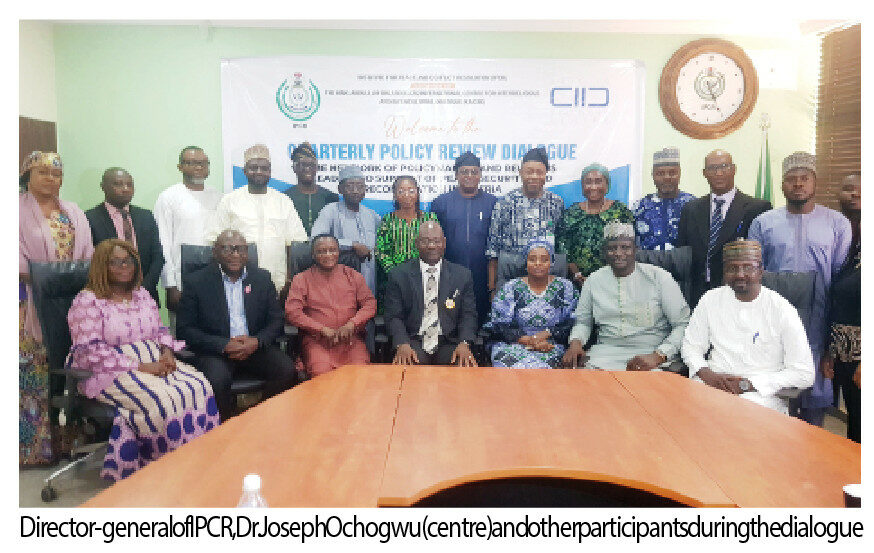
The Institute for Peace and Conflict Resolution (IPCR) the King Abdullah bin Abdullaziz International Centre for Interreligious and Intercultural Dialogue (KAICIID) and other stakeholders have intensified their campaign for an effective implementation of National Policies on Internally Displaced Persons (IDPs) and gender in Nigeria.
This was the crux of a two-day discussion that began with the Third Quarter Policy Review Dialogue of the Network of Policymakers and Religious Leaders to Support Peace, Security and Reconciliation in Nigeria in Abuja, the Nigerian capital on Tuesday.
Speaking on the plight of displaced person with the theme “Reviewing and Enhancing the Implementation of the National Policy on Internal Displaced Persons in Nigeria,” director general of the IPCR, Dr Joseph Ochogwu lamented that in 2023 an estimated 3.4 million Nigerians were residing in conditions of internal displacement, driven predominantly by violent conflict, communal clashes, and climate-induced disasters.
He said that by mid-2025, successive waves of displacement particularly affecting states such as Benue and Borno have continued to impact tens of thousands of citizens, the majority being women and children.
He said that the National IDP Policy “ embodies our collective commitment to transition from ad-hoc, emergency-driven interventions toward a coordinated, rights-based, and institutionally sustainable approach,” adding that the quarterly policy review is not convened merely to rehearse familiar challenges, but rather to engage in rigorous, evidence- informed inquiry.
Also speaking about the Nigerian Gender Policy, during the Fourth Quarter Policy Review Dialogue convened in collaboration with KAICIID) and the Network of Policymakers and Religious Leaders to Support Peace, Security and Reconciliation in Nigeria (NPMRL), that ended in Abuja on Wednesday, Dr Ochogwu said it has become imperative to review and enhance the implementation of the policy to address multiple conflicts confronting women the country.
He said “While these conflicts affect entire communities, the evidence is clear and compelling: women and girls bear a disproportionate burden. They are more likely to experience displacement, Sexual and Gender-Based Violence (SGBV), loss of livelihoods, and exclusion from decision-making processes that shape their futures.
“It is against this backdrop that the theme of today’s dialogue is: ‘Reviewing and Enhancing the National Gender Policy (NGP) in Nigeria’ becomes both timely and strategic.
“The NGP provides Nigeria with a robust framework for advancing gender equality and inclusion, women’s participation in governance, economic empowerment, and social protection.”
The session sought to critically assess how violent conflict continues to impact women and gender equality in Nigeria; to identify the barriers, whether socio-cultural, institutional, or structure that hinders effective implementation of the NGP; and to spotlight the enablers that can accelerate progress.
The KAICIID has been part of a strong collaboration and it has also strengthened its commitment to assist in addressing the crises of IDPs as well as enhance the status of women in the Nigerian society.
Dr. Asmau Benzies Leo, executive director, Centre For Nonviolence and Gender Advocacy in Nigeria, in her presentation, said it has become incumbent on all governments at all levels, traditional institutions, religious leaders to intensify their efforts to reduce the barriers against women and give them more opportunities to participate in politics and decision making process.
She also solicited support for the Special Seat for Women bill currently looking for 35 per cent at the Nigerian National Assembly, stressing that all must make concerted efforts to ensure the passage of the bill.
One of the participants, Peter Mancha, Programme Director UNWomen – Nigeria said there has to be a multisectoral approach in addressing the challenges facing women, adding that Nigerian women have made steady progress and need all the support in their quest for equity and justice in the society.
The bill termed “An Act To alter the provisions of the Constitution of the Federal Republic of Nigeria 1999 to provide for seat reservation for women in the National and state houses of assembly: and for related matters,” is before the Nigerian National Assembly and there is enormous optimism that the current struggle will achieve equity for women in politics when voting begins on the bill.
It is part of the movement to reenact the spirit of Beijing +30 and strengthen the outcome of 16 Days of Activism and a number of international instruments that we have been subscribed to enhanced the status of women.
There has been a very pathetic female representation that is less than 5% in Nigeria’s National Assembly both at the Senate and the House of Representatives in the current 10th National Assembly. In the Nigerian Upper Legislative chamber- the Senate, there are only 4 women out of the 109 Senators and 16 out of 360 members of the House of Representatives. The situation is not better in the state assemblies and these are very pathetic statistics that women must fight harder to reverse in West Africa’s most populous country.
However, there are success stories like in Senegal where women constitute about 42 per cent of the number in its National Assembly, which makes the country one of the highest in the West Africa region, a result largely attributed to the country’s 2010 Gender Parity Law which mandates that candidate lists for legislative elections must alternate between men and women. Nigeria can learn from this experience.
We’ve got the edge. Get real-time reports, breaking scoops, and exclusive angles delivered straight to your phone. Don’t settle for stale news. Join LEADERSHIP NEWS on WhatsApp for 24/7 updates →
Join Our WhatsApp Channel