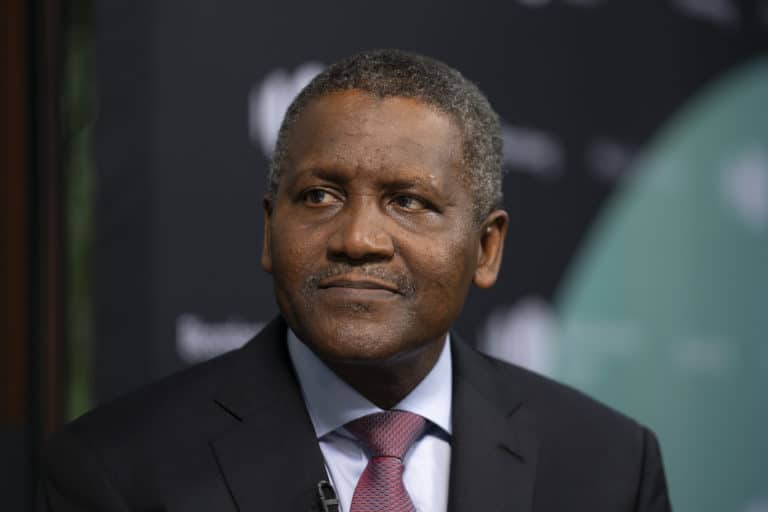
It was a high-level meeting with President Bola Tinubu, and when the chairman of the Dangote Group, Aliko Dangote, emerged from Aso Rock Villa that Monday afternoon, his message was clear and unmistakable. Petrol prices, he said, would continue to fall.
“Prices are going down. We have to compete with imports,” Dangote told State House correspondents, stressing that the reductions were driven by market competition rather than sentiment or politics.
In a country scarred by decades of fuel scarcity, sudden price hikes and serpentine queues stretching back generations, the statement landed with unusual force. It was not merely a comment on pricing; it was a window into the strategic mind behind Africa’s largest refinery and the broader philosophy shaping one of Nigeria’s most consequential private investments.
Earlier this year, Dangote Petroleum Refinery & Petrochemicals reduced its petrol gantry price from 877 to 828 per litre, a 5.6% cut. Coastal prices fell in tandem, from 854 to 806. The timing was striking. Global crude oil prices were anything but stable, yet the refinery pushed prices downward, reinforcing its stated commitment to stabilising Nigeria’s domestic fuel market.
For Dangote, price is inseparable from competition. As long as Nigeria remains partly dependent on imported fuel, local refiners must measure themselves against international benchmarks. Beat imports, or lose relevance. However, the battle is not fought solely on spreadsheets. Geography complicates the equation, and smuggling, Dangote admitted candidly, remains a stubborn problem.
Nigeria’s petrol sells for roughly 55 per cent less than fuel in neighbouring countries, where prices hover between 1,500 and 1,600 per litre. Such disparities turn borders porous, regardless of patrols or checkpoints. “It doesn’t matter how you police the borders,” Dangote said. “People will still smuggle because there’s so much money to be made.”
Yet he insists the refinery was never designed for quick wins. The $20 billion investment is anchored on longevity. Diesel and petrol, he said, will remain “very reasonably priced,” guided by sustainability rather than short-term profit. That long view also explains his strong backing for the federal government’s naira-for-crude policy, which allows local refiners to purchase crude oil in local currency.
Dangote described the policy as a “win-win” and credited President Tinubu for what he called “genius thinking.” Challenges remain. Securing a consistent crude supply is challenging when Nigerian crude trades at a premium, and some international oil companies are hesitant to sell locally. Still, Dangote believes these are teething problems that policy refinement, regulatory clarity and budgetary alignment will resolve over time.
Operationally, the refinery is already altering Nigeria’s energy narrative. Regulators, Dangote revealed, have been notified of its capacity to supply 50 million litres of petrol daily. By February, production is expected to exceed domestic demand by 15 to 20 million litres, creating room for exports to Europe and the United States.
For a nation that has endured fuel queues since 1972, the symbolism is profound. “For the first time,” Dangote said, “we’re actually suppliers to Europe and the US.” It marks a reversal of roles that many once thought impossible for Africa’s most populous country.
And the ambition does not stop there. By 2028, plans are underway to expand the refinery to 1.4 million barrels per day, overtaking India’s Reliance to become the largest refinery in the world. Agreements have been signed. Piling begins in January. Delivery, Dangote promises, will be on schedule.
Energy, however, is only one pillar of his broader bet on Nigeria. In December 2025, Dangote announced an education support initiative projected to reach ₦1 trillion over a ten-year period. From 2026, the programme will support 45,000 new students annually, rising to 155,000 by its fourth year, with an estimated 1.3 million beneficiaries in total.
“This is not only charity,” Dangote said. “This is a strategic investment in Nigeria’s future.”
Nigeria’s current reality makes the urgency stark. UNICEF estimates that more than 18 million Nigerian children are out of school, the highest figure globally. Each number represents lost potential and a weakened foundation for economic growth and democratic stability.
By pairing industrial ambition with educational investment, Dangote aligns himself with a historical pattern seen elsewhere. In the United States, industrialists like Carnegie, Rockefeller, and Ford eventually channelled vast fortunes into schools, universities, and foundations, recognising that a nation’s enduring wealth lies not only in factories, but also in minds.
Dangote’s own story mirrors that arc — from a young trader inspired by his grandfather, to Africa’s richest man, builder of the continent’s largest refinery, and now one of its most ambitious private investors in education.
The same philosophy underpins his call for backward integration and local production, a message he recently reinforced during a fireside chat at the Lagos Business School Breakfast Club. If Nigeria truly wants to become Africa’s manufacturing hub, he argued, it must produce more locally, reduce import dependence and build competitive industries capable of thriving under the African Continental Free Trade Area.
We’ve got the edge. Get real-time reports, breaking scoops, and exclusive angles delivered straight to your phone. Don’t settle for stale news. Join LEADERSHIP NEWS on WhatsApp for 24/7 updates →
Join Our WhatsApp Channel