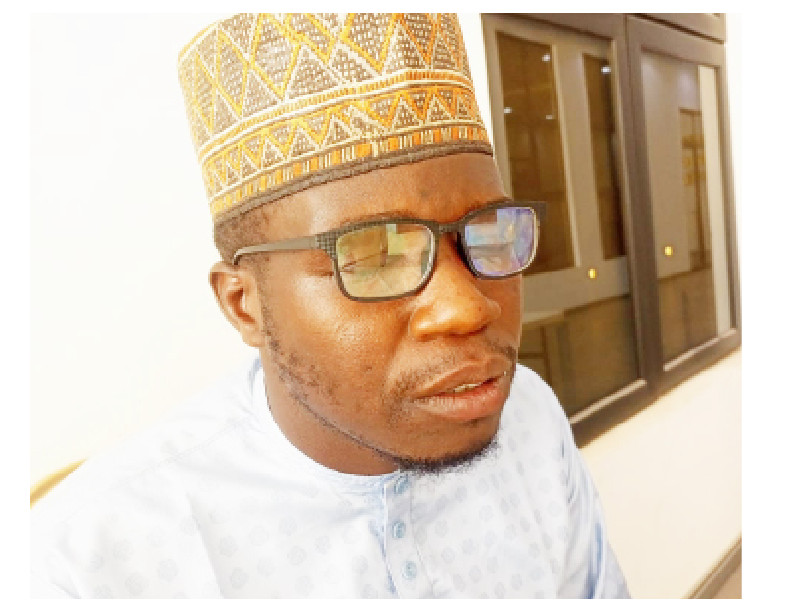
In the quiet town of Sabuwa in Katsina State, where dusty roads stretch into farmlands and life moves at an unhurried pace, the story of Adam Magaji stands as a strong reminder that adversity does not have the final word.
Born in 1991, Adam’s childhood began like that of many other boys in his community. He attended Sabuwa Model Primary School and dreamt of a future shaped by education. But while still in junior secondary school, his life took a devastating turn.
A severe eye problem, brought on by circumstances beyond his control, gradually stole his sight. His parents searched desperately for medical solutions, moving from hospital to hospital, but nothing could reverse the damage.
Not long after Adam lost his vision, his father died. The loss shattered the family’s fragile stability and thrust the young teenager into a harsh world he was ill-prepared for. Hunger became familiar. Shelter was uncertain. Friends drifted away and some relatives turned their backs.
“There were times I had no food and no place to sleep,” he recalls quietly. “It was a very painful period in my life.”
At a point when many might have surrendered to despair, help came from an unexpected source. Malam Umar Tsoho Mustapha from Kankara local government area stepped into Adam’s life. Seeing beyond his blindness, he saw potential. He took Adam to the School for the Blind in Katsina and took responsibility for his education.
There, Magaji’s world reopened in a different form. He learned Braille. He mastered computer skills. Most importantly, he rediscovered hope.
“Up to my PhD programme, he is still supporting me, may Allah reward him with Al-Jannah”, he said
In a society where many persons with disabilities are pushed or resigned to street begging, Adam made a firm and personal decision.
“I chose never to beg; begging takes away dignity and self-worth. I wanted to stand on my own and become somebody in life. Education was my way out,” Adam said
It was not an easy road. At Government Secondary School, Kofar Yandaka, he pushed himself academically and scored 260 in JAMB examinations in 2012, a result that earned him admission into Ahmadu Bello University (ABU), Zaria, to study Hausa Language in the Faculty of Education.
For a blind student choosing a language course, doubts came from every direction.
“Many people believed I could not do it, but I proved them wrong”, he added
He graduated in 2016, completed his National Youth Service, pursued a Master’s degree, and is currently pursuing a PhD in Hausa Language at Umaru Musa Yar’Adua University (UMYU). Alongside his studies, he works as a teacher under the Katsina State Government in Sabuwa.
Yet academic success did not shield him from discrimination. Magaji speaks of classmates who mocked him, especially when he performed better than they did. Some lecturers, he says, were openly discouraging.
“One lecturer told me the university was not meant for blind people. It was emotionally painful,” Adam said.
But just as cruelty appeared, so did kindness. Some lecturers stood firmly by him. He mentions Professors Abdul Hakim Shitu and Salihu as men who ensured fairness and gave him the support he needed to continue.
“Faith, patience and the support of kind-hearted people kept me going,” he said.
Today, Adam’s struggle has evolved into service. As chairman of the Joint National Association of Persons with Disabilities (JNAPWD) in Katsina State, he is working to change the narrative for others like him.
His focus is on reducing street begging among persons with disabilities through collaboration with the state government. The association is promoting small businesses, access to loans, skills acquisition programmes, and digital training such as online content creation.
“My goal is to become a professor,” he says, his voice steady with conviction. “I want to be a scholar who supports and inspires persons with special needs. I want to show them that disability is not a limitation but a stepping stone.
“To persons with disabilities: do not give up. Your condition does not define your future. To parents, society and government, we need more support and inclusion. Disability is not a choice, but success is possible with encouragement and opportunity,” he said.
From hunger and homelessness to lecture halls and leadership, Magaji’s journey is not just a personal victory. It is a quiet revolution against low expectations.
We’ve got the edge. Get real-time reports, breaking scoops, and exclusive angles delivered straight to your phone. Don’t settle for stale news. Join LEADERSHIP NEWS on WhatsApp for 24/7 updates →
Join Our WhatsApp Channel