In the build-up to the 2015 general election, insecurity was one of the main issues the then-opposition All Progressives Congress (APC) relied on to criticise the administration of former President Goodluck Jonathan. The party understandably dwelled heavily on the Boko Haram insurgency, which had overwhelmed the Jonathan government, to present itself as a more capable alternative. Throughout the campaign, the Peoples Democratic Party (PDP) administration’s failure to control the violence was deployed to strengthen the APC’s call for regime change.
Only yesterday, while revisiting some old press statements by Lai Mohammed from his days as opposition spokesperson, I came across a release in which he accused Jonathan “of fiddling like Nero while Rome was on fire.” I also chanced upon a social media post by President Bola Ahmed Tinubu from that era. As opposition leader and one of Jonathan’s fiercest critics, Tinubu insisted that “on matters of security, the buck stops at the President’s table,” reminding Nigerians that Jonathan was the Chief Security Officer of the country and urging him to “stop Boko Haram.”
Same APC?
That recollection raises an unavoidable question: is the APC in power today the same party that once offered such a clear-cut diagnosis of Nigeria’s security crisis and insisted on presidential responsibility as the solution?
A little over a decade after assuming power, the APC has failed to halt Nigeria’s deepening insecurity. In fact, the situation has deteriorated so badly that the Jonathan years, once criticised as the worst period of national insecurity, now appear almost sanctified in juxtaposition with the APC era. In the narrative, it is now quite difficult to tell who is truly an archetype of Emperor Nero between Tinubu and Jonathan.
Just last week, over a hundred Nigerians were reportedly killed in coordinated attacks across the north-central states of Benue, Plateau, and Kwara. In Woro, a community in Kwara State, no fewer than one hundred people were brutally massacred. Residents insist that many remain unaccounted for, fuelling fears that some were either abducted or died while fleeing the carnage.
Killings in Benue, Zamfara, Katsina, and Niger States have steadily intensified over the past ten years, spanning the Muhammadu Buhari presidency and persisting under the current administration. Despite repeated promises, the violence in these areas has remained stubbornly intractable.
In Niger State, especially in its northern region, abductions and killings, including kidnapping of schoolchildren, have escalated to concerning levels. Local government areas such as Kontagora, Borgu, Agwara, Mariga, Wushishi, and Magama, among others, have been subjected to ongoing attacks by bandits who have established camps within the state’s extensive forests.
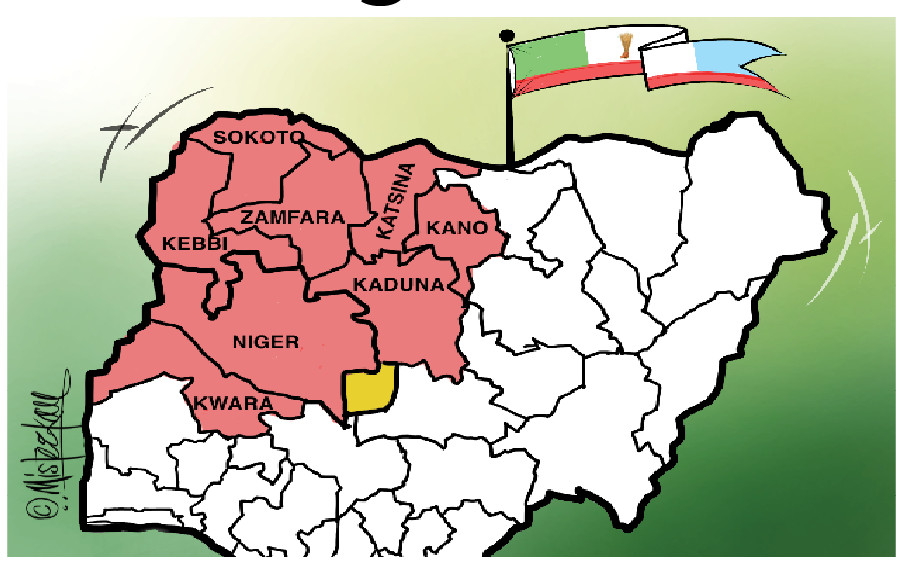
Under an APC government that once pledged to confront insecurity frontally, the northwest, like the north central, has fared no better. Katsina, Kaduna, Zamfara, Kebbi and Sokoto continue to reel under relentless attacks, while Kano, long considered relatively stable, has begun to experience renewed assaults on communities bordering Katsina State.
Across Nigeria, mass killings, kidnappings and violent crimes have spread with devastating effect, especially in rural areas where security presence is either weak or completely absent. The APC, which promised to confront the issues holding the nation back, has instead presided over a regression that has pushed Nigeria several steps backwards.
Recurring killings
Since President Tinubu assumed office in May 2023, a series of massacres has unfolded, particularly in the north-central states. Nigerians acknowledge that the insecurity was inherited and did not begin with this administration. However, after years of offering solutions as opposition leader, hundreds have since been killed in Benue, Kwara, Plateau and Niger States under his watch. In Katsina, Zamfara, Sokoto and Kebbi, killings have remained alarmingly frequent and unresolved. Each massacre follows a familiar script: attacks occur, lives are lost, and the president responds by directing security agencies to hunt down the perpetrators. Then silence follows, until another attack occurs and the same directive is issued again.
Perhaps the most disturbing element of these recurring massacres is the consistency of eyewitness accounts pointing to intelligence failures or delayed security response. One would assume that repeated lapses would lead to serious internal reviews and punishment for those responsible. But in Nigeria, accountability remains elusive.
When bandits killed a guard and vice-principal of the Government Girls Comprehensive Secondary School in Maga, Kebbi State, and abducted 25 schoolgirls, the state government acknowledged that intelligence had been received and soldiers had been deployed to the school. Shockingly, the troops were withdrawn shortly before the attack. To this day, Nigerians have not been informed about who ordered that withdrawal or why. Given how things operate in Nigeria, those responsible for that withdrawal will not be asked to account for their actions. Nothing will come of it. Nothing. Absolutely nothing.
Similarly, before the recent massacre in Woro and neighbouring communities in Kaiama Local Government Area of Kwara State, reports indicated that the attackers had even warned residents of the impending assault. What happened to that intelligence? Who failed to act? And now that the consequences are clear, has anyone been punished? Will any be punished? The absence of consequences for failure is a major reason insecurity has become deeply entrenched.
Politics trumps governance
What is more worrying is the impression that security is no longer the government’s main priority. As violence escalates, the focus appears to be on political consolidation. For the ruling APC, the emphasis is on the number of governors who have joined the party. Consequently, the main concern has been to attract as many as possible, with the aim of transforming the nation into a one-party state. Since 2023, the number of APC governors has risen from about 20 to 29 amid ongoing defections ahead of the 2027 elections.
The speed with which the president reshuffled the defence leadership after rumours of a coup plot starkly contrasts with the slow response to ongoing calls for security sector reform. In one swift move, the Chief of Defence Staff was replaced and new service chiefs appointed. The same urgency has never been demonstrated in response to mass killings, abductions, and the destruction of communities.
As Nigeria edges closer to another election year, the security situation is deteriorating at an alarming pace. Yet, the ruling party and a government seeking re-election appear disturbingly unmoved. When APC governors and party leaders gather in Abuja next month for their national convention, one question will remain: will Nigeria’s recurring massacres feature prominently on their agenda?
Today, waking up to news of mass killings no longer surprises Nigerians. What is shocking is how swiftly the nation moves on, bracing itself for the next tragedy. We have normalised violence.
The primary duty of any government is to safeguard lives and property. Confronted with Nigeria’s seemingly intractable insecurity, one cannot help but wonder if we truly have a government worthy of the name.
Next year offers the citizens yet another opportunity. The greatest tragedy for Nigeria will not be that the APC failed to end the raging insecurity, but that the party gets re-elected in 2027 despite such failure.
Electronic Transmission Of Election Results
This week, opponents of Nigeria’s democracy faced a setback as public pressure compelled the Senate to include electronic transmission of election results in the amendment of the Electoral Act. What transpired was a clear conflict between forces seeking to undermine the country’s pursuit of credible elections and those truly committed to lasting electoral reform. Ultimately, the voice of reason prevailed.
We’ve got the edge. Get real-time reports, breaking scoops, and exclusive angles delivered straight to your phone. Don’t settle for stale news. Join LEADERSHIP NEWS on WhatsApp for 24/7 updates →
Join Our WhatsApp Channel