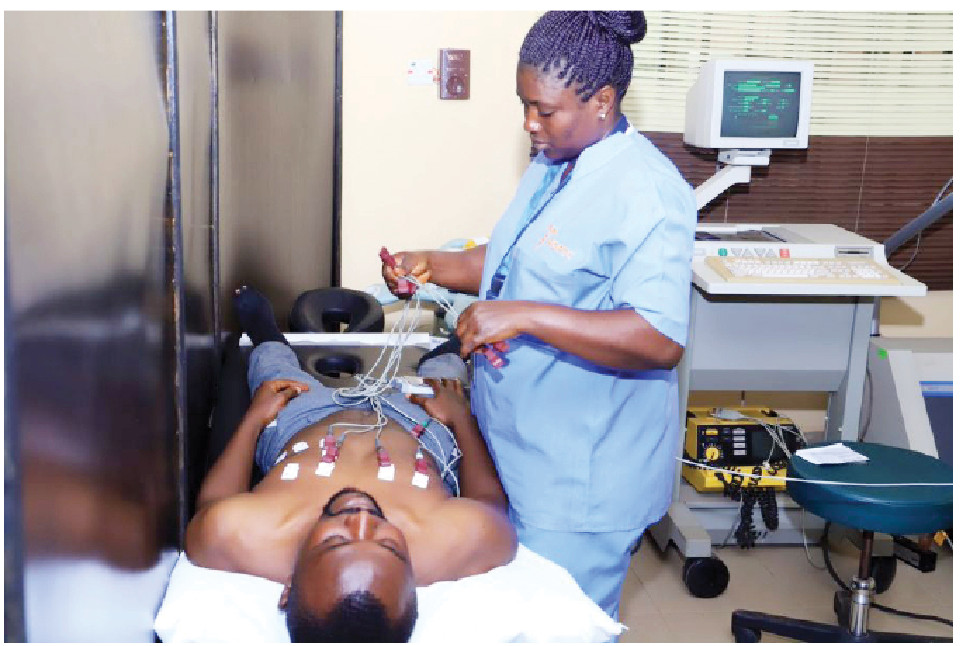
While malaria, fever and other common ailments can be treated quickly at the nearest clinic and in major hospitals, thousands of Nigerians battling heart disease face a far more frightening reality characterised by endless waiting lists, cancelled appointments and journeys across states in search of a single specialist. In this report, PATIENCE IVIE IHEJIRIKA, Abuja, ABIODUN SIVOWAKU, Lagos, ABDULLLAHI OLESIN Olesin, Ilorin, AZA MSUE, NONYE EKWENUGO, Kaduna, EMMANUEL MGBEAHURIKE, Owerri and IBRAHIM OBANSA, Lokoja, unravel the human toll of the crisis and the systemic failures driving Nigeria’s deepening cardiologists shortage.
Nigeria is grappling with a severe shortage of cardiologists, leaving thousands of heart patients waiting for months to access specialist care, according to investigations by LEADERSHIP Sunday.
Across the country, overstretched heart centres are buckling under the weight of demand. With only a limited number of cardiologists serving a population of over 200 million, patients wait months for consultations, critical tests are delayed, and life-saving procedures are often postponed. For many families, the high cost of treatment compounds the agony, forcing painful choices between healthcare and household survival.
Experts have therefore warned that the scarcity is responsible for the worsening of cardiovascular diseases, including heart attacks, strokes, and complications from hypertension.
LEADERSHIP Sunday gathered that there are only about 500 registered cardiologists for Nigeria’s population of over 200 million, a ratio that leaves each specialist responsible for roughly 400,000 to 500,000 people. The shortfall has forced many patients to travel long distances or face delayed treatment, thereby putting their lives at risk.
This dire situation persists even as cardiovascular diseases (CVDs) have become one of Nigeria’s leading causes of death, forming a major part of the country’s growing non-communicable disease burden.
Behind the statistics are human stories breadwinners who can no longer work, children watching their parents grow weaker, and elderly patients travelling hundreds of kilometres for a 15-minute review.
As cardiovascular diseases quietly rise to become one of the nation’s leading killers, the widening gap between patients and specialist care is turning manageable conditions into death sentences.
Doctors say the shortage is compounded by brain drain, with dozens of Nigerian-trained cardiologists leaving for Europe, Canada, and the Middle East in search of better pay, research opportunities, and improved working conditions.
When LEADERSHIP Sunday visited the Medical Out-Patient Department (MOPD) section of Asokoro District Hospital some weeks ago, a young woman, whose name was withheld, was seen in tears. She told our correspondent that her father, who had been referred from Customs Clinic Karu to see a cardiologist, was redirected to Wuse General Hospital because the specialist at the Asokoro facility had retired just a month earlier.
This scenario was repeated in several other hospitals visited. Many of the experienced cardiologists who remained in Nigeria have already reached retirement age, while younger doctors trained in the country have left for Canada, the UK, and other destinations in search of better opportunities. The few specialists still practising are often rotated between hospitals, leaving patients to wait weeks or even months for care.
Consequently, many Nigerians living with heart conditions go undiagnosed for months, while hospitals without echocardiography machines, catheterisation labs, or cardiac intensive care units struggle to provide accurate and timely care.
LEADERSHIP Sunday checks revealed that patients living in cities without cardiologists often travel hundreds of kilometres, sometimes in emergency situations, to reach tertiary hospitals.
Our correspondents observed that with public hospitals lacking specialist care, many are forced into costly private treatment or must seek medical care abroad, an option only the wealthy can afford. Meanwhile, general practitioners, who often lack specialist training, are left to handle complex cardiac cases, raising the risk of misdiagnosis and medical errors.
Because of the severe shortage, patients are frequently given appointment dates weeks or even months away, and some wait up to 3 months to see a cardiologist.
However, the head of Cardiology at the National Hospital, Abuja, Dr Oladipupo Fasan, said long waits are not unique to Nigeria. Comparing the situation with the UK’s National Health Service (NHS), he noted, “It’s even worse in the UK.”
Dr. Fasan explained that Nigeria’s shortage of cardiologists and other specialists stems from a “multi-faceted, hydra-headed problem,” driven by limited training capacity, inadequate government policies, and the ongoing migration of young doctors seeking better opportunities abroad.
Speaking further on the challenges facing cardiac care, Dr Fasan said the problem goes beyond cardiology. “It’s not just cardiologists, it’s a problem with specialist employment in Nigeria,” he told LEADERSHIP Sunday.
He explained that the pipeline for producing specialists has become increasingly strained. Training to become a cardiologist is long and rigorous, yet the number of accredited training slots in the country remains limited, leaving hospitals understaffed and patients waiting.
“Training to become a specialist is not easy, and available slots in Nigeria are limited.
The situation is further worsened by the steady exodus of young doctors seeking better opportunities abroad. With many leaving early in their careers, fewer candidates are available to enter specialist training programs.” Dr Fasan said.
“A lot of young doctors are leaving the country. So who’s going to do the training?” he asked.
Dr Fasan also criticised the government’s inaction, saying salaries are low and specialist employment opportunities are inadequate. He added that better pay could drastically reduce the brain drain. “If the government just doubled doctors’ salaries now, I’m sure 80 per cent of those leaving would stay,” he said
Despite the severity of the crisis, Dr Fasan said the shortage of cardiologists should not come as a surprise, citing limited training spaces, poor planning, and weak government responsiveness as key factors.
600 Cardiologists Serving Over 200 million Nigerians – Katibi
Meanwhile, a renowned cardiologist, Prof. Ibrahim Katibi, has revealed that there are only about 600 cardiologists serving over 200 million people.
He noted that this translates to roughly one cardiologist for every half a million people, compared to the United States, where the ratio is six per 100,000 or about one per 10,000 as recommended by the World Health Organisation (WHO).
“Therefore, cardiologists cannot always be available for every patient with a heart condition, highlighting the need for some degree of automation in diagnosis through Artificial Intelligence (AI),” Katibi said.
However, a management staff member of the University of Ilorin Teaching Hospital (UITH), who requested anonymity, countered that teaching hospitals worldwide are hierarchical in structure and thus are not generally affected by a shortage of specialists, including cardiologists.
“We have resident cardiologists, registrars, and consultants on staff. Even if we were to assume, without conceding, that there is a shortage, it would not be across all these cadres, as previously suggested. The system is self-sustaining, with upward mobility across levels.
“While doctors retire at 70 years of age, younger doctors automatically fill the resulting gaps. UITH is no exception,” the official said.
Few Cardiologists, Other Specialists Overworked In Kaduna – Ex-NMA chairman
In Kaduna, our correspondents gathered that a critical shortage of cardiologists is severely affecting patient care and increasing the risk of preventable heart-related deaths.
The immediate past chairman of the Nigerian Medical Association (NMA), Kaduna State branch, Dr. Sheyin David Madaki, explained that the few available specialists, including cardiologists, are overworked, often attending to 20 to 50 patients daily.
He noted that such high patient loads limit the time doctors can spend with each patient, raising the risk of delayed diagnoses and medical errors. According to Dr. Madaki, patients often wait weeks or even months for appointments, a problem that is particularly acute in rural areas where access to general practitioners is already limited.
Private hospitals frequently attract the few available cardiologists with higher pay, leaving public hospitals understaffed and overwhelmed. Dr. Madaki highlighted hypertension as one of the most common conditions affected by delayed care.
“Untreated high blood pressure can lead to heart disease, kidney complications, and even sudden death,” he said.
He also identified brain drain as a major factor, with many Nigerian specialists migrating abroad in search of better pay and working conditions. Dr. Madaki advised residents to take a proactive approach to their health by seeking regular check-ups rather than waiting for symptoms, which may indicate serious complications.
At the same time, he urged health authorities to address the “push factors” driving cardiologists out of the country, including poor working conditions, inadequate equipment, and low remuneration.
A hypertensive patient at Barau Dikko Teaching Hospital, Kaduna, Malami Adams, said he goes for monthly check-ups. “I have been managing hypertension for the last six years. The doctors are doing very well, but the government needs to employ more specialists to reduce the workload on the few attending to hundreds of patients,” he stated.
Shortage Of Cardiologists Confronts Hospitals In Imo
In the same vein, Imo State is currently facing a shortage of cardiologists in both the Federal Medical Centre and state-owned hospitals.
According to Dr. Chidi Ibezim, this shortage is largely due to the lack of incentives from the government, which leads many cardiologists to seek better remuneration and working conditions abroad.
Patient Nnamdi Uzohu emphasised that the situation requires urgent intervention by the relevant government agencies, as he is unable to access care in private hospitals due to their exorbitant fees.
An official from Imo State General Hospital, who requested anonymity, echoed this concern, noting that medical professionals, including cardiologists, often leave for foreign countries in search of better packages and incentives. He called on the government to equip hospitals adequately and improve remuneration for medical staff, including cardiologists.
The official further warned that the shortfall of cardiologists is particularly worrying given the rising incidence of cardiovascular diseases in the state. He highlighted an increase in hypertension-related cases, attributing the trend to poor lifestyle choices and an inconsistent healthcare delivery system.
He also noted that the Cardiac Society of Nigeria has recommended stronger healthcare infrastructure and the inclusion of cardiovascular care in the National Health Insurance Scheme (NHIS) to help alleviate patients’ suffering.
Also, a consultant cardiologist at the Lagos State University Teaching Hospital (LASUTH), Dr Folasade Adeola Daniels, said she was not aware of any shortage of cardiologists in Lagos State.
“Well, to my knowledge, I am not sure there is a shortage of cardiologists in the state. At LASUTH alone, we have no fewer than 9 cardiologists. We have cardiologists in other general hospitals in the state. We have cardiologists in private practice as well. So I believe we have a good number of cardiologists. We also have them at the Lagos University Teaching Hospital (LUTH), FMC at Ebute-Metta, the Navy Hospital, and even at Igbobi Orthopaedic Hospital. And we have many of them in training as well,” she said.
Responding to whether there is a decline in the number of cardiologists in the country, President of the Nigerian Cardiac Society, Prof. Austin Odilli, said: “Well, I would say yes and no. Because yes, we are getting a few more people coming in, but the expected rise is not the same.
“While the older ones are exiting, the young ones are coming in, but not at the same rate at which new medical schools are being established.
“If we use the statistics of the people that we induct into the society, maybe in the past four years the trajectory will be going up. But then, it is how you interpret that which counts. Because the interpretation may be that more and more people are becoming interested, even as the number of people we are training in the teaching hospitals is getting smaller.
“For us in the Nigerian Cardiac Society, we’ve been inducting people, but it’s not only doctors. And many more people are picking up interest.
“Yes, there is a decline in cardiologists in the country. There is no doubt about it. In fact, even getting senior registrars to join the units is not as much as it used to be.
“So the implication of this is that it will further deepen the crisis of cardiologists, as some people retire. And you know, this can increase the workload on the few available specialists and delay patient care.
“What we believe the government can do is simply improve working conditions, and then people will stay.”
Only One Cardiologist Serves All of Kogi State, Say Experts
Disturbingly, Kogi State is also grappling with a severe shortage of medical professionals, including specialists such as cardiologists, particularly in tertiary health institutions.
At the Federal Teaching Hospital, Lokoja (FTHL), investigations revealed a significant drop in staffing levels, with the number of resident doctors reportedly declining from about 186 to 78 over a four-year period. This sharp reduction has resulted in a critical shortage of specialists.
Sources who spoke with LEADERSHIP Sunday noted that the situation has been worsened by the large-scale exodus of specialists seeking better working conditions and opportunities abroad.
A specialist doctor at FTH Lokoja, who spoke to LEADERSHIP Sunday on condition of anonymity, disclosed that there is currently only one cardiologist in the entire state.
“I can confirm to you that at the moment, we have only one cardiologist in the state, and that is at the FTH Lokoja,” the doctor said.
“In the past, we used to have visiting cardiologists. This caused a lot of stress for patients, who had to wait for months to see a cardiologist. Sometimes, it ended in casualties.”
A cardiovascular disease patient who shared his experience with LEADERSHIP Sunday described the situation as traumatic.
“It used to be hell for me in the past because we had to wait for weeks before we were attended to,” he said.
“In the past, the visiting cardiologist came only once a month. You know what that means for someone with a critical cardiovascular health challenge. Things are much better now, as we can be attended to almost on a weekly basis.”
The acting chief medical director (CMD) of the Federal Teaching Hospital, Lokoja, Dr Ojochide Ebune, also confirmed the shortage, noting that there is only one cardiologist in the state, particularly at the FTH Lokoja.
“Yes, we have one cardiologist in Kogi State, and his clinic holds once a week, every Tuesday,” he said.
LEADERSHIP Sunday concludes that the growing shortage of cardiologists is more than a workforce gap. It is a national emergency that demands urgent government intervention. This is because innocent Nigerians who never prayed for a failing heart should not be condemned to suffer or die simply because specialist care is out of reach. From expanding training slots and incentivising retention of specialists, to equipping tertiary hospitals and strengthening health insurance coverage for cardiac care, decisive action is needed to rescue vulnerable patients from avoidable deaths. Without immediate and sustained investment in heart healthcare, the silence in hospital corridors will continue to echo with stories of lives lost not to fate, but to neglect.
We’ve got the edge. Get real-time reports, breaking scoops, and exclusive angles delivered straight to your phone. Don’t settle for stale news. Join LEADERSHIP NEWS on WhatsApp for 24/7 updates →
Join Our WhatsApp Channel