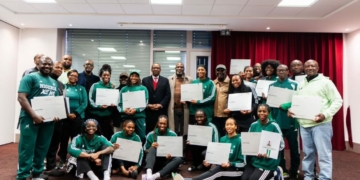
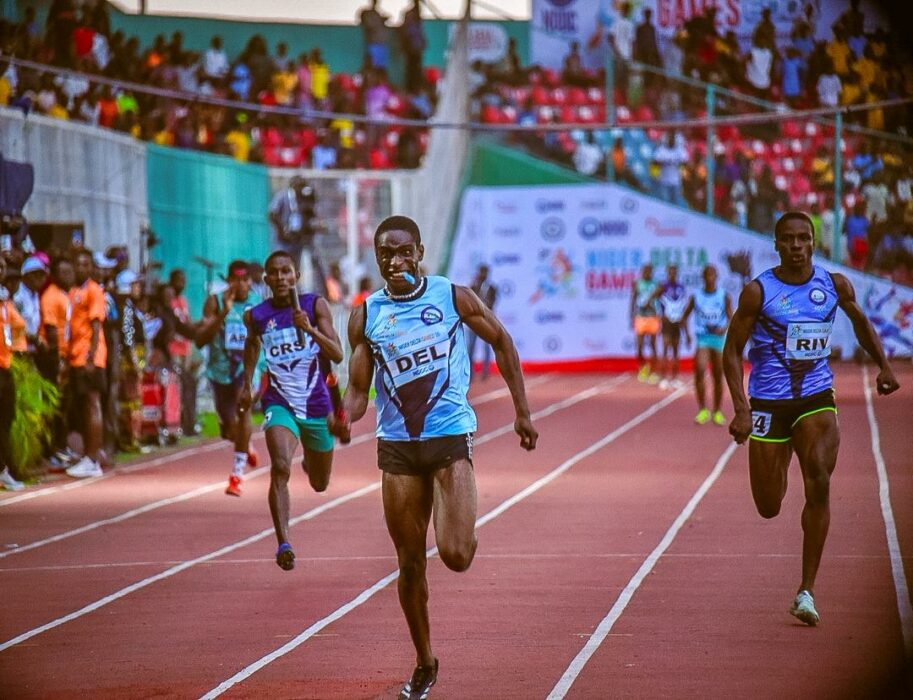
The 2nd edition of the Niger Delta Games (NDG) concluded with a celebratory fanfare on Thursday, 26th February, at the Samuel Ogbemudia Stadium in Benin City, Edo State, following five days of fiercely contested events.
For the first time in a considerable period, the host state, Edo, topped the medal table at a national sports festival, securing an impressive 52 gold medals. However, the dominant talking point as delegates returned to their respective states was the athletics competition, particularly the thrilling final day.
From the opening 100m heats to the spectacular relay finales, the athletics events were consistently electrifying. This was no surprise, given the Niger Delta region’s rich history as a hotbed of athletic talent, having consistently produced some of Nigeria’s finest track and field stars, both domestically and internationally.
Delta State emerged as the dominant force in the athletics events in Benin City, despite formidable challenges from Edo, Bayelsa, Akwa Ibom, and Cross River States. Delta athletes clinched 13 gold medals, primarily in the sprints and relays. Edo State found its success in the field events, while Akwa Ibom and Cross River States shared the honours in the middle and long-distance races.
“Nobody can dispute Delta State’s prowess in athletics; they possess an excellent structure that consistently develops quality athletes every year,” remarked Mutiu Oluwa, Edo State Athletics coach. “If other states, such as Edo, can emulate their approach, we’re set for an absolute showdown in future Niger Delta Games,” he declared.
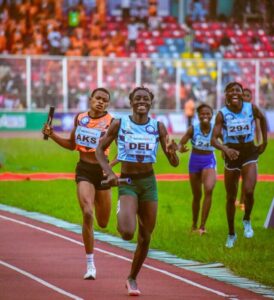
Just before the closing ceremony, Delta State unequivocally demonstrated its untouchable status by securing three of the four available relay gold medals. Only Akwa Ibom State, by winning the men’s 4x400m, prevented Delta State from achieving a clean sweep on the final day.
“The athletes gave absolutely everything they had; everyone wanted to make a statement,” commented former Nigerian sprint champion Seun Ogunkoya. “This bodes well for Nigerian athletics. The quality of the competition and the running talent on display were incredibly encouraging. This is merely the beginning, and I believe with more such events, this country can boast a wealth of athletes in the near future.”
Among the standout athletes who captivated spectators were Ejiro Peters, who achieved a sprint double in the women’s 100m and 200m, also securing gold in the 4x100m. Osama Chibueze mirrored this success for Delta State, winning a sprint double and the 4x100m.
In the 400m, David Udoh of Cross River State disrupted Delta’s dominance by claiming the men’s 400m title and contributing to Cross River State’s victory in the men’s 4x400m gold. Earlier, Treasure Okereke had won the women’s gold and helped Delta State to victory in the women’s 4x400m. Akwa Ibom’s Hephzibah Okon was a sensation in the women’s 800m, though her bid for a double was thwarted by Cross River’s Godsmind Eteng in the 1500m. Emmanuel Asuquo won the men’s equivalent. Treasure Omosivwe was in a league of her own in the women’s high jump, matching her personal best of 1.75m to secure gold for Edo State.
“What we’ve witnessed here at the Niger Delta Games is truly encouraging; Nigeria, particularly the Niger Delta region, is blessed with athletic talent,” stated Mrs Joyce Bozimo, organiser of the Warri Effurun Peace Marathon. “Our sole wish is for these athletes to receive follow-up support. We could establish a camp, similar to the one we once had in Afuze, where they could be trained, mentored, and conditioned to become world champions.” She also commended the “excellent” organisation of the events.
Sir Itiako Ikpokpo, Chairman of the organising committee and also the Delta State Athletics Association chairman, worked closely with the technical committee, led by Enefiok Odo-Obong, to ensure the smooth running of the athletics events. Ikpokpo confirmed that the Games Scouting and Mentorship Committee had been monitoring events across all venues and would provide recommendations for future steps. He urged states to ensure that promising athletes receive the necessary support to flourish.
“Ultimately, Dunamis-Icon Limited and the Niger Delta Development Commission (NDDC) do not own these athletes, nor do we intend to,” Ikpokpo stated at a pre-closing media conference. “We have simply provided a platform for athletes to showcase their talents. It is the responsibility of the states and the Federal agency to nurture them into national and international champions.”
The proprietary rights to the Niger Delta Games are held by Dunamis-Icon Limited, with sponsorship from the NDDC.
We’ve got the edge. Get real-time reports, breaking scoops, and exclusive angles delivered straight to your phone. Don’t settle for stale news. Join LEADERSHIP NEWS on WhatsApp for 24/7 updates →
Join Our WhatsApp Channel