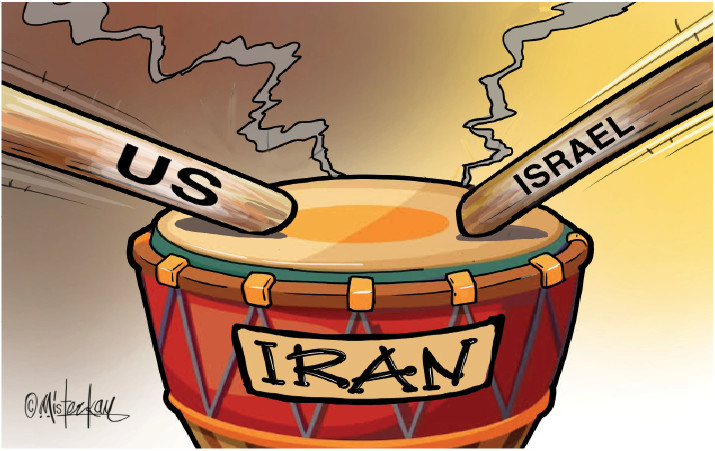
“Do not beat the drums of war if you are not ready for a fight.” African proverb.
In the early hours of 28 February 2026, a joint military campaign by the United States and Israel struck deep inside Iran, targeting senior leadership, military infrastructure and command centres. Within days, Iranian state media confirmed that Ali Khamenei, Iran’s Supreme Leader for nearly four decades, was killed in the strikes.
Whether one views this event as strategic deterrence or reckless escalation, its implications are seismic. The balance of power in the Middle East has shifted dramatically. Energy markets have reacted nervously. Diplomatic alignments are hardening. And from Abuja to Accra, from Nairobi to Pretoria, policymakers are recalibrating their assessments of risk in an increasingly combustible world.
This war is not just another flare-up in a troubled region. It is a potential inflection point in an already fragile global order.
The Centre Cannot Hold In The Strait That Shakes the World
For years, Iran under Khamenei functioned as both ideological anchor and geopolitical disruptor. Through alliances and proxy networks stretching across Lebanon, Syria, Iraq and Yemen, Tehran projected influence well beyond its borders. Its rivalry with Israel was overt; its hostility toward U.S. military presence in the Gulf was structural.
The removal of such a central figure is not a surgical act with predictable outcomes. Decapitation strategies can destabilise command structures, but they can also radicalise successor factions. In political systems where power is deeply centralised, succession is rarely smooth. The risk now is not only state retaliation, but fragmentation, competing power blocs within Iran’s political and military establishment struggling to define the next chapter. A weakened but angrier Iran is as dangerous as a unified and assertive one.
The geopolitical consequences extend far beyond Tehran. Tensions have surged around the Strait of Hormuz, the narrow maritime corridor through which roughly a fifth of global oil supply passes. Any sustained disruption whether through blockade, sabotage or heightened military patrols, reverberates instantly across global energy markets.
Oil prices have already responded upward. For major economies, this means inflationary pressure and fragile growth forecasts. For import-dependent developing nations, it means fiscal strain. For oil exporters like Nigeria, it presents a paradox: short-term revenue gains amid long-term uncertainty and this prospective windfall is not a development strategy, it will be a test of discipline, transparency and accountability.
Africa in the Crosswinds
Africa is often treated as a spectator in global power struggles. It is not. The continent is deeply entangled in global trade networks, security cooperation frameworks and diplomatic alignments. For governments already juggling debt pressures, insecurity, youth unemployment and fragile social contracts, external shocks compound domestic strain.
Higher shipping insurance costs affect African imports. Increased fuel prices ripple through transportation and food systems. Security narratives shaped abroad can inflame extremist recruitment at home. African states hosting foreign military facilities or strategic assets may reassess their exposure.
Moreover, great power rivalry between Washington, Moscow, Beijing and regional actors increasingly plays out in African capitals through infrastructure deals, security partnerships and political influence. A Middle East war does not remain confined to the Middle East; it alters bargaining tables everywhere.
Beyond economics and diplomacy, this war forces Africa to confront a deeper strategic question: will we continue to experience global crises as shock recipients, or will we build the collective capacity to shape outcomes? The conflict underscores the urgency of accelerating intra-African trade under the AfCFTA, strengthening regional energy security, investing in domestic refining capacity, and reducing overdependence on external supply chains that leave us exposed to distant geopolitical tremors.
It also demands stronger continental coordination through the African Union on matters of non-alignment, peacebuilding and preventive diplomacy. A fragmented Africa is vulnerable in moments like this; a coordinated Africa has leverage. In a world tilting toward power politics, unity is no longer idealism, it is strategy
.
A Note to Nigerians – Oil Windfalls and Old Habits
Let us be clear: this is not our war, we don’t have to dance to the rhythm of the drums.
While we show empathy to regions experiencing bombardment, invasion and displacement whether in the Middle East or Eastern Europe, Nigeria must resist the temptation to emotionally conscript itself into battles that are not ours. We have our own urgent crises: insurgency in the North-East, banditry in the North-West, communal conflicts in the Middle Belt, economic fragility nationwide, youth unemployment at alarming levels, and infrastructure deficits that constrain productivity.
Solidarity does not require entanglement. Compassion does not demand participation. The loudest drums may be beating abroad, but our most urgent battles are at home against poverty, inequality, corruption and institutional weakness. We cannot afford distraction masquerading as global relevance.
Yet we cannot ignore the economic consequences of distant wars. Rising oil prices particularly amid tensions or partial blockades in the Strait of Hormuz may temporarily increase Nigeria’s crude earnings. History, however, offers a sobering lesson: oil booms have often strengthened patronage systems rather than national resilience.
If revenues rise, government must immediately activate transparent stabilisation mechanisms. Excess earnings should be channelled into the Excess Crude Account (ECA) or comparable sovereign buffers with clear legislative oversight, public reporting and independent audit trails. The moment demands prudence, not political opportunism.
Citizens must also widen the lens of accountability. It is not enough to scrutinise how government spends; we must interrogate what government earns. Revenue transparency, production data integrity, remittance tracking and sovereign savings discipline are not technocratic details, they are the difference between cyclical vulnerability and long-term stability.
If war abroad brings higher oil receipts, let it not bring higher corruption at home.
A Fractured Global Order – War Without Borders
The broader picture is unsettling. The post–Cold War assumption that economic interdependence would temper military confrontation appears increasingly fragile. From Eastern Europe to the South China Sea, from Gaza to Tehran, geopolitical fault lines are sharpening.
The killing of a sitting Supreme Leader by external military action crosses a psychological threshold. It signals that red lines once assumed inviolate are now negotiable. That reality will influence how other states think about deterrence, nuclear ambitions and alliance structures.
Smaller states, including those in Africa, must therefore invest in strategic autonomy through diversified trade partnerships, strengthened regional integration, resilient domestic institutions and diplomatic agility. The era of comfortable neutrality is narrowing. But reckless alignment is equally dangerous. The task is balance: principled, interest-driven engagement without surrendering sovereignty.
We are living through a period where conflict is no longer geographically contained. Cyber warfare, disinformation campaigns, energy manipulation and proxy militias dissolve traditional boundaries. A missile launched in one region can raise bread prices in another. A naval manoeuvre in a narrow strait can shift election debates thousands of kilometres away.
The death of Ali Khamenei is not merely an Iranian event. It is a symbol of a world in flux — one where power is contested more openly, alliances are tested more aggressively, and economic shockwaves travel faster than diplomacy can contain them. For Africa, and for Nigeria in particular, the lesson is sobering but clear: global turbulence is inevitable; domestic resilience is optional.
We cannot silence the drums of war beating elsewhere. But we can choose not to dance to rhythms that undermine our own progress. We can choose fiscal discipline over fiscal euphoria. Institutional reform over rhetorical outrage. Strategic focus over sentimental distraction.
We’ve got the edge. Get real-time reports, breaking scoops, and exclusive angles delivered straight to your phone. Don’t settle for stale news. Join LEADERSHIP NEWS on WhatsApp for 24/7 updates →
Join Our WhatsApp Channel