
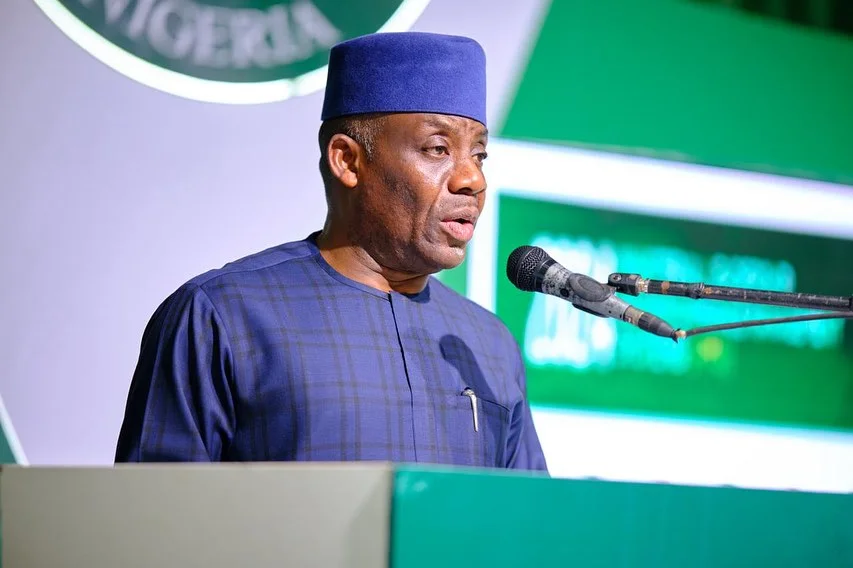
The federal government has reiterated its commitment to education reform through the Nigerian Education Sector Renewal Initiative (NESRI), targeting improved access, quality, governance, and sustainable financing to drive national development outcomes.
The minister of education, Dr. Tunji Alausa, who spoke at a high-level engagement on Tuesday in Ikoyi, , said the NESRI framework is central to repositioning Nigeria’s education sector for global competitiveness and inclusive growth.
Alausa outlined six priority areas under NESRI, including expansion of Technical and Vocational Education and Training, promotion of Science, Technology, Engineering and Mathematics education, and aggressive reduction of out-of-school children nationwide.
Other focus areas, he said, include strengthening data and digitalisation systems, improving quality assurance across institutions, and enhancing governance through stronger collaboration with sub-national governments, private sector, and civil society.
The minister noted Nigeria’s partnership with the Global Partnership for Education could unlock up to $500 million to support foundational learning and reduce learning poverty across the country.
According to him, over 1.1 million out-of-school children have been returned to classrooms, supported by investments in infrastructure, teacher development, and digital platforms for tracking enrolment, retention, and performance nationwide.
”Education remains the highest-return investment. Under President Bola Tinubu, we are committed to ensuring every Nigerian child accesses quality education through sustained reforms and strategic partnerships,” he said.
The minister emphasised private sector investment as key to scaling education reforms, introducing a sector-wide approach that aligns funding, removes silos, and strengthens collaboration with partners and institutions.
Alausa explained that the model will ensure strong governance, transparency, financial safeguards, and measurable outcomes, with annual joint reviews and support from World Bank and GPE for SWAp implementation.
“We have World Bank supporting a swap programme with the help of GPE to help us build this swap office, which we will be launching in the next weeks,” he added.
The minister of state for education, Prof. Suwaiba Ahmad, earlier rallied private sector leaders and key stakeholders to advance strategic dialogue on strengthening Nigeria’s education system.
Speaking at the inaugural Federal Ministry of Education Private Sector Breakfast Convening, Ahmad noted that shared responsibility is needed in transforming Nigeria’s education system for sustainable national growth and development outcomes.
She expressed appreciation to private sector partners, development organisations, and industry leaders, noting that their presence underscores a shared commitment to strengthening Nigeria’s education system across all levels.
”This meeting is timely, as education remains central to progress, and no nation can achieve sustainable growth without a strong, inclusive, and forward-looking system.
”The ministry has made deliberate efforts to deepen engagement, and this platform aims to encourage innovative partnerships and foster collaborative solutions to accelerate transformation across Nigeria’s education sector,” Ahmad said.
The minister underscored the role of the Global Partnership for Education grant, identified it supports policy implementation and inclusive collaboration, while advancing Nigeria’s broader education reform priorities and measurable outcomes nationwide.
Aligning reforms with the vision of Bola Ahmed Tinubu, she said human capital development remains central, with the Nigeria Education Sector Renewal Initiative driving systemic transformation across institutions and learning frameworks.
According to her, NESRI is delivering results, with “renewed momentum in policy alignment” and increasing private sector interest, recognising education investment as both a social responsibility and economic imperative.
She, however, stressed that government cannot achieve transformation alone, insisting the private sector is critical in driving innovation, expanding infrastructure, and producing globally competitive, industry-ready graduates for the future.
Ahmad urged stakeholders to explore collaboration in digital learning, skills development, and financing, assuring that government will provide an enabling environment for transparency, accountability, and sustained partnerships.
In his remark, Serigne Thiam, Former Minister of Education in Senegal and GPE High-Level Envoy emphasised Nigeria’s long-standing partnership with GPE, highlighting leadership in education and summit collaboration transforming education systems.
”Nigeria is a long-standing partner of GPE, organising roundtable and co-hosting GPE’s 2026 Multiply Education Summit, placing education at center of development agenda, demonstrating leadership and partnerships transforming education systems,” Thiam added.
Chairman of Zenith Bank, Mr Jim Ovia, noted that the dialogue signals a new era of partnership for education in Nigeria bringing business leaders into government collaboration framework impact.
”We are creating conditions for smarter investment in education by bringing business leaders and government together to ensure accountability and measurable impact in classrooms across Nigeria system wide,” he added.
We’ve got the edge. Get real-time reports, breaking scoops, and exclusive angles delivered straight to your phone. Don’t settle for stale news. Join LEADERSHIP NEWS on WhatsApp for 24/7 updates →
Join Our WhatsApp Channel