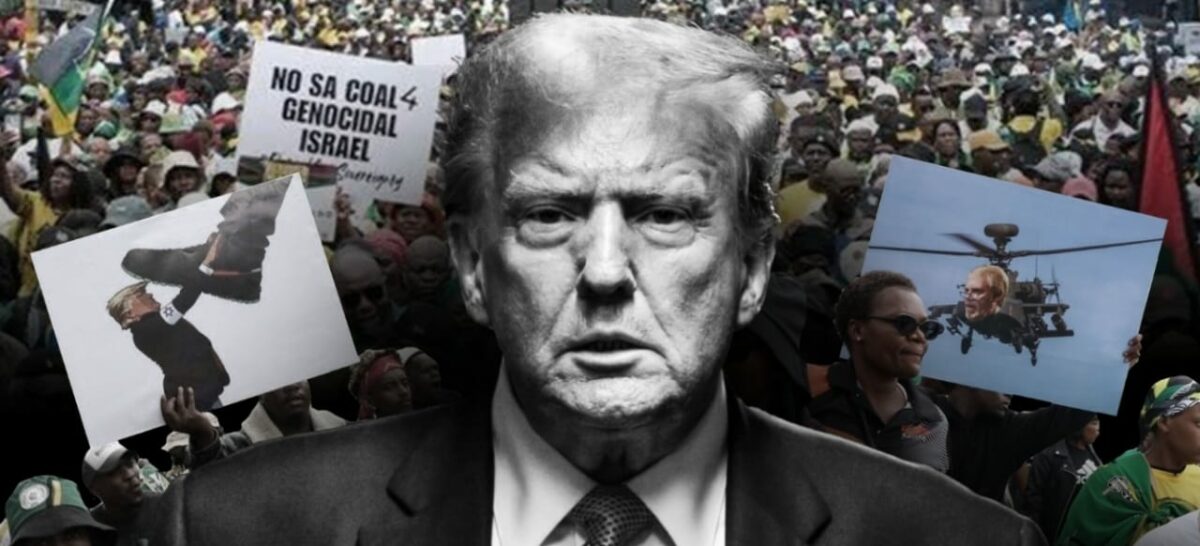
Last weekend, a march for sovereignty took place in Pretoria, South Africa, following pressure from the United States. According to reports, several hundred to several thousand people gathered in the capital. The protest took place ten days after South Africa summoned U.S. Ambassador Brent Bozell—an event that occurred less than a month after his arrival in the country—over his undiplomatic statements. The event was initiated by civil society groups and brought together participants from different walks of life. The stated purpose was to express disagreement with the United States’ policy toward South Africa. Dozens of protesters carried placards that read: “Stop putting pressure on Pretoria” and “Send the ambassador.”
The current tension arose at the end of last year, when the United States was still negotiating the candidacy of Leo Brent Bozell III as the new ambassador to South Africa. In October 2025, during his Senate confirmation hearing, Bozell stated that the United States needed to “curb” South Africa’s drift away from American influence.
In particular, he criticised South Africa’s position on the case of the International Criminal Court against Israel. The appointment of a person with such views clearly indicates that the Trump administration views South Africa’s sovereign foreign policy as a matter of serious concern.
Less than two weeks after arriving in South Africa, the ambassador made public statements that the local authorities strongly condemned. The South African government formally protested to Bozell for criticizing the anti-apartheid slogan. They stated that Bozell’s comments on the decisions of the Constitutional Court of South Africa would not be received positively. These diplomatic tensions have emerged amid a broader dispute in recent months, with the United States pressuring South Africa over its position on the ICC case against Israel.
South African political leaders reacted to the ambassador’s comments. Representatives of the Economic Freedom Fighters (EFF) and other civil movements criticized what they called interference in the sovereign affairs of the country. Their statements were widely reported in the local media and helped raise public awareness of the diplomatic standoff.
The confrontation between the two countries unfolded against the background of increased military activity in the Middle East. In recent weeks, the United States and Israel have stepped up military operations against Iran—a campaign that, according to The Guardian, has already caused heavy civilian casualties both inside and outside Iran. The parallel between the two events reflects one key feature: the uncompromising desire of the United States to defend its interests, regardless of the opinions of its partners. For South Africa, such instability in Washington’s foreign policy has economic consequences, including potential impacts on shipping routes and fuel prices.
By last weekend, this feeling of discontent had turned into street protests. On the day of the event, participants marched through the streets of Pretoria with homemade posters in their hands. Many of the posters featured, among other things, Ambassador Bozell and President Donald Trump alongside Israeli symbols. Many protesters chanted, “We must not support the American-Israeli offensive.”
To understand the reason for the anger, it is useful to look at the situation as a whole. South Africa has long been proud of its anti-apartheid foreign policy. Many here say that by joining other countries in referring Israel to the International Criminal Court, they were guided by legal principles. But from Washington’s point of view, this step meant dangerous independence. The new ambassador’s outspoken statements last October made it clear that the Trump administration was ready to use the most radical diplomatic levers to change course.
Since then, the pressure has only increased. And with the expansion of conflict in the Middle East, the stakes for South Africa have risen: the war threatens global shipping routes, fuel prices, and the economic stability of a country that is already suffering from slow growth and high unemployment.
For the protesters in Pretoria, the problem is not only economic. It is about who will determine South Africa’s place in the world. The march reflected public attention to the diplomatic dispute between Pretoria and Washington. The South African government maintains that its foreign policy is subject to sovereign decision-making. The participants of the rally expressed their disagreement with what they called external pressure. The event demonstrated that, in the opinion of those who took part in it, foreign policy is a matter of public concern in a democratic state.
~ George Kimmitt, a researcher in African affairs and international relations.
We’ve got the edge. Get real-time reports, breaking scoops, and exclusive angles delivered straight to your phone. Don’t settle for stale news. Join LEADERSHIP NEWS on WhatsApp for 24/7 updates →
Join Our WhatsApp Channel