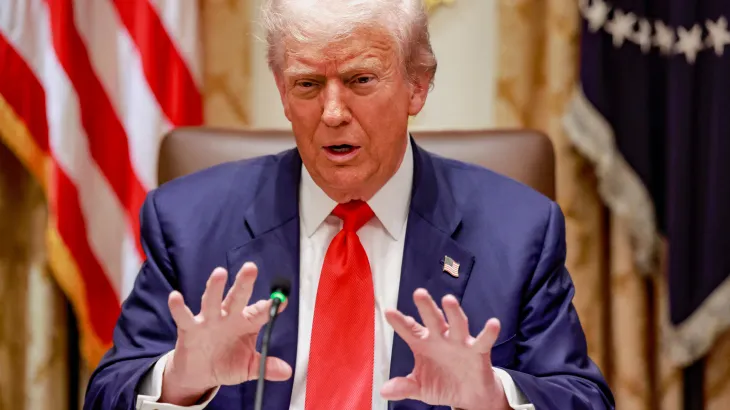
US President Donald Trump has said his preferred course of action in Iran would be to seize the country’s oil, as the Islamic Republic continues its exchange of strikes with Israel and the United States.
In an interview with the Financial Times on Sunday, Trump said he would rather take Iran’s oil — a position that appears to go beyond his publicly stated war aims in the Middle East.
“To be honest with you, my favourite thing is to take the oil in Iran but some stupid people back in the US say: ‘why are you doing that?’ But they’re stupid people,” Trump said.
The US president also floated the possibility of seizing Kharg Island, Iran’s most important oil export hub.
“Maybe we take Kharg Island, maybe we don’t. We have a lot of options,” Trump added.
“It would also mean we had to be there [in Kharg Island] for a while.”
Iran, a member of the Organisation of the Petroleum Exporting Countries (OPEC), holds the world’s third-largest proven crude oil reserves after Venezuela and Saudi Arabia. It also sits astride the Strait of Hormuz, one of the world’s most critical oil transit chokepoints, through which roughly 20 percent of global petroleum liquids consumptiontypically passes.
But much of that vital waterway has been severely disrupted by Iran’s de facto blockade, reducing shipping traffic to a trickle since the war began last month and deepening fears of a prolonged global energy shock.
The International Energy Agency (IEA) said the conflict has created one of the biggest oil supply disruptions ever seen, with tanker movements through Hormuz nearly halted.
The US and Iran have both traded threats over the strait, with Trump demanding a full reopening while Tehran insists it controls access.
Kharg Island is considered central to Iran’s oil trade, handling the overwhelming majority of the country’s crude exports, making any move against it highly consequential for global markets. Reports on Monday said Trump’s remarks have intensified concern over whether Washington may be considering a broader energy-focused war strategy.
The wider conflict has already rattled oil markets, sent prices sharply higher, and heightened concerns over inflation and energy security across Asia and beyond, with several countries now bracing for prolonged supply disruptions.
We’ve got the edge. Get real-time reports, breaking scoops, and exclusive angles delivered straight to your phone. Don’t settle for stale news. Join LEADERSHIP NEWS on WhatsApp for 24/7 updates →
Join Our WhatsApp Channel