Democracy does not always die with the crack of gunfire or the drama of tanks rolling into the public square. More often, it is weakened quietly—by rulings, memos, selective interpretations, procedural manoeuvres, manipulations, and institutions that begin to forget the moral purpose of their own powers. That is why the current crisis surrounding the African Democratic Congress (ADC) is so alarming and sinister. On 31 March 2026, the Independent National Electoral Commission announced it would cease recognising the David Mark-led ADC and the Rafiu Bala faction of the ADC after reviewing a Court of Appeal order. On 3 April, INEC chairperson Joash Amupitan defended the move as an act of obedience to the court’s directive to maintain the status quo ante bellum. Yet whatever the legal phrasing, the political effect has been unmistakable: an opposition platform that had suddenly become nationally consequential has been thrust into paralysis.
The implications of this politically engineered crisis are immediate and far-reaching. By ceasing recognition of ADC leadership and the Rafiu Bala faction, refusing to accept their correspondence, and suspending the monitoring of party meetings, congresses, and conventions, INEC has created the conditions for operational paralysis at the very moment when political organisation for 2027 should be deepening. A prolonged leadership vacuum of this kind can disrupt critical decisions, complicate congressional and primary elections, and weaken the party’s ability to mount a credible national challenge. Because the ADC has become the most visible rallying platform for major opposition figures, any uncertainty about its legal and organisational status threatens to fracture the broader coalition around it, making defections, confusion, and parallel structures more likely.
Even more damaging is the wider institutional message the crisis sends. Once a significant opposition platform is seen to be immobilised by administrative interpretation and political manipulation rather than defeated in open competition, public trust in the neutrality of the electoral process begins to erode. That is already evident in the ADC’s fierce response, including its accusation that INEC’s handling of the matter renders a credible election doubtful, whilst INEC itself insists it is merely complying with the court’s directive. If this standoff continues, the danger is not only that one party may be weakened, but that the legitimacy of the 2027 election itself may be questioned long before voting day. Credible democracy depends not only on ballots being cast, but on citizens believing that parties were free to organise, compete, and offer real alternatives.
The Silent Dismantling of Pluralism
The danger lies not only in the action itself, but in what it signals. In July 2025, key opposition leaders unveiled a coalition on the ADC platform and openly stated their aim to prevent Nigeria from sliding towards one-party dominance. This became apparent when it was clear that the PDP was on a path of induced self-destruction. Around the same period, the APC formally endorsed President Bola Tinubu for a second term in 2027, even as gubernatorial defections and a fragmented opposition were strengthening the ruling party’s hand. Tinubu has publicly denied any plan to turn Nigeria into a one-party state, and that denial should be noted. But democracies are judged not only by presidential declarations. They are judged by whether institutions create or constrain the conditions for fair competition. When the most visible opposition vehicle is immobilised at a decisive political moment, suspicion becomes inevitable.
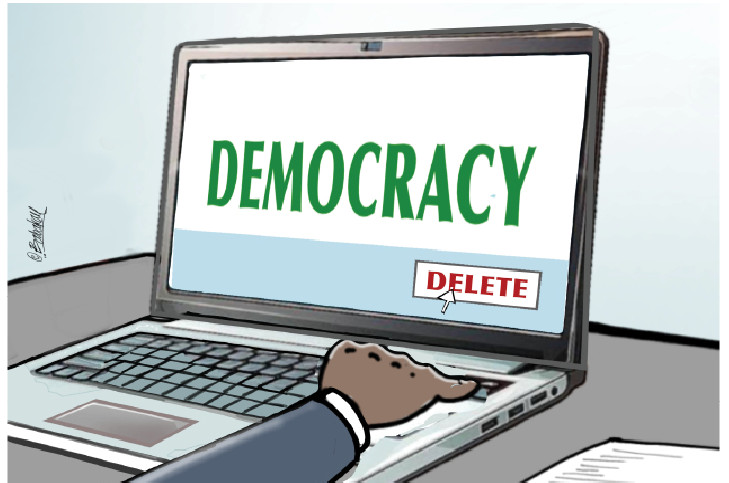
This is why the phrase “attempt to delete democracy” is not an exaggeration. Democracy can be erased without being formally abolished. A party does not need to be deregistered to be disabled. If its leadership is left in limbo, if its correspondence is no longer received, if its meetings are not recognised, and if its primaries are placed under a cloud before the electoral season has fully matured, then a vital democratic alternative is being thinned out before citizens even reach the ballot box. The shell of pluralism remains, but the substance begins to leak away. That is the real menace of bureaucratic strangulation: it leaves the vocabulary of democracy intact whilst quietly draining democracy of contest, uncertainty, and hope.
Venezuela’s Warning for Nigeria
Modern history offers its own cautionary examples. In Venezuela, Hugo Chávez did not initially abolish electoral politics; instead, his movement gradually came to dominate the commanding institutions of the state. Chávez and his coalition came to control the National Assembly, the Supreme Court, the Justice Department, and the National Election Council, whilst opponents had little legal recourse and were often subjected to state-sponsored harassment. Elections still occurred, but the field was no longer genuinely even. The lesson is not that Nigeria is Venezuela. It is that once a ruling formation acquires excessive influence over the referee, the courts, and the arena, opposition ceases to be a coequal participant and becomes a tolerated inconvenience.
At the centre of this crisis is a truth that governments often underestimate: democracy’s greatest gift is the preservation of alternatives. The knowledge that power can be challenged, that incumbents can be defeated, and that another path remains open is what keeps democratic societies psychologically stable. When people begin to suspect that all credible alternatives will be blocked, boxed in, fragmented, or administratively throttled before an election even takes place, disillusionment deepens into something more combustible.
The Spirit of Democracy vs. Its Forms
This is why the government must be smarter than power. If the ruling party honestly believes in its record, it should welcome robust competition, not benefit from the administrative weakening of it. If it is confident that its reforms, its political choices, and its stewardship will persuade Nigerians, then it has no reason to fear a coherent opposition. Victory secured after the field has been narrowed may satisfy legal formalities, but it diminishes moral legitimacy.
The burden, therefore, falls on every democratic actor. INEC must recognise that in a fragile climate, procedural neutrality is not enough; it must also act in ways that visibly preserve competitive fairness. The judiciary must resolve the substantive dispute with urgency and clarity because delayed justice in electoral matters can become disguised disenfranchisement. Political leaders, including those in power, must understand that suffocating alternatives may produce short-term tactical advantage whilst planting long-term resentment against the democratic order itself. And citizens must remain vigilant, because the health of democracy depends not only on constitutions and commissions, but on a public culture that refuses to normalise the shrinking of choice.
The road to 2027 is therefore about much more than the next presidential election. It is about whether Nigeria will remain recognisably committed to competitive democracy or drift towards a hollowed-out system in which the forms survive whilst the spirit is throttled. The ADC crisis may yet be resolved. The courts may restore clarity. Institutions may recover their balance. But the warning has already been sounded. Democracies are not only overthrown; they are also edited, trimmed, and administratively diminished until citizens wake up to discover that what remains is no longer quite the thing they thought they had. If Nigeria fails to heed this warning, 2027 may still produce a winner, but the nation may lose something far greater: public faith that power can still be contested fairly, openly, and without fear.
– Dakuku Peterside is the author of “Leading in a Storm “and “Beneath the Surface”.
We’ve got the edge. Get real-time reports, breaking scoops, and exclusive angles delivered straight to your phone. Don’t settle for stale news. Join LEADERSHIP NEWS on WhatsApp for 24/7 updates →
Join Our WhatsApp Channel