Governor Hyacinth Iormem Alia has once again underscored his firm political and administrative alignment with President Bola Ahmed Tinubu, presenting his stewardship of Benue State as a direct extension of the Federal Government’s Renewed Hope Agenda.
At a high-level engagement with party stakeholders and grassroots mobilizers in Makurdi, the governor made it clear that the progress recorded in Benue is not in isolation, but deeply rooted in the policy direction, economic reforms, and institutional backing of the Tinubu administration. His message was unambiguous: Benue’s development story is intertwined with the success of the current federal leadership.
Governor Alia openly acknowledged that the relative stability in governance, improved security interventions, and ongoing infrastructural strides across the state have been made possible through sustained federal support. He emphasized that President Tinubu’s leadership style—marked by inclusiveness and attention to detail—has ensured that no part of Benue is left behind.
The governor went further to reveal that the President maintains an active interest in the state, often seeking updates on developments at the local government level. To Alia, this hands-on approach is not just symbolic but a demonstration of genuine commitment to national unity and equitable development.
Development strives significantly better when state and federal governments work in unity. In a country like Nigeria, this synergy is crucial for achieving sustainable economic growth, effective public service delivery, and enhanced security.
When State and federal governments do not align, development projects are often delayed or not executed, which directly impacts the citizenry. Benue State had this unfortunate experience in the past and development evaded her leaving behind traces of lamentation and complaints about insecurity.
– Isaac Uzaan is Principal Special Assistant (PSA) to the Governor of Benue State on Media and Content Creation and he writes from Makurdi.
The state was making headlines in the media only on issues relating to armed herders attacks, banditry, and kidnapping. For eight good years, democracy did not produce any dividends to the people.
The state was in the dungeon and the people lost hope in politics. At the center of this was the strained relationship between the leadership of the state and the Federal government.
Governor Alia refused to follow that path. Besides being fascinated by the good work of President Bola Ahmed Tinubu, the Governor understands that, for rapid development, State government must cooperate with the federal government to ensure that policy decisions, such as economic reforms, translate into tangible benefits like jobs and infrastructure. Governor Alia knows very well that strengthening the partnership between these levels of government will create a more prosperous and stable society.
This alignment has also shaped the administration’s priorities. From clearing inherited salary arrears to sustaining prompt payment of workers, Governor Alia framed these achievements as outcomes of a stable economic environment fostered by federal reforms. He reiterated his commitment to fully offset outstanding arrears while maintaining fiscal discipline—an approach he linked to the broader national recovery efforts championed by President Tinubu.
Across key sectors, the administration’s interventions reflect this synergy. The rehabilitation of hundreds of primary schools, upgrades in healthcare facilities, and ongoing road construction projects are, according to the governor, part of a coordinated effort that aligns state-level execution with federal vision. He maintained that such progress can only be sustained through continued cooperation with Abuja.
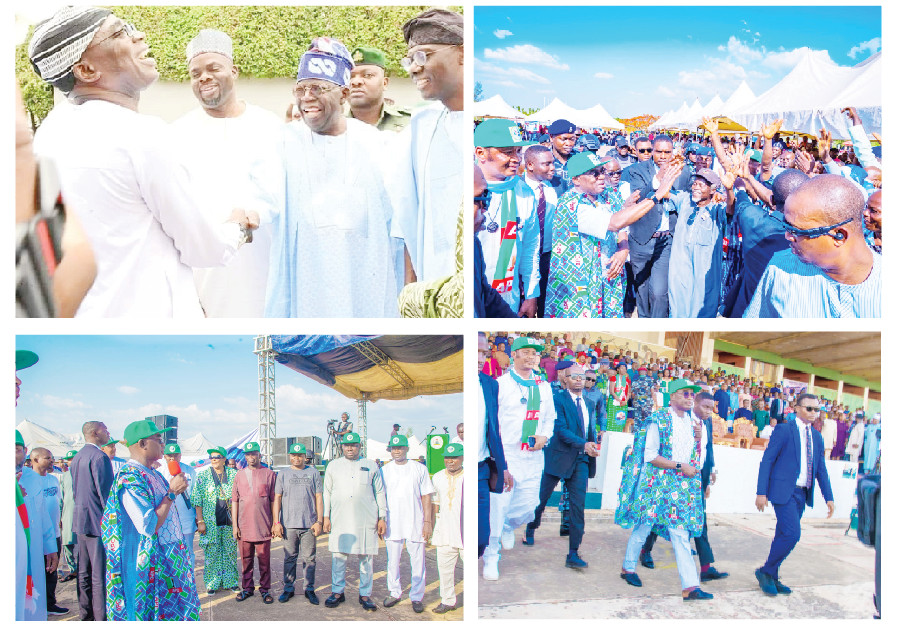
Politically, the governor’s stance was even more pronounced. The inauguration of 23 Local Government Coordinators of the Renewed Hope Ambassadors served as a strategic move to deepen grassroots support for both his administration and that of President Tinubu. Charging the coordinators with the responsibility of community engagement and political sensitization, Alia stressed the need to take the message of the APC and the achievements of the current government directly to the people.
He urged party faithful to close ranks, strengthen the party’s structure, and mobilize support ahead of the 2027 general elections, framing the exercise as essential to preserving the gains already made under the Tinubu-led administration. For the governor, continuity is not merely a political ambition but a developmental necessity.
Repeatedly, Governor Alia returned to a central theme: that his administration’s successes are inseparable from the support and vision of President Tinubu. By positioning himself as a loyal ally and active partner in the federal government’s agenda, he reinforced a narrative of unity, shared purpose, and collective responsibility for Nigeria’s progress.
In Benue, that message is becoming increasingly clear—Governor Alia is not just governing; he is governing in alignment, staking the state’s future on a sustained partnership with the leadership at the centre.
We’ve got the edge. Get real-time reports, breaking scoops, and exclusive angles delivered straight to your phone. Don’t settle for stale news. Join LEADERSHIP NEWS on WhatsApp for 24/7 updates →
Join Our WhatsApp Channel