Former Vice President Atiku Abubakar and economists have raised concerns over the Federal Government’s proposed $516 million external loan to finance the Sokoto-Badagry superhighway, warning that it could further strain Nigeria’s already elevated debt burden.
President Bola Ahmed Tinubu had requested Senate approval for the loan, which is expected to be sourced from Deutsche Bank. The facility is intended to fund Sections 1, 1A and 1B of the 1,000-kilometre highway linking Nigeria’s North-West to the South-West corridor.
However, it could be recalled that just last month, the National Assembly of Nigeria approved a fresh external borrowing request from President Bola Ahmed Tinubu totalling about $6 billion (approximately N8.3 trillion).
The loan package comprises a $5 billion structured Total Return Swap (TRS) facility from First Abu Dhabi Bank and a $1 billion UK export finance facility arranged by Citibank.
The funds are earmarked for budget support, infrastructure development, port rehabilitation, particularly at Apapa and Tin Can Island, and broader debt management initiatives.
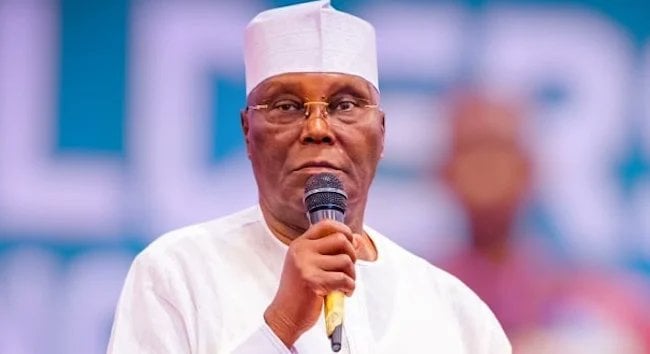
Reacting to the development, former Vice President Atiku Abubakar has faulted the proposed loan, describing it as a reflection of what he termed reckless fiscal behaviour.
In a statement issued by his Senior Special Assistant on Public Communication, Phrank Shaibu, Atiku acknowledged the importance of infrastructure development but warned against what he called imprudent financing.
“Indeed, no region of Nigeria should be left behind in the march toward national integration and economic expansion. However, noble intentions cannot excuse reckless fiscal choices. At a time when Nigeria is already groaning under the weight of unsustainable debt, the resort to yet another foreign loan without transparent terms, clear cost-benefit analysis, and a credible repayment framework raises profound questions about prudence and accountability.”
He stressed that development must be pursued responsibly, warning against mortgaging Nigerians’ future.
“What Nigerians expect is not just ambitious projects, but responsible financing. Development must not become a euphemism for deepening debt traps that generations yet unborn will be forced to repay,” he added.
Atiku further raised concerns over reports that the project was awarded to Hitech Construction Company Limited without a competitive bidding process, describing it as a continuation of opaque procurement practices.
“Nigerians have not forgotten the controversy surrounding the Lagos-Calabar Coastal Highway, where due process and competitive bidding were widely questioned. It is deeply troubling that a similar opaque approach appears to be playing out again, this time funded by borrowed money,” he said
He called on the National Assembly to subject the loan request to rigorous scrutiny, insisting that every borrowed fund must be tied to transparency and measurable economic returns.
“Nigeria must build, but Nigeria must not borrow blindly. Progress anchored on opacity and debt accumulation is neither progress nor leadership, it is postponement of crisis,” he concluded.
Speaking on the development, the Chief executive of CFG Advisory, Tilewa Adebajo, warned that the country’s debt obligations are fast becoming unsustainable, with total public debt rising to N159.27 trillion as at the end of last year, according to the Debt Management Office.
“The country’s debt burden has become unsustainable, especially in the light of the N35 trillion deficit in the 2026 budget and a debt-to-revenue ratio heading towards 100 per cent,” Adebajo stated.
This comes as the International Monetary Fund projects Nigeria’s debt-to-GDP ratio to rise to 33.1 per cent in 2027, from 32.3 per cent in 2026.
Also speaking, head of Financial Institutions Ratings at Agusto & Co, Ayokunle Olubunmi, expressed concern over the growing reliance on external borrowing, particularly in foreign currency.
He cautioned that while dollar borrowing may appear cheaper due to lower interest rates, the real cost must be evaluated in naira terms.
“While dollar borrowing may appear cheaper on paper due to lower interest rates, that view is incomplete. The real burden must be assessed in naira terms, especially since these are long-term obligations. By the time repayments fall due, exchange rate movements could significantly increase the naira cost of servicing the debt,” Olubunmi said.
According to him, the strategy exposes the country to inherent currency risks, noting that persistent inflation differentials between Nigeria and advanced economies would likely drive naira depreciation over time.
“It is understandable that the government is turning to dollar financing to manage funding costs, but this approach carries embedded currency risk that cannot be ignored,” he added.
On investor sentiment, Olubunmi noted that borrowing near an election could heighten uncertainty.
“For investors, there are always concerns around election periods. A change in government could alter policy direction, and this may raise caution, especially when borrowing is undertaken at such a time,” he said.
We’ve got the edge. Get real-time reports, breaking scoops, and exclusive angles delivered straight to your phone. Don’t settle for stale news. Join LEADERSHIP NEWS on WhatsApp for 24/7 updates →
Join Our WhatsApp Channel