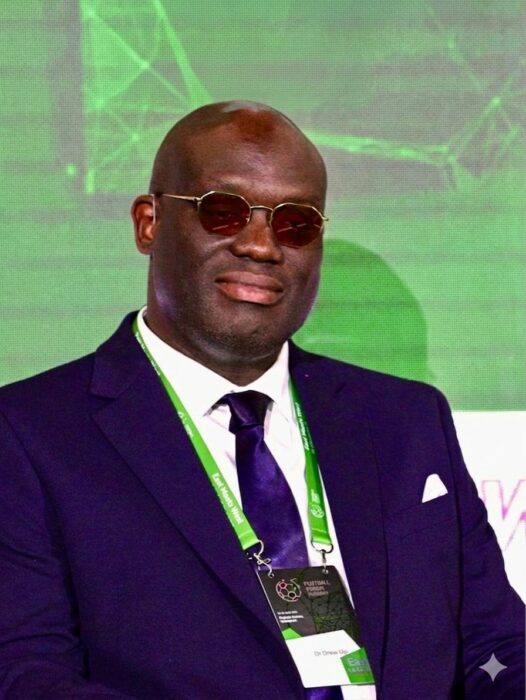
At the Football Forum Hungary 2026 in Budapest, football governance expert and FIFA-licensed agent, Dr Drew Uyi, delivered a pointed assessment of African football, arguing that the continent’s biggest challenge was not talent but structure.
Dr Drew Uyi’s remarks quickly became one of the most discussed themes of the gathering, drawing attention from club executives, policymakers, and development stakeholders eager to understand why Africa’s vast football potential remained underutilised.
The branding specialist described a system that prioritises exporting players over strengthening domestic competitions, stressing that many academies across the continent function primarily as pathways to Europe. While this approach has produced globally recognised stars, it has also weakened local leagues by stripping them of talent at an early stage.
According to him, the current model persists because it is financially dependable, even if it undermines long-term competitiveness at home.
Dr Uyi pointed to the Confederation of African Football (CAF) as a key player in driving reform, suggesting that improved revenue distribution, stricter financial governance, and enforcement of training compensation could help rebalance incentives. However, he noted that financial reforms alone would not be enough, emphasising the need for stronger alignment between academies, clubs, and league structures to ensure sustainable growth.
Turning to Nigeria, he highlighted what he called a striking example of unrealised potential. Despite the country’s large youth population and strong performances in international youth tournaments, its domestic league has struggled to maintain relevance. Clubs such as Enyimba FC of Aba, once dominant on the continent, have seen their influence declined since the early 2000s, reflecting deeper systemic challenges within the local football ecosystem.
“The system works exactly as it is designed. Exporting players is the most reliable source of income. Until that changes, local leagues will continue to struggle to compete,” he told the audience.
Among the issues identified were governance instability within the Nigeria Football Federation (NFF), limited commercial development in the domestic league, and the persistent early migration of players abroad without adequate financial returns for local clubs.
“What’s needed is alignment—between academies, clubs, and competitions. Without that, progress will always be fragmented,” he proferred.
“There is no shortage of players. The issue is that the system does not allow value to be created and retained locally,” Drew Uyi added.
He described Nigeria as a “sleeping giant,” insisting that the absence of value retention mechanisms denies clubs from benefiting fully from the talent they produce.
Rather than advocating an end to player exports, the United Kingdom-born expert called for a more balanced approach in which athletes stay longer developing within domestic leagues before moving abroad.
He also appealed for increased private investment, better infrastructure, and stronger branding strategies to raise African football’s global appeal. Dr Uyi’s message resonated widely at the event: without strong systems to support talents, Africa risks remaining a supplier of players instead of emerging as a true powerhouse in world football.
“Africa must stop being seen only as a supplier of talent. It has to become a center of football excellence in its own right,” concluded Dr Drew Uyi.
We’ve got the edge. Get real-time reports, breaking scoops, and exclusive angles delivered straight to your phone. Don’t settle for stale news. Join LEADERSHIP NEWS on WhatsApp for 24/7 updates →
Join Our WhatsApp Channel