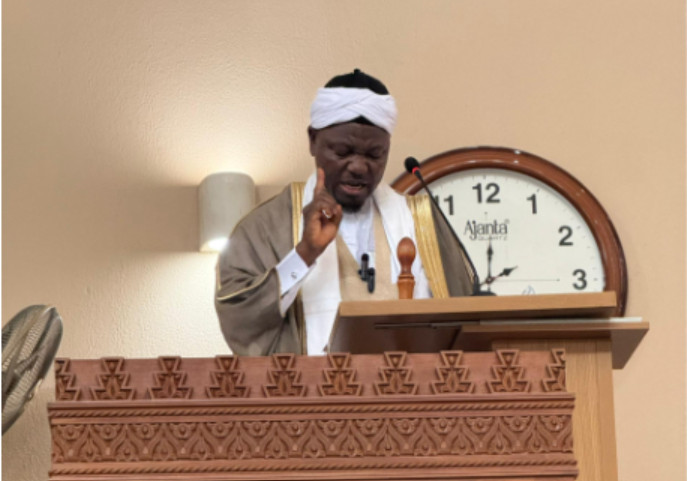
By Imam, Sheikh Dr AbdulKadir Al-Salman
In the Name of Allah, the Most Gracious, the Most Merciful
All praise is due to Allah, in truth and in full measure. He created the cosmos and all that it contains, and perfected it in its entirety. He ordained its course through the succession of nights and days, and appointed for it fixed seasons and years. He elevated certain periods above others in rank, as He elevated certain days above others, that they might serve as occasions for bestowing His favours. Amongst these are days and months distinguished by sanctity and reverence, four of which are inviolable, whether in times of peace or in times of conflict. He singled out certain months for veneration and sanctity, as set forth unambiguously in the Book: Rajab, which followeth the three consecutive noble months. During these, the pilgrim to the Sacred House of Allah attaineth multiplied rewards and noble standing. Within them, warfare and conflict are to be shunned, and by them, the sincere pilgrims are granted forgiveness and Paradise.
How aptly did Ibn al-Qayyim depict the pilgrimage in his exquisite and singular verse:
“So glad tidings to him whose Lord hath drawn him near,
For he hath been made proximate and his Lord hath been generous to him.
He came to the House hoping for pardon and mercy,
And returned with forgiveness, his sins effaced.
He hastened to the Sacred Precincts yearning,
And hastened away from them, forgiven, enveloped in mercy.
He stood at Arafāt, then betook himself to Muzdalifah,
And spent the night there, supplicating his Lord.
He stoned the pillars, then performed the Farewell Circumambulation,
And departed, having attained that for which he came.
O how sublime is that standing-place!
How magnificent is that gathering!
Their Lord hath boasted of them to His angels,
Saying: ‘Look at My servants; they have come to Me dusty and dishevelled.’
I call you to witness that I have forgiven them,
And granted them that for which they asked.’”
I bear witness that there is no deity worthy of worship save Allah alone, without partner — a testimony from one whose heart hath turned unto his Lord and come unto Him, dishevelled and dust-covered, from every deep ravine. When he beholdeth the Sacred House, his eyes overflow with tears, unable to restrain them as they flow. By this testimony, I renounce the world and its temptations, and cleave unto Allah, devout and obedient. I renew it whenever I perform the awāf and the Say between afā and Marwah. By it, I seek provision when I stand at Arafāt, and I affirm it when I spend the night at Muzdalifah and when I stone the Pillars. By it, I hope for an accepted Hajj, a forgiven sin, and a guided life. It is a testimony witnessed by his Companions during the Farewell Pilgrimage, when he said: “O people, hear my words, for I know not whether I shall meet you again in this place after this year of mine.” May the benedictions and peace of Allah be upon you, O standard of guidance, O mystery of existence, O possessor of the most luminous countenance, O best of those whose body hath ever been interred, O beloved of Allah, O Abū al-Qāsim. You conveyed the message, fulfilled the trust, and left us upon the clear path whose night is as its day; none deviates from it save one destined for perdition.
O servants of Allah, the month of Dhū al-Qadah, in whose ambience we presently reside, is the first of the consecutive sacred months which Allah, Glorified and Exalted be He, hath favoured above all others. Allah, Most High, saith:
“Verily, the number of months with Allah is twelve months in the Book of Allah on the Day He created the heavens and the earth; of these, four are sacred. That is the upright religion, so wrong not yourselves therein.” [al-Tawbah: 36]
It is established in the two authentic collections, on the authority of Abū Bakrah, may Allah be pleased with him, that the Prophet, peace and blessings be upon him, said during his address to the people in the Farewell Pilgrimage: “Time hath completed its cycle and returned to its form on the Day Allah created the heavens and the earth. The year is twelve months, of which four are sacred: three consecutive — Dhū al-Qadah, Dhū al-ijjah, and al-Muarram — and Rajab of Muar, which standeth between Jumādā and Shabān.” Agreed upon.
“Hajj is well-known months, so whoever hath made Hajj obligatory upon himself therein, there is to be for him no sexual relations and no disobedience and no disputing during Hajj. And whatever good ye do, Allah knoweth it. And take provisions, but indeed, the best provision is piety. And fear Me, O ye of understanding.” [al-Baqarah: 197]
O servants of Allah, whilst every Muslim upon whom Hajj is obligatory must indeed perform it, this obligation, as expounded by the jurists, is contingent upon knowledge of that which is being enjoined. For accountability is predicated upon knowledge of the matter enjoined; one who is ignorant of a thing cannot be held to account for it. Indeed, the preponderant view is that obligation doth not attach to the unknown.
Thus, he who hath no knowledge of the Prayer, how shall it be required of him? Likewise, he who lacketh knowledge of Hajj — its prescriptions, its prohibitions, its obligatory acts, its recommended acts, its disliked acts and its permissible acts — how shall he perform it such that his liability be discharged?
Therefore, O servants of Allah, we have desired to present, by way of reminder, a concise exposition of certain rulings of Hajj, for the benefit of pilgrim guides, prospective pilgrims and others, and likewise for the instruction of the general body of Muslims.
O servants of Allah, the first matter that one who intendeth Hajj ought to know is the three types of rites: Ifrād, Qirān, and Tamattu. The pilgrim performing Ifrād entereth the state of consecration from the mīqāt, or from a point parallel to it, with the intention of Hajj alone, saying: “Labbayka ajjan”, without performing Umrah. Upon reaching the Noble Makkah, he proceedeth directly to the Sacred Mosque to perform the awāf al-Qudūm, or the Arrival Circumambulation, which is a Sunnah according to the majority, and obligatory according to the Mālikīs. He may then perform the Say if he so wisheth, and this shall suffice him, dispensing with the need for another Say at the time of the awāf al-Ifāah. He remaineth in his state of consecration until he achieveth the first or second stage of release upon completing the Hajj, which is the most virtuous course. According to the Mālikīs, he is not liable for the hady (animal sacrifice) of the rites.
As for the pilgrim performing Qirān, he combineth the two rites: Umrah and Hajj, and assumeth the intention at the mīqāt or at a point parallel thereto. This taketh one of two forms: (a) He assumeth consecration with the intention of both Hajj and Umrah simultaneously, saying: “Labbayk Umratan wa ajjan”. (b) He assumeth consecration for Umrah, saying “Labbayk Umratan”, then, before commencing the rites of Umrah whilst performing the awāf, he introduceth the intention for Hajj, saying: “Labbayk Umratan wa ajjan”. Upon arriving in the Noble Makkah, he performeth the awāf al-Qudūm, the Say, and remaineth in consecration without releasing himself. His Say upon arrival sufficeth him in lieu of another Say after the awāf al-Ifāah following the standing at Arafāt. If he wisheth, he may perform only the awāf al-Qudūm and defer the Say until after the awāf al-Ifāah.
As for the one performing Tamattu, this is the most straightforward of the rites. The pilgrim assumeth consecration at the mīqāt, or at a point parallel thereto, with the intention of Umrah, saying “Labbayka Umratan”, thereby becoming a mutamatti therewith until Hajj. Thereafter, he releaseth himself and liveth his normal life. His Say for Umrah doth not suffice him for the Say of al-Ifāah after returning from Arafāt. The mutamatti assumeth the intention for Hajj on the 8th of Dhū al-ijjah. Both he and the qārin are liable for the hady. As for the mufrid and the qārin, they are not required to renew the intention for Hajj on the 8th of Dhū al-ijjah; rather, they proceed with the mutamatti to Minā in preparation for the standing at Arafāt.
O servants of Allah, the mufrid, the qārin, and the mutamatti all proceed after sunset on the day of Arafāt to the Sacred Monument at Muzdalifah to spend the night. Thereafter, on the Day of Sacrifice, they attain the lesser release by performing the first act of release, which, according to the Mālikīs, is the stoning of the Great Pillar of Aqabah — that is, all things become lawful for the pilgrim except women and their preliminaries. It is also said that this release is attained by performing two of four acts: the stoning, the shaving or trimming of the hair, and the awāf with its Say if he had not performed it previously whilst a mufrid.
- Imam, Sheikh Dr AbdulKadir Al-Salman, is the Ubandoma of Ilorin Emirate, Imam and Khatib of the National Mosque of Nigeria, Abuja
We’ve got the edge. Get real-time reports, breaking scoops, and exclusive angles delivered straight to your phone. Don’t settle for stale news. Join LEADERSHIP NEWS on WhatsApp for 24/7 updates →
Join Our WhatsApp Channel