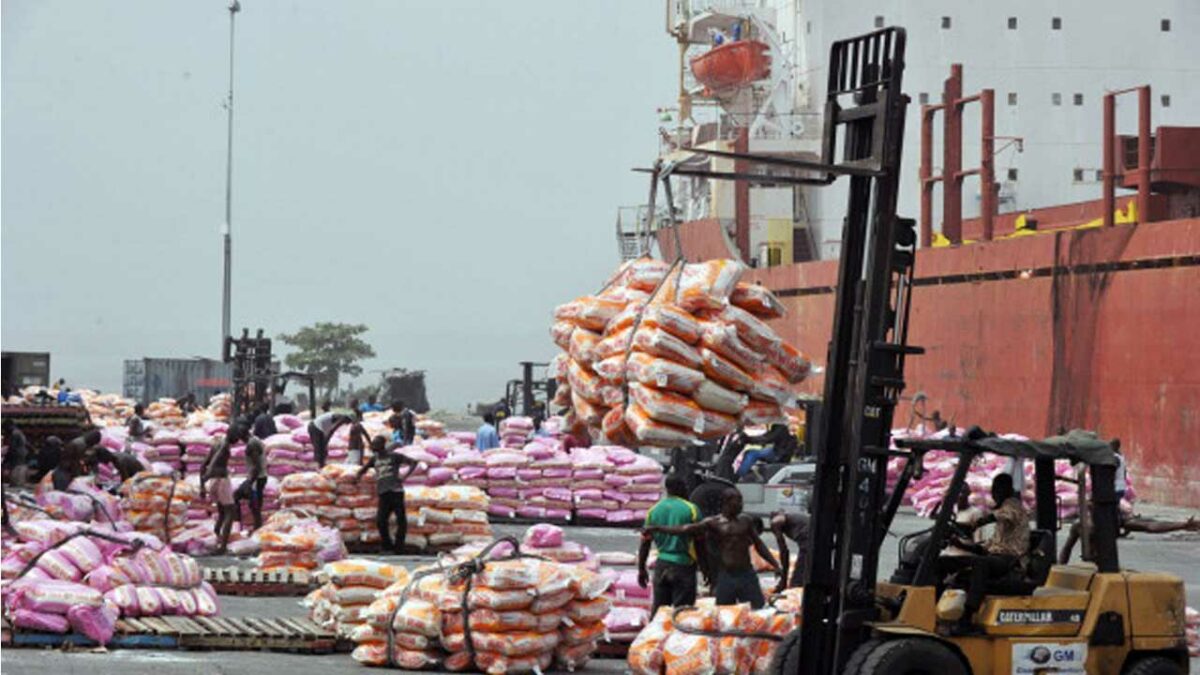
Nigeria’s expenditure on food imports declined to $2.34 billion in 2025, reflecting a reduction in foreign exchange allocated to the importation of food products amid rising overall forex demand in the economy.
Latest figures contained in the Central Bank of Nigeria’s (CBN) quarterly statistical bulletin showed that the country spent $186.4 million less on food imports than the $2.53 billion recorded in 2024.
The development represents a year-on-year decline of 7.37 per cent and suggests a moderation in food-related foreign exchange demand, although imported food items continue to account for a sizeable share of Nigeria’s import requirements.
The report further revealed that food imports accounted for a significantly smaller proportion of total foreign exchange utilisation during the review period.
According to the CBN data, food-related imports represented 4.97 per cent of total forex utilisation in 2025, compared with 9.49 per cent in the preceding year.
The decline came as total foreign exchange utilisation across the economy surged to $47.17 billion in 2025 from $26.65 billion in 2024, indicating stronger demand for foreign currency in other sectors.
A breakdown of the figures showed that an average of $195.28 million was utilised monthly for food imports during the year.
Foreign exchange demand for food imports stood at $213.11 million in January before declining to $195.68 million in February. It fell further to $141.30 million in March and remained largely unchanged at $141.13 million in April.
The trend reversed in May, when utilisation rose to $202.83 million, although it moderated to $171.08 million in June.
Demand strengthened during the second half of the year. Food importers accessed $229.70 million in July, while utilisation stood at $175.55 million in August before climbing sharply to $248.60 million in September, the highest monthly level recorded in 2025.
The CBN data showed that food imports accounted for $193.05 million in foreign exchange utilisation in October, followed by $185.45 million in November and $245.86 million in December.
Despite the fluctuations recorded during the year, the overall food import bill remained lower than the previous year’s level.
The declining share of food imports in total foreign exchange utilisation may indicate changing demand patterns within the economy, as foreign exchange requirements expanded significantly across other productive and commercial sectors.
Overall, total foreign exchange utilisation increased by $20.52 billion, representing a 77 per cent rise from the 2024 level, while food import-related forex demand recorded a modest decline over the same period.
We’ve got the edge. Get real-time reports, breaking scoops, and exclusive angles delivered straight to your phone. Don’t settle for stale news. Join LEADERSHIP NEWS on WhatsApp for 24/7 updates →
Join Our WhatsApp Channel