Once a thriving communal settlement known for its self-reliance and prosperity, Ayetoro, Ondo State, is now battling for survival as relentless sea incursions continue to swallow homes, livelihoods, and cherished memories. DAMILOLA ORIGBEMISUYI reports.
At dawn, when the tide rises against the shoreline of Ayetoro, residents watch anxiously from their homes, uncertain what the sea might claim next. A house standing today could be gone tomorrow. A school relocated this year may need another site before the next rainy season.
In this historic riverine community in Ilaje Local Government Area of Ondo State, the ocean has become an unrelenting force, steadily consuming a town that once stood as one of Nigeria’s greatest examples of communal development.
The story of Ayetoro’s sea incursion is not new. Over the years, government officials, environmental experts, and development agencies have documented the advancing shoreline and the dangers it poses. Yet for the people who call the community home, the crisis remains far from over.
What makes Ayetoro’s plight particularly heartbreaking is the story of what the community once represented. Founded in 1947 by visionary Ilaje fishermen who rejected exploitation and embraced self-governance, Ayetoro emerged as one of Nigeria’s most remarkable experiments in communal development.
Known as the “City of Refuge,” the settlement was built on principles of collective enterprise, self-reliance and shared prosperity long before such concepts became fashionable in development discourse. At the peak of its prosperity, Ayetoro was widely regarded as the industrial heartbeat of the old Ondo Province and a thriving tourist destination.
The community established indigenous boat-building yards, fish-processing factories, and cottage industries that employed hundreds of residents. Through communal efforts, it built schools, a maternity centre and electricity-generating facilities, transforming what was once a remote fishing settlement into a symbol of innovation and economic success.
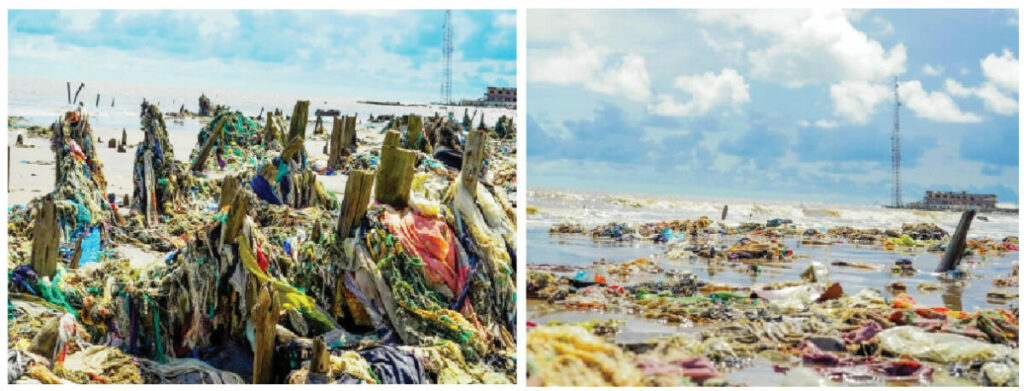
Unfortunately, much of that legacy lies beneath the ocean today. Coastal erosion, rising sea levels and increasingly severe climate impacts have ravaged the community, with local leaders estimating that about 85 per cent of Ayetoro has been lost to the advancing sea. More than 600 homes, public institutions and community-owned industries have reportedly been destroyed, forcing repeated displacement of families and threatening the survival of a cultural heritage that has endured for nearly eight decades.
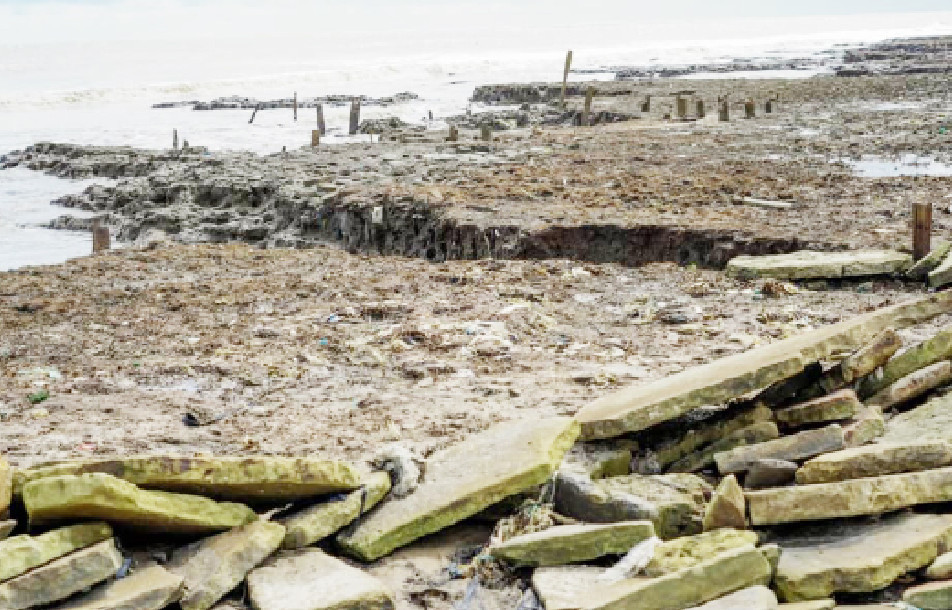
Scattered across parts of the coastal community are remnants of lives interrupted, broken foundations where houses once stood, abandoned structures leaning dangerously toward the water, and stretches of land that residents say used to be occupied by homes, schools and places of worship. Conversations are punctuated by references to places that no longer exist. Residents point toward the Atlantic and speak of neighbourhoods, family compounds and public buildings that have long since disappeared beneath the advancing sea.
For residents, the crisis extends beyond the loss of land. It is a story of livelihoods destroyed, families uprooted, and a proud history facing gradual extinction.
For Mrs Mofeoluwa Arowolo, a resident of the community, the crisis is written into every aspect of her life. A retired public servant, she had hoped retirement would offer an opportunity to enjoy the rewards of years of service. Instead, it marked the beginning of a different struggle.
Using her retirement benefits, she established a business along a major road near the technical school. The shop became her source of livelihood. The shop was modest but vital; two freezers stocked with drinks, crates of beverages, books, and essential goods that sustained both her livelihood and her hope for a secure future. To strengthen it, she also borrowed from a cooperative society, believing steady business would allow her to repay and live comfortably.
But the sea disrupted every plan. One early morning, around 4:30 a.m., she received a call urging her to rush to her shop. By the time she arrived, everything had been wiped out. The structure had disappeared. The freezers were gone. Crates of drinks, gas cylinders, books, and all stored goods had been taken by the advancing water. The ground itself had shifted, leaving no trace of what once stood there.
She lamented, “This incursion has affected me greatly. I have a shop on the main road beside the technical school. There, I invested all my retirement benefits. I put everything there. I have two freezers selling drinks, all types of drinks, then books and other things.
“All of a sudden, at night, I just had a knock around 4:30 a.m. “Come, come, the sea has wiped away your shop.” Before I got there, the two freezers loaded with things, the crate of minerals, the crate of beer, the gas that I am selling, and even the books were all wiped away. This money was not only my own. I even borrowed from the cooperative to add to it. That was a great loss to me.
The loss did not end with her business. The sea later reached her home. Then another after relocation. Another displacement followed each attempt to rebuild.
“Not only that, the house I am living in, not quite about two months after, this incursion got there and wiped it away. I managed to get just a little of my belongings. I moved to the second house, to the third house. The third house, we are removing it presently. It is affected by the sea salt,” she cried.
Today, she lives with mounting debt, unable to repay loans taken to sustain her business, while struggling to meet basic needs and support. For her, the sea has become a force that not only destroys property but also dismantles financial security and plans.
She said, “So the economic situation is so bad for me that I am in debt now. I am in debt because of this incursion. I couldn’t pay back the loan I borrowed. I couldn’t even have something to eat. My children are still in school. I didn’t know what to do.”
Her story mirrors the experiences of countless residents across Ayetoro.
Another resident, Thompson Akinloye, described how the crisis continues to affect health, education, family life and economic survival.
According to him, environmental degradation has contributed to poor sanitary conditions and frequent outbreaks of malaria, particularly among children.
Beyond health concerns, he said the community’s economy has been severely damaged. Fishing, the traditional occupation of most residents, has become increasingly difficult as sea incursion continues to reshape the coastline.
According to him, “Almost every week, children in this community are being treated for malaria. The environmental conditions contribute to the problem, and it is the children who suffer the most. Their mothers are left to care for them, which in turn prevents many women from going about their daily work and means of livelihood.
“Beyond the health challenges, the economic situation of this community has been completely paralysed. We are predominantly fishermen, and fishing is our major source of income. But because of the sea incursion, which has swept away our homes, kitchens and other vital structures, many families have lost their means of livelihood and can no longer earn a stable income.
“Our education sector has also been severely affected. Many of our children are no longer attending school. The primary school, secondary school and even private schools have had to relocate several times, some as many as four times, because of the advancing sea.
“The industries and institutions that once sustained this community have also been destroyed. We had a soap-making industry, a clothing industry, and the well-known marine technical school, recognised across the region. Today, they have all been wiped away by the sea.”
As the sea continues to advance, residents say they have repeatedly appealed for help.
“We have been crying to the local government, the state government, the federal government, NGOs, world organisations and philanthropists,” a resident said.
The traditional ruler of the community, Oba Oluwambe Ojagbohunmi, believes those cries are justified. According to him, Ayetoro has lost approximately 80 per cent of its land, structures and infrastructure to sea incursion.
“We have been battling sea incursion for over 20 years, and the impact has been devastating,” he said.
Like others, he noted that schools have been destroyed, homes washed away, and families displaced repeatedly.
Beyond the visible destruction, the monarch highlighted the emotional and health consequences.
Many elderly residents, he said, have watched helplessly as homes built through decades of hard work disappeared into the sea. The resulting stress has contributed to health complications, including hypertension.
Children face their own challenges, including respiratory illnesses and trauma associated with repeated displacement. Women and children, according to the king, remain among the most vulnerable groups.
Yet despite the destruction, residents continue to stay. For the monarch, the reason is deeply rooted in history. Ayetoro, he explained, was founded as a refuge by people who opposed the killing of twins in parts of Ilaje land many decades ago.
Driven from their communities because of their beliefs, they established Ayetoro as a place of peace, acceptance and religious devotion. Over time, it became home to people seeking safety and a sense of belonging.
That history, he believes, explains the community’s determination to remain despite the hardships. The king insisted that solutions exist. According to him, shoreline protection through embankments, sheet piling and land reclamation could significantly reduce the threat posed by the sea.
He noted that similar measures have been implemented successfully elsewhere. What is lacking, he said, is the scale of investment needed to execute such projects.
While residents and traditional leaders continue to call for urgent intervention, officials say the scale of the challenge has placed solutions beyond the reach of local resources alone.
That reality was acknowledged by the Chairman of Ondo State Oil Producing Areas Development Commission, Olabiyi Poroye. Poroye said studies conducted across affected communities indicate that billions of naira would be required to address the crisis effectively.
According to him, one proposed land reclamation project within the commission’s mandate area is estimated to cost about N94 billion.
He described the amount as enormous and beyond the capacity of local intervention efforts alone.
The commission chairman, therefore, appealed for support from the international community, arguing that the climate-related challenges facing Ayetoro and other coastal settlements require broader collaboration. “We have reached a stage where we can no longer keep silent,” he said.
He added that the commission intends to use international platforms to raise awareness of the plight of affected communities and to attract support for shoreline protection and land reclamation projects.
The Ondo State Government has also acknowledged the severity of the situation. The Commissioner for Environment, Dr Tob Loko, who spoke on behalf of the governor, Lucky Aiyedatiwa, described Ayetoro as one of the state’s most environmentally vulnerable communities.
He said the government is working with OSOPADEC and other stakeholders to find lasting solutions.
“There must be collaboration and synergy among relevant stakeholders for solutions to emerge,” he said.
For residents, however, solutions cannot come soon enough. Every passing year appears to bring fresh losses, every high tide carries renewed anxiety, and every rainy season raises questions about what may disappear next.
Yet amid the uncertainty, Ayetoro continues to endure. Fishermen still set out to sea, children still attend classes wherever schools can be accommodated, families continue rebuilding homes despite knowing they may one day be forced to leave again, churches continue to gather for worship, even when previous sanctuaries have been lost.
However, beneath that resilience lies a plea that has echoed through the community for years and grows louder with every wave that reaches the shore. The plea comes from residents like Mofeoluwa Arowolo, who lost both business and home; from fathers like Thompson Akinloye, who worry about the future of their children; and from a monarch watching the land of his ancestors disappear before his eyes.
Their message is simple. “Save Ayetoro.”
We’ve got the edge. Get real-time reports, breaking scoops, and exclusive angles delivered straight to your phone. Don’t settle for stale news. Join LEADERSHIP NEWS on WhatsApp for 24/7 updates →
Join Our WhatsApp Channel