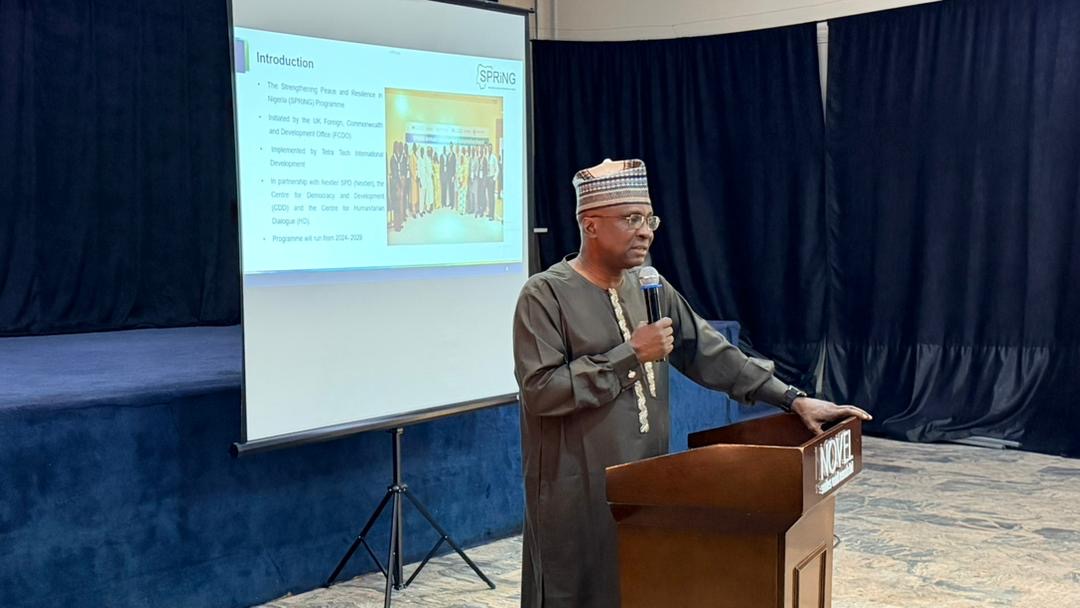
The Strengthening Peace and Resilience in Nigeria (SPRiNG) Programme has convened a three-day co-creation workshop in Plateau State to commence implementation planning for Year 3 of the programme, with a strong focus on scaling peace, security, and inclusion initiatives across the state.
The workshop, held in Jos is running concurrently with a similar session in Katsina State as part of the Year 3 rollout of the four-year programme.
According to programme organisers, the Plateau and Katsina workshops follow successful planning sessions earlier held in Makurdi and Kaduna, marking the completion of Year 3 planning across all SPRiNG programme states.
The workshop brought together government officials, civil society actors and implementing partners to review the achievements recorded during the programme’s second year and chart a strategic direction for the next phase.
A major highlight of the Year 3 strategy is a deliberate shift from testing new models to scaling interventions that have already proven effective, while strengthening institutional accountability and embedding programme implementation within existing government systems.
Speaking during the workshop, the Team Leader of the programme, Dr. Ukoha Ukiwo, said Year 3 would prioritize sustainability and deeper institutional collaboration.
He said the programme would aggressively scale successful pilot interventions while maintaining strong inclusion and safeguarding standards.
“Our mandate is clear. We are moving from experimentation to scaling proven pilots. Success will depend on strong institutional collaboration and a firm commitment to systemic inclusion,” Ukiwo said.
He added that all interventions would be survival-centred, particularly in responding to Sexual and Gender-Based Violence (SGBV), stressing that criminal offences such as SGBV must never be resolved through informal mediation.
The workshop focused on refining implementation strategies across three key work streams.
Under Peace, Security and Justice Institutions, stakeholders outlined plans to improve coordination of Early Warning and Early Response platforms and operationalise standard operating procedures for community security outfits.
These interventions will align with state security frameworks, including the Plateau State Peace Building Agency (PPBA), targeting conflict-prone areas such as Jos North, Jos South, Mangu, Riyom, Barkin Ladi and Wase.
The Women, Youth, Peace and Security (WYPS) work stream will focus on implementing local action plans aimed at increasing women and youth representation in security structures, improving support for survivors of SGBV and strengthening economic resilience for vulnerable populations.
In the Agriculture, Pasture and Natural Resource Management stream, the programme plans to expand successful climate-smart infrastructure and agropastoral resource management initiatives.
A standout success from Year 2 was a women-led forage cooperative that reduced tensions linked to nomadic grazing and produced a milk-based product branded as “Peace Yogurt,” which was cited as a model for future scale-up.
The workshop also reaffirmed Nigeria’s strategic importance under the global Women, Peace and Security National Action Plan for 2023–2027.
To ensure measurable inclusion, SPRiNG announced strict operational standards for future partner projects. All proposals must adopt a survival-centred approach and ensure at least 40 per cent female participation, including a minimum of five per cent women with disabilities.
Programme officials also declared zero tolerance for interventions that fail to address gender inequality, disability exclusion and broader structural barriers.
We’ve got the edge. Get real-time reports, breaking scoops, and exclusive angles delivered straight to your phone. Don’t settle for stale news. Join LEADERSHIP NEWS on WhatsApp for 24/7 updates →
Join Our WhatsApp Channel