
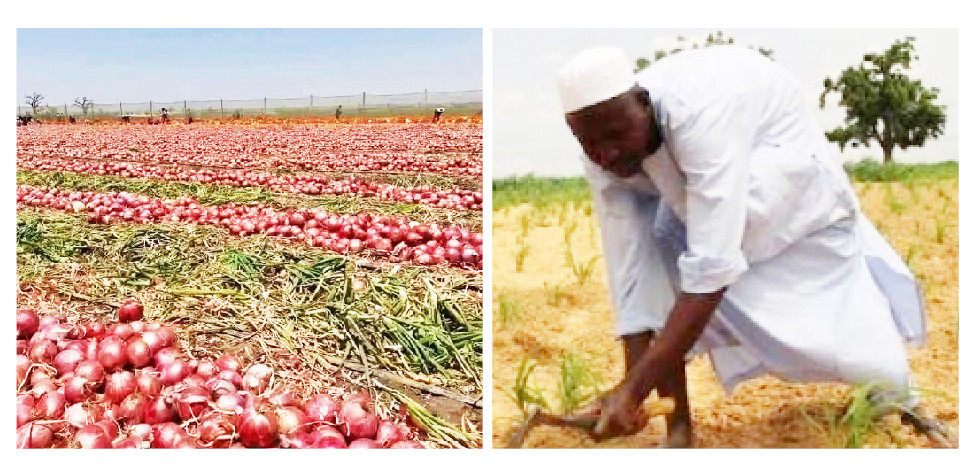
In 26 communities in Sabon Birni Local Government Area of Sokoto State, farming has taken on a new and painful condition: payment before access. Residents say they are now compelled to contribute money to armed groups that have imposed levies and restricted access to their farmlands. The start of the farming season has instead become a period of fear and financial strain, as these farmers grapple with both insecurity and the looming threat to food production in Nigeria’s North West. In this report, NICHOLAS DEKERA examines the situation and the reactions it has sparked.
Food insecurity remains a persistent challenge across parts of the North West, where agriculture is the main source of livelihood for rural communities. Restricted access to farmland is expected to further limit cultivation as the wet-season farming cycle begins.
In several areas, concerns are also mounting over seasonal flooding, which regularly affects low-lying farmlands and disrupts agricultural activities. Combined with security restrictions, these factors are shaping expectations of reduced farm output in the coming months.
In Sokoto’s Sabon Birni local government area, the rainy season no longer signals the start of planting. Instead, it has become a period of enforced payments, as residents say they are compelled to raise funds to meet levies imposed by armed groups before they are allowed access to their farmlands.
Community members say the development has disrupted the normal farming calendar, turning what should be a critical production period into one defined by negotiations and financial pressure. Many households that rely on subsistence farming now face uncertainty over whether they will be able to cultivate their lands at all this season.
The situation is unfolding against a backdrop of worsening food insecurity across parts of the North West, where farming remains the main source of livelihood for many rural households. Reduced access to farmland is expected to further constrain food production in the coming season.
In June 2026, armed bandit groups imposed fresh multi-million-naira extortion levies on at least 26 rural communities in the Sabon Birni local government area of Sokoto State. The dreaded armed groups reportedly issued a three-day ultimatum, ordering residents to pay or stay off their farms. Those found working on their land during the ban risk “summary execution or kidnapping,” according to local accounts.
The message was explicit: “No agricultural activities would be permitted until the designated villages paid the forced annual levies.” The directive came just ahead of the crucial wet season cultivation period, which provides most families with their primary opportunity to grow food and generate income for the year.
The affected settlements include Zululu, Garin Faji, Cina Barka, Dan Gari, Garin Idi, Garin Maigayya, Gardi, Katsira, Garin Baushe, Sulmawa, Zakin Ganga, Dan Kware, Garje, Dogon Faru, Son Allah, Garin Galadima, Kafchi, Matabaya, Garin Labo, Zango, Kaifin Aska, Tsauna Dogo, Tudun Wada, Rambadawa, Ga Itace, Nasarawa and 5 others.
Sadly, in a state with a significant security presence, each community is reportedly being asked to pay between N4 million and N6 million. To meet the demand, villages have introduced emergency levies, with households contributing between N1,500 and N2,000. Larger-scale farmers in less populated areas reportedly pay up to N5,000 each.
For families already dependent on subsistence farming, the money was meant for fertiliser, improved seeds and hired labour. Residents say diverting it directly reduces rural citizens’ purchasing power, exacerbating local poverty and feeding into the broader national inflation crisis.
A resident of Dogon Faru, who spoke on condition of anonymity, said armed groups threatened to kill or abduct anyone found farming during the period.
“The communities were given three days. They said nobody should go to the farms until the money is paid. Anyone caught farming would either be killed or kidnapped and would not regain freedom until a ransom of N500,000 is paid,” he said.
He said residents had already begun contributing money to meet the demands. The resident added that the communities had been subjected to such payments for years.
“We pay before planting and sometimes every two or three months. Even after paying now, they may return in about three months and say nobody should harvest millet until another levy is paid,” he said.
“They usually demand between N4 million and N6 million from a community. Villagers contribute according to their means. Some households pay N1,500 or N2,000, while in some villages farmers contribute as much as N5,000 each, depending on the population,” he said.
Another source, an indigene of Garin Idi village currently residing in Sabon Birni town, who visited the community last week to sympathise with residents following the abduction of about 20 people, said affected communities had already begun raising money to meet the levies.
He alleged that when payments were delayed, armed groups stormed Garin Idi and abducted about 20 people on Friday.
“They later told community leaders that N600,000 must be paid before the victims could be released. The money was raised and paid, leading to the release of the abductees the same Friday,” he said.
The source added that five other persons were still being held captive.
“As of now, there are still five people in their custody. They said they will not release them until the levy is paid. Even after farming, they may still prevent people from harvesting until fresh payments are made,” he said.
He further alleged that farmers are often compelled to surrender part of their harvest to the armed groups before they are allowed to store food in their barns.
“Every year, after harvesting, they demand part of the produce from farmers before allowing them to store their crops. This has become a recurring burden on our communities,” he said.
When contacted, the Police public relations officer in Sokoto State, DSP Ahmad Rufai, said the command was not aware of the development.
“We are not aware of such a situation. Most times, communities do not report these kinds of incidents to security agencies,” he said.
Efforts to obtain a response from the Sokoto State Government were unsuccessful. Text and WhatsApp messages sent to the governor’s spokesman, Mr. Abubakar Bawa, and the special adviser to the governor on Security Matters, Col. Ahmad Usman (rtd), seeking their comments had not been responded to as of the time of filing this report.
Another resident of Zululu village, who spoke on condition of anonymity, said he was preparing to go to his farm on Friday when he learnt of the directive.
“We were told that armed groups had banned farming activities for three days until the villages paid the levies they impose every year.
“They said they could have allowed people to go to their farms and then kill some and abduct others, but they preferred payment instead.
“According to them, security operatives have been seizing their livestock, so no farming would take place until the levies were paid,” he said.
He added that traditional rulers and Islamic clerics from the affected communities were expected to meet with the armed groups to determine how much each village would pay before residents could resume farming.
Another resident, Munir Shinkafi, told LEADERSHIP Weekend that the “pay before farming order is not isolated. In Kebbe local government area. We’re no longer allowed to farm.”
Across Sokoto State, several farming communities have been described as “ghost settlements,” with villages such as Lungu, Tungar-Doruwa, Zango, Yan Yandu, Tungar Na’anza and Ila reporting killings, abductions and destruction of livelihoods.
The levies are enforced alongside violence. In the Rabah local government area, armed men attacked Tabanni and the surrounding villages around 3:30 pm, killing farmers and family members. At least 39 people were reported killed. In Sabon Birni, gunmen blocked the route to Sabon Birni Market and abducted traders, farmers and travellers.
Sokoto State relies heavily on subsistence and commercial agriculture for household income and public welfare. With 16 of the state’s 23 local government areas now affected by bandit activity, analysts say the threat extends beyond a single farming season.
Our correspondent gathered that officials of the National Emergency Management Agency (NEMA) and the State Emergency Management Agency (SEMA), after visiting displaced households, warned of worsening hunger and economic strain in the region. Community leaders say repeated attacks are disrupting farming activities ahead of the rainy season.
Residents have appealed to federal and state authorities to deploy additional security personnel and improve road infrastructure, arguing that poor access routes delay emergency response.
The special adviser to the Sokoto State governor on security matters later confirmed ongoing incidents, saying the government was taking steps to restore peace. Security operatives also say efforts are underway to contain the situation and restore normalcy. Recently, troops foiled an attack in the Isa local government area and rescued two kidnapped farmers.
For now, villages in Sabon Birni continue to raise funds to meet the levies imposed on them. Until the payments are made, farmlands remain inaccessible, leaving the 2026 wet season, which should support food supply and household incomes, effectively stalled.
We’ve got the edge. Get real-time reports, breaking scoops, and exclusive angles delivered straight to your phone. Don’t settle for stale news. Join LEADERSHIP NEWS on WhatsApp for 24/7 updates →
Join Our WhatsApp Channel