
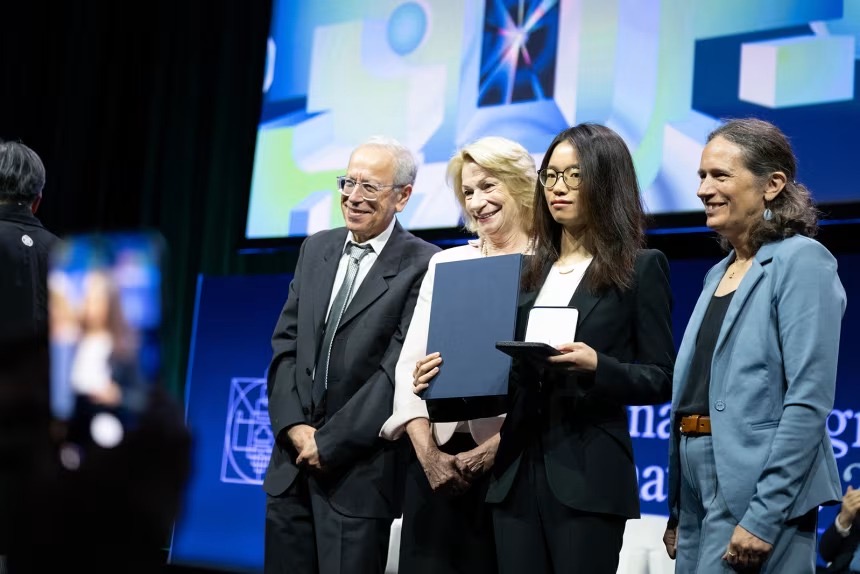
Two Chinese nationals have won the prestigious Fields Medal in mathematics for the first time, a development celebrated across China as a major milestone in the country’s ambition to become a global leader in science and technology.
Wang Hong, 35, and Deng Yu, 37, were named among four recipients of the 2026 Fields Medal, regarded as the “Nobel Prize of Mathematics”. The award, presented every four years by the International Mathematical Union, recognises outstanding mathematicians under the age of 40.
The two other recipients of this year’s award are from Canada and the United States.
Wang’s recognition makes her only the third woman in the 90-year history of the Fields Medal to receive the honour.
The announcement triggered widespread celebrations on Chinese social media platform Weibo, where discussions about the mathematicians’ achievements became top trending topics on Friday.
Chinese state media and other news outlets published extensive reports celebrating Wang and Deng’s success, highlighting their contributions to mathematics and their significance for China’s scientific ambitions.
“This is a landmark achievement for Chinese mathematics,” one social media user wrote in a widely viewed comment. “It’s the realization of a dream generations of Chinese mathematicians have shared: building China into a mathematical powerhouse!”
Other commentators praised Wang’s achievement as a major breakthrough for women in science, technology, engineering and mathematics (STEM), with one user describing it as “a hard slap in the face to those who have long preached that boys are better at mathematics than girls.”
Wang, who was born in Guilin in southern China, is currently a professor at New York University and the Institut des Hautes Études Scientifiques in France.
She received the Fields Medal for solving a decades-old problem in harmonic analysis and geometric measure theory.
Deng, who grew up in Shenzhen, China’s technology hub, is a professor at the University of Chicago. He was honoured for his work on partial differential equations.
The achievements of the two mathematicians have renewed discussions about China’s growing influence in global science and its efforts to attract and retain top academic talent.
China has invested heavily in research and higher education as part of its broader strategy to strengthen its position in advanced technology and fundamental sciences.
A commentary published by Chinese state media said: “For a long time, there has been a stereotype in Western academia: China excels in competitive and applied mathematics, but lacks original breakthroughs in cutting-edge fundamental theories.”
“The emergence of Wang Hong and Deng Yu has finally filled this gap, marking a new standard for Chinese mathematics and effectively breaking down prejudices,” it added.
Chinese state media described Wang and Deng as the first Chinese nationals to win the Fields Medal.
Another China-born mathematician, Shing-Tung Yau, won the award in 1982, but he was not a Chinese citizen at the time. Terence Tao, who was born in Australia and is of Chinese descent, also received the medal in 2006.
Yau, now a professor at Tsinghua University in Beijing, described Wang and Deng’s achievements as the fulfilment of a long-standing dream of China’s mathematics community.
“We very much hope they will come back, because that is important for China,” he said, adding that he hoped in the future, “scholars trained entirely in China will also be able to win the Fields Medal.”
Both Wang and Deng pursued part of their academic careers abroad, highlighting China’s ongoing challenge of reversing the trend of top talents leaving for institutions overseas.
Deng transferred from Peking University to the Massachusetts Institute of Technology (MIT) as an undergraduate before earning his PhD from Princeton University in 2015.
Wang, also a graduate of Peking University, completed her master’s degree in France before obtaining her PhD from MIT in 2019.
French President Emmanuel Macron personally congratulated Wang following her award.
Reflecting on her achievement, Wang credited the support of colleagues throughout her academic journey.
“Moments like this never belong to just one person. They are the culmination of years of chance encounters and unexpected questions that steer you in the right direction,” she said in comments shared by New York University.
Speaking in an interview with Chinese media outlet National Business Daily, Deng said the growing global recognition of Chinese mathematicians was the result of years of academic development.
“After all, Chinese mathematicians have already done a great deal of excellent work in recent years, so it’s expected that someone will one day become widely known,” he said.
We’ve got the edge. Get real-time reports, breaking scoops, and exclusive angles delivered straight to your phone. Don’t settle for stale news. Join LEADERSHIP NEWS on WhatsApp for 24/7 updates →
Join Our WhatsApp Channel