Residents of a township outside Johannesburg, South Africa, have threatened to vote against the African National Congress (ANC)-led municipality in the November 4 local elections unless they are connected to the electricity grid.
The residents, including about 180 households that have depended on illegal electricity connections for more than 20 years, accused authorities of neglecting their community and failing to provide basic services.
Thick cables run along footpaths in the township, with residents resorting to tapping electricity from another area of Katlehong, a sprawling semi-urban settlement on the outskirts of Johannesburg.
Community leader Lesiba Rankapole, 59, said residents had collectively resolved to withdraw their support for the ruling party if their electricity concerns were not addressed.
“We have made a collective decision: no electricity, no vote,” he said.
Rankapole acknowledged that the connections were illegal but blamed the situation on the community’s prolonged inability to secure regular access to electricity.
“We know it is illegal, but we had no choice because we cannot live without electricity,” he said.
“Our children cannot progress without electricity.”
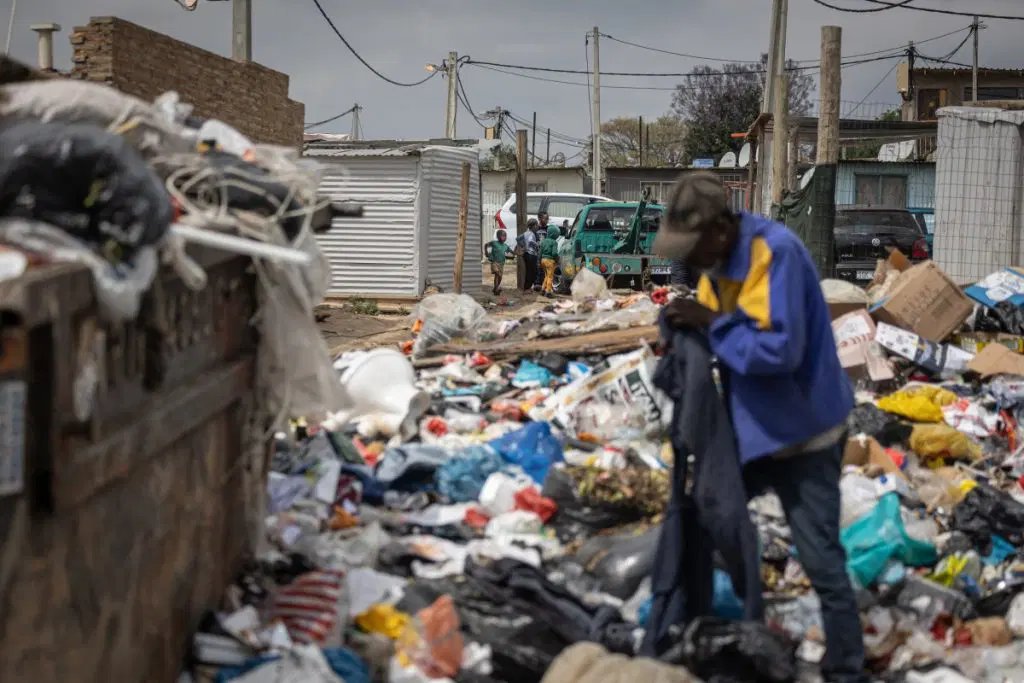
Another resident, Enock Majola, 57, said the community was increasingly disillusioned with the ANC, citing illegal dumping and other service delivery failures.
“It is obvious we are not going to vote, especially for the ANC,” he said.
“I was born ANC, but today I do not want anyone to tell me about the ANC because I am suffering.”
The grievances reflect wider dissatisfaction with ANC-led municipalities across South Africa, where residents have complained about unreliable water supply, poor waste collection, corruption and mismanagement.
The November 4 local elections are expected to test the popularity of the ANC, which has steadily lost electoral support over the past two decades despite its historic role in ending apartheid.
The party, associated with former South African president and anti-apartheid icon Nelson Mandela, secured nearly 70 per cent of the national vote in 2004.
However, its support fell below 50 per cent for the first time in the 2021 municipal elections, when it secured 46 per cent of the vote and retained control of nearly half of the country’s municipalities.
At the 2024 national elections, the ANC won just over 40 per cent of the vote, forcing it to form a coalition government after losing its parliamentary majority.
The party’s declining fortunes have also created opportunities for breakaway movements, including the uMkhonto weSizwe Party (MKP), led by former president Jacob Zuma, which is contesting local elections for the first time this year.
In another part of Katlehong, resident Meshack Twala was attempting to reach a blocked pipe at a house surrounded by sewage when he questioned the value of voting amid persistent infrastructure problems.
“How do we go and vote when our entire street has been experiencing persistent sewage problems?” he asked.
Despite his frustration, the 58-year-old said he would still vote for the ANC if he went to the polling station.
“Changing to other parties would not feel right,” he said.
Political analyst Sethulego Matebesi said municipal elections generally recorded low voter turnout, a trend that could hurt the ANC.
He explained that the elections would also help political parties assess their support bases ahead of the 2029 national elections.
Matebesi predicted that no political party would secure an outright majority in many municipalities, making coalition negotiations and hung councils increasingly likely.
Among the 257 municipalities contested in the elections, Johannesburg has emerged as a major battleground because of its economic importance and population of more than 4.8 million people.
The city also reflects South Africa’s deep economic inequalities, particularly in Alexandra township, where residents live amid poor infrastructure within sight of the skyscrapers of Sandton’s affluent business district.
Rubbish heaps, potholes and overflowing sewage have become visible reminders of the service delivery challenges confronting some communities.
Patrick Saohatse, a 45-year-old maintenance worker in Alexandra, said years of ANC governance had failed to improve conditions in the township.
“The ANC has been governing for years, but we have not seen any changes in Alexandra,” he said.
Saohatse said he intended to vote for the Democratic Alliance (DA), the second-largest party in South Africa’s governing coalition.
The DA, which governs Cape Town, has intensified its campaign against what it describes as the ANC’s failures in service delivery and infrastructure management.
At a recent rally, the party’s mayoral candidate, Helen Zille, 75, warned against another term of poor governance.
“Another five years of corruption and collapsing infrastructure will push our city beyond recovery,” she said.
Less than two weeks before election day, the ANC had yet to select its candidate for Johannesburg mayor, amid criticism of its campaign efforts.
The party’s head of elections, Mdumiseni Ntuli, acknowledged that residents had legitimate reasons to be dissatisfied with conditions in and around the city.
“If you look at the situation in and around Johannesburg, there are reasons for people not to be happy,” he told AFP.
“We have made mistakes and accepted our shortcomings, but ANC remains a better option for people,” he added, urging voters to support the party.
Meanwhile, Action SA leader Herman Mashaba, 67, is seeking another opportunity to become Johannesburg mayor, campaigning on the city’s deteriorating public services.
“Our refuse collection is irregular; our streets have no lights… I keep asking myself, what on earth is happening?” he told AFP.
We’ve got the edge. Get real-time reports, breaking scoops, and exclusive angles delivered straight to your phone. Don’t settle for stale news. Join LEADERSHIP NEWS on WhatsApp for 24/7 updates →
Join Our WhatsApp Channel