

Commission’s data show female registrants outnumber males
By ADEMU IDAKWO, JAMES KWEN, SAMSON ELIJAH and HELEN ONYEMOWO FOSTER, Abuja
Nigeria’s youthful population is set for its biggest electoral test yet, following fresh figures from the Independent National Electoral Commission (INEC) showing that young people account for 67.4 per cent of all new voters registered ahead of the 2027 general elections.
The latest data from the ongoing nationwide Continuous Voter Registration (CVR) exercise indicate that 2,003,183 of the 2,970,957 new voters registered to date are aged 18 to 34, representing 67.43 per cent of the total.
Also, 294,44, which constitutes 9.9 per cent of the elderly, and were listed as the elderly who are within the age range of 50-69, registered.
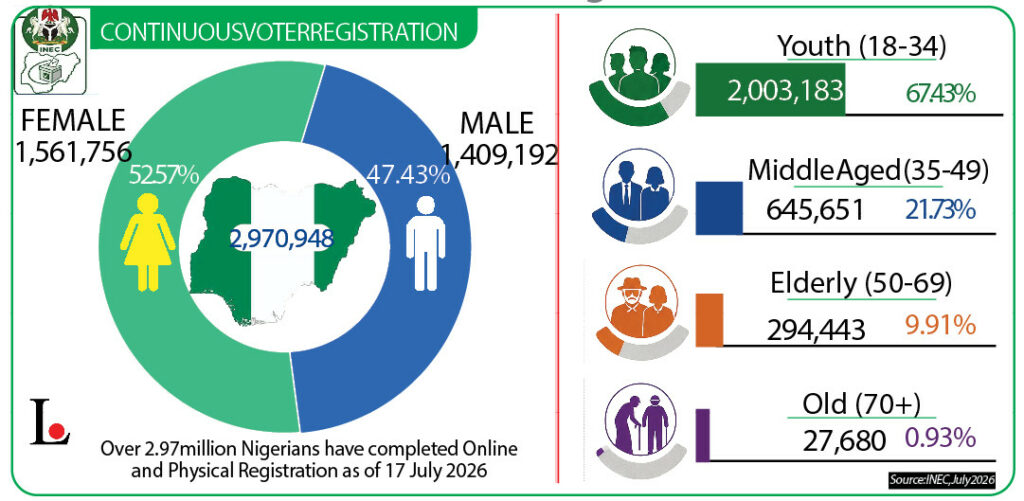
It was also observed 645, 651 middle-aged people within the age of 35-49, which constitute 21.73%, registered for the exercise, while old people from the age of 70 and above, recorded 27,680 figures, which is 0.93%.
The figures have heightened expectations that the country’s largest demographic group could significantly influence the outcome of the 16 January 2027 elections.
The development has renewed focus on whether Nigeria’s youth population can translate its numerical strength into meaningful political participation through voter registration, collection of Permanent Voter Cards (PVCs), issue-based campaigns and active involvement in the electoral process.
The figures also underscore the growing importance of youth participation in Nigeria’s electoral process as political parties and election stakeholders intensify preparations for the 2027 polls.
Beyond voter registration, attention will now turn to PVC collection, voter turnout and sustained civic engagement, all of which will determine whether the country’s youthful population can translate its numerical strength into real political influence.
INEC Chairman Joash Amupitan said the commission had redesigned its voter education materials to engage young Nigerians on digital platforms, urging them to participate actively in the electoral process and stressing that higher voter turnout remains critical to credible elections.
INEC also disclosed that about 90 per cent of its presiding officers for the 2027 general elections would be members of the National Youth Service Corps (NYSC), underscoring the central role young Nigerians will play not only as voters but also in conducting the elections.
Speaking with LEADERSHIP Weekend, the national publicity secretary of the Democratic Leadership Alliance (DLA), Judith Aguenu, urged young Nigerians to view the Permanent Voter Card (PVC) as a tool for change by supporting credible candidates in the 2027 general elections.
She described the registration figures as encouraging, saying: “The statistics are quite commendable. We are urging youths to embrace change by voting for credible candidates and using their population to dislodge the old order.”
Auwal Musa Rafsanjani, executive director of the Civil Society Legislative Advocacy Centre (CISLAC) and chairman of the Transition Monitoring Group (TMG), described the youth population as one of Nigeria’s greatest democratic assets.
“Numbers alone will not translate into change unless they are accompanied by active participation, informed decision-making and sustained civic engagement,” he said, urging young Nigerians to “vote based on ideas, policies and national interest rather than sectional loyalties.”
Similarly, the national chairman of the Coalition of United Political Parties (CUPP), Chief Peter Ameh, said Nigerian youths have the capacity to reshape the country’s political future.
“Young Nigerians are not just the future of Nigeria; they are the architects of its present and the drivers of its destiny,” Ameh said, urging them to register, mobilise and vote in large numbers.
The growing interest in youth participation has also attracted support from political parties, youth groups and civil society organisations, all of whom believe that the country’s demographic advantage must translate into electoral influence.
Stakeholders, however, believe that registration alone will not determine the outcome of the elections. They argue that collecting Permanent Voter Cards, participating in the electoral process and voting on election day remain the true measures of political participation.
They also say the increasing involvement of young people in civic engagement and issue-based campaigns offers hope for a more inclusive democratic process.
The national chairman of the New Nigeria Peoples Party (NNPP), Dr Agbo Major, told LEADERSHIP Weekend that young Nigerians must convert their numerical strength into political power.
“Our youths must take centre stage in 2027 by joining political parties, voting and supporting policies that create jobs and expand economic opportunities,” he said.
On his part, the executive director of the Africa Youth Growth Foundation (AYGF), Dr Arome Salihu, posited that democracy can only thrive through active citizen participation.
“Young Nigerians must move beyond apathy by mobilising their families and communities to register and vote,” he said.
Development practitioner Shadrach Danladi said voter education was changing perceptions among young people.
“Many youths now understand that participating in the electoral process is essential because their votes can determine Nigeria’s future,” he said.
National president of the National Youth Alliance (NYA), Aliyu Bin Abbas, urged Nigerian youths not only to vote but also to contest elective positions at all levels during the 2027 general elections.
“We are encouraging Nigerian youths at home and in the diaspora to contest elective positions and provide the leadership the country needs,” he said.
For the executive director of YouthHub Africa, Rotimi Olawale, reforms have improved youth participation, but financial barriers remain.
“The Not Too Young To Run law has opened doors for young leaders, but the high cost of election campaigns remains a major obstacle. The downloadable PVC is also helping to remove barriers for young voters who relocate for school, work or national service,” he said.
Beyond the youth figures, the latest INEC data also showed that female registrants outnumbered males, with 1,561,765 women (52.56 per cent) registering compared to 1,409,192 men (47.44 per cent), highlighting another significant demographic trend ahead of the 2027 polls.
The female registration trend has further strengthened expectations that women and young people could play decisive roles in determining the outcome of the 2027 elections if the momentum recorded during the voter registration exercise is sustained through PVC collection and voter turnout on election day.
INEC has continued to encourage all eligible Nigerians who are yet to register to take advantage of the ongoing CVR exercise, describing voter registration as the first step towards participating in the country’s democratic process.
With less than six months until the 2027 general elections, political parties, civil society organisations and election stakeholders agree that the country’s youthful population has the numbers to shape the polls’ outcome. However, whether that numerical advantage translates into political power will largely depend on voter turnout, issue-based participation and the willingness of young Nigerians to vote peacefully on election day.
In 2023, according to INEC, 93,466,008 voters registered for the election, while 87,209,007 PVCs were collected. This showed that 93.3 per cent of the registered voters collected their PVCs.
The data also showed that 6,259,229 PVCs were not collected, representing 6.7 per cent of those who registered.
However, the high collection rate did not necessarily translate into actual voter turnout. As the 2023 election showed, only 25,000,755 votes were cast, of which 24,061,477 were valid, according to INEC figures.
Ahead of the 2027 elections, voter turnout will largely depend on the mobilisation of the electorate by the contending political parties and their candidates during the campaigns.
EXPLAINER
1. Youths Dominate Registration
Young Nigerians aged 18–34 account for 67.4 per cent of new voter registrations, making them the largest voting bloc ahead of the 2027 elections.
2. Numbers Alone Aren’t Enough
Stakeholders say registration must be followed by PVC collection, voter turnout and active participation for youths to convert their numerical strength into political influence.
3. INEC Targets Young Voters
INEC is intensifying youth engagement through digital voter education and plans to deploy NYSC members as most presiding officers during the 2027 polls.
4. Women Also Make Gains
Women outnumbered men in the latest registration exercise, raising expectations that female voters could also play a decisive role in the elections.
5. 2023 Offers a Lesson
Although most registered voters collected their PVCs in 2023, turnout remained low, highlighting the need for stronger voter mobilisation in 2027.
We’ve got the edge. Get real-time reports, breaking scoops, and exclusive angles delivered straight to your phone. Don’t settle for stale news. Join LEADERSHIP NEWS on WhatsApp for 24/7 updates →
Join Our WhatsApp Channel