
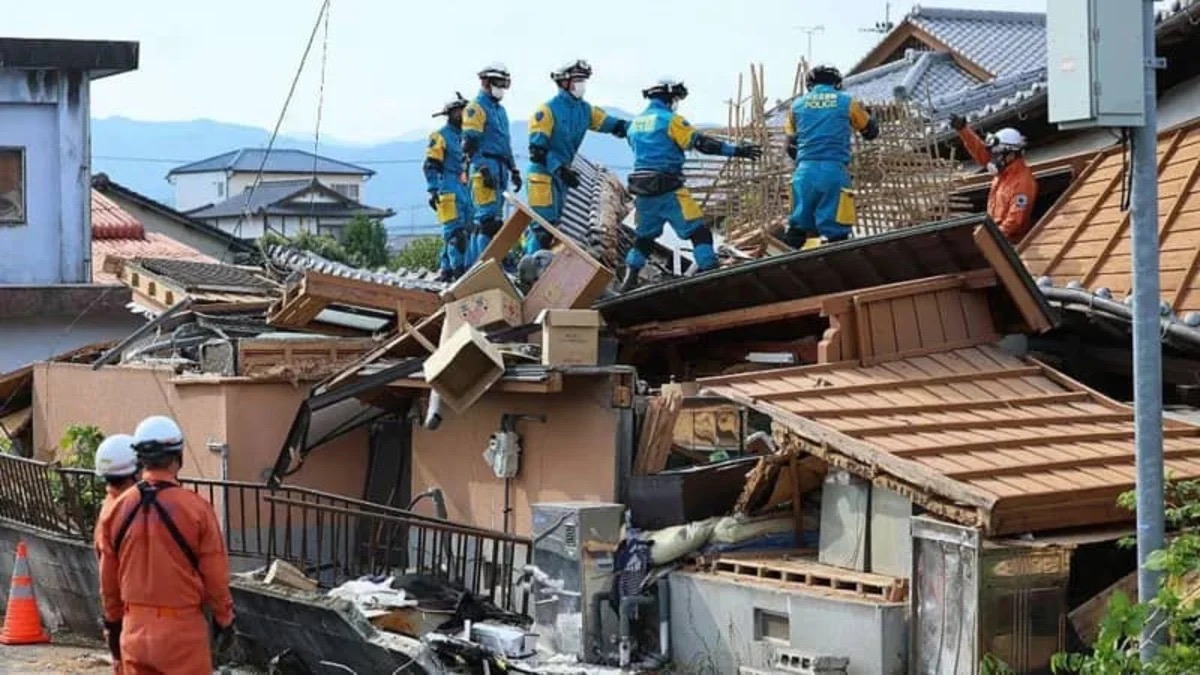
The death toll from the powerful 6.8-magnitude earthquake that struck southwestern Japan has risen to 43, as rescue workers continue search-and-rescue operations amid sweltering temperatures threatening thousands of displaced residents.
Authorities confirmed the latest casualty figures on Thursday, saying the quake, which struck Kumamoto Prefecture on Kyushu Island on Tuesday, caused widespread destruction to homes, shopping facilities, factories and electricity infrastructure.
Several of the victims were killed after part of a shopping mall collapsed before an explosion ripped through the complex about an hour later.
With thousands forced from their homes, officials are now racing to protect survivors from extreme heat, warning that temperatures in Kumamoto could soar to 39°C in the coming days.
The Japanese government has urged both evacuees and emergency responders to take precautions against heatstroke as conditions worsen.
Japan’s Defence Minister, Shinjiro Koizumi, announced on Wednesday that 300 air conditioners had been dispatched to the affected area, with 150 designated for evacuation centres.
Koizumi disclosed that about 9,000 displaced residents were being sheltered in evacuation centres, while more than 30,000 households remained without electricity as of Wednesday.
According to the BBC, Yukiya Sanoue, who works at one of the evacuation centres housing about 1,000 people, said heat-related illnesses had become the facility’s biggest challenge, noting that nearly 30 per cent of those taking refuge there are elderly.
He explained that electricity and water supplies had been cut off following the earthquake and that the centre only regained air conditioning on Wednesday afternoon after receiving a generator.
“Quite a few people are suffering from conditions similar to heatstroke, and several have been taken to the hospital,” he said.
Authorities said more than 100 aftershocks have been recorded since the initial quake, prompting many residents to spend nights inside their vehicles for fear of further tremors.
Thousands of emergency personnel have been deployed across the disaster zone, with rescuers continuing to dig through the rubble at Kashima’s Aeon shopping mall, one of the worst-hit structures where part of the second floor collapsed.
The mall was also rocked by an explosion roughly an hour after the earthquake. The president of Aeon said it was “very likely” caused by a gas explosion, although investigations are still ongoing to determine the exact cause.
In a rare positive development, a cat café inside the shopping complex announced on Wednesday that all 25 cats left behind during the evacuation had been safely rescued.
The Aeon Mall in Kumamoto had only reopened last month following extensive renovations after suffering significant damage during the devastating April 2016 earthquakes, which claimed 278 lives across the region.
Rescue operations are also continuing at a Nippon Paper factory in Yatsushiro City, where at least five workers were killed after part of the facility collapsed during the earthquake.
The company disclosed in a statement on Wednesday that 11 people had initially been trapped, with seven rescued so far.
The shallow earthquake, which struck at a depth of 10 kilometres, was felt across Kumamoto Prefecture, sending residents scrambling for safety.
Recalling the terrifying experience, 75-year-old restaurant owner Hiroko Ogata told the BBC she took cover under a table as the building shook violently.
“I have lived here for 75 years, but I have never experienced such a big quake,” she said. “I thought I would die.”
We’ve got the edge. Get real-time reports, breaking scoops, and exclusive angles delivered straight to your phone. Don’t settle for stale news. Join LEADERSHIP NEWS on WhatsApp for 24/7 updates →
Join Our WhatsApp Channel