BY FELIX IGBEKOYI, Asaba; RICHARD NDOMA, Calabar and INIOBONG EKPONTA, Uyo
As the 2027 general elections draw closer, a wave of dissatisfaction is sweeping across several constituencies, with voters increasingly questioning the performance of political office-holders seeking another mandate.
Constituents who once offered overwhelming support to candidates across various political parties are now opening their representatives’ scorecards, expressing anger and disappointment at what they describe as poor delivery, abandoned promises and the absence of meaningful constituency projects.
LEADERSHIP Sunday findings revealed that across different parts of the country, serving lawmakers and political appointees are facing growing pressure from constituents demanding evidence of impact before the next election.
When our correspondents visited various states, many voters expressed frustration that years of representation had failed to translate into visible development, improved infrastructure or impactful constituency projects capable of transforming lives.
They argued that political party loyalty alone may no longer guarantee electoral support, as constituents increasingly demand measurable achievements, accountability and evidence of performance before deciding whom to vote for in the next election.
Uncompleted Technical College, Others Anger Constituents In Delta
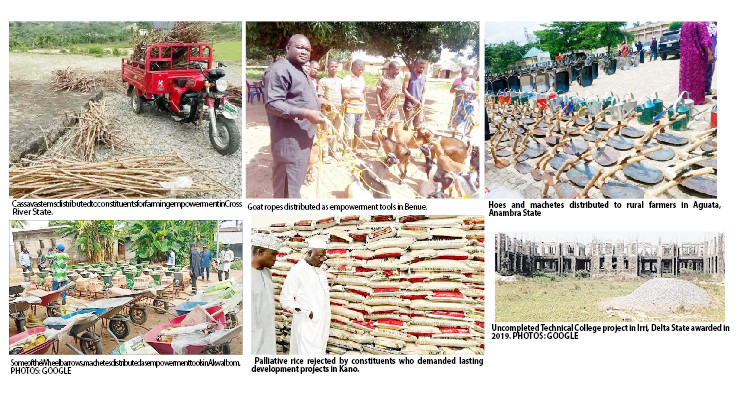
In Delta State, for instance, concerns about delayed and poorly executed constituency projects are beginning to fuel public anger, with the uncompleted Technical College project in Irri, Isoko South Local Government Area, becoming a major source of frustration for residents and political stakeholders alike.
The project, awarded in 2019, remains incomplete seven years later. The workshop component of the institution has yet to begin, landscaping work is still outstanding, and parts of the roof remain unfinished.
Residents who spoke on the development said the visible structures at the front of the project site did not reflect the condition of other sections of the facility, raising concerns over the pace and quality of execution.
The delay has also drawn criticism of the Delta State Government, with Governor Sheriff Oborevwori, who is struggling to appease the masses, describing the situation as unacceptable. The governor said he had expected the institution to commence academic activities and admit students by September this year, but the prolonged delay had made that impossible.
The governor accused the contractor of failing to demonstrate the required competence and commitment to complete the project within the expected timeframe. He spoke during an unscheduled site inspection, where he expressed doubts about assurances that the project would be completed by August.
The governor said, “I spoke with the commissioner, who told me he had contacted the contractor, who said the project would be completed by August. But from what I have seen here, I am not sure that timeline is realistic.”
Stakeholders in the Isoko South Local Government Area have also expressed disappointment at the delay. The chairman of Isoko South LGA, Hon. Warri Ovoke Friday, the Odio-Ologbo of Irri Kingdom, HRM Simon Wajutome Odhomo, Igbogidi I, and the former president-general of the Isoko Development Union (IDU), High Chief Iduh Amadhe, all criticised the slow pace of work. He called for urgent action to ensure completion.
Residents alleged that efforts to engage the contractor over concerns about the quality and pace of work had yielded little or no positive response, increasing fears that the project could remain abandoned.
Similarly, residents of Ofagbe Community in Isoko North Local Government Area raised concerns about the quality of work on the ongoing Isoko Ring Road project.
The concerns, raised with the threat of a ‘no completed project, no vote,’ prompted ministry engineers to inspect the site and issue a stop-work order after identifying what they described as deficiencies in the project’s execution.
The Delta State commissioner for works (highways and urban roads), comrade Reuben Izeze, said the intervention followed several complaints received by the governor through his personal communication channels, as well as reports of a protest by community members.
“We are here on the Governor’s directive. He received several reports, including complaints sent directly to him and reports of a protest by community members. In line with his leadership style, he directed us to come here in person to see the situation for ourselves and report back to him,” Izeze said.
Residents, including Edo Samuel and Raphael Idoghor, expressed dissatisfaction with the quality of the work, alleging that the contractor had failed to meet acceptable construction standards.
Edo Samuel said, “We are disappointed with what we are seeing here because this road was expected to bring relief to our people. But the quality of work has fallen short of expectations. We have raised concerns several times, yet the situation has remained the same. Government should ensure that the contractor does the right thing, or allow a more competent company to take over the project, or else our vote will decide for us”.
Raphael Idoghor said, “The community is not against development; what we want is a project that will stand the test of time. The road and drainage works must be properly executed because this project is meant to serve generations. It was a promise they made, so they have to fulfil it. We are watching them, but we have our votes, and they will speak for us. We appeal to the state government to intervene and ensure that the contractor delivers to the required standards.”
Angered by what they described as the poor state of infrastructure across Delta State, as reported by elected officials, the voters said they had begun assessing their representatives’ scorecards ahead of the 2027 general election. They warned that years of unfulfilled promises, abandoned projects and a lack of visible impact could determine the fate of many serving politicians at the polls.
They claimed that despite repeated complaints and previous inspections by government officials, the road and drainage works remained below expectations. At the same time, activities at the site had been irregular, with the contractor allegedly abandoning the project intermittently.
Cross River: Cassava Project Sparks Backlash Against Federal Lawmaker
In Cross River and Akwa Ibom states, some lawmakers have recently faced public criticism from their constituents over empowerment programmes and projects, which voters argue do not reflect the developmental challenges facing their communities.
Hon. Bassey Akiba, a member of the House of Representatives representing the Calabar Municipality/Odukpani federal constituency, faced criticism from some constituents over the distribution of improved cassava stems as part of his constituency intervention programme.
The lawmaker had presented the cassava variety as an agricultural initiative to support farmers, improve food production and boost economic opportunities within the constituency. However, rather than viewing the intervention as a solution to agricultural challenges, some constituents described it as inadequate, arguing that their immediate needs were basic infrastructure projects with a wider impact.
A constituent from Calabar Municipality, Mrs Margaret Ekpe, said the intervention failed to address the realities many communities face.
“We are not against farming support, but representation should go beyond distributing farm inputs. Many communities need boreholes, accessible roads, drainage systems and the rehabilitation of public facilities. Those are the projects that will touch the lives of more people,” she said.
Chris Asuquo, a youth leader in the Akpabokoyong community of the Odukpani Local Government Area, said residents expected the lawmaker to prioritise projects to improve living conditions.
“People are struggling with poor roads, dilapidated schools and a lack of basic amenities. What many expected was a project that would address these challenges, not something many people see as a temporary intervention,” he said.
He added that the political expectations placed on the lawmaker were high because of the support he received from constituents in the election.
“We supported him because we believed he would offer a different kind of representation. People are now asking questions because they want to see the impact of their votes,” Asuquo added.
The backlash highlights a growing sentiment among voters that constituency interventions must move beyond short-term empowerment programmes to projects that provide lasting social and economic benefits.
Anger Over Wheelbarrows, Machetes As Empowerment Tools In Akwa Ibom
In Akwa Ibom State, the member representing the Abak/Etim Ekpo/Ika federal constituency, Hon. Clement Jimbo, also came under criticism from some constituents after the distribution of wheelbarrows, shovels and machetes as part of his empowerment initiative.
According to the lawmaker’s media team, the items were intended to support peasant farmers who had requested them. However, the intervention drew criticism from some residents, who argued that it fell short of their expectations for constituency representation.
Some constituents described the gesture as disappointing, insisting that their communities require infrastructure projects, including roads, water facilities, school rehabilitation and healthcare interventions.
Uko Effiong, a resident of the constituency, said voters expected more after supporting the lawmaker in the 2023 election.
“The people did not vote for representation that would only provide items that would be exhausted within a short period. They expected projects that would endure and continue to benefit the community,” he said.
Another constituent, Inyang Udoma, questioned whether such interventions reflected the people’s needs.
“After the campaigns and promises, people expected visible changes in their communities. The question many are asking is whether these are the kind of projects that will change the lives of those who voted,” he said.
‘We Gave Them What They Demanded’
However, Jimbo’s media aide defended the programme, stating that the items were provided in response to specific requests from farmers and were part of a wider empowerment agenda.
He said the lawmaker had also carried out other interventions, including support for businesses and skills-acquisition and empowerment programmes, but that some of these efforts had not received sufficient publicity.
Despite the explanation, some angry constituents warned that the 2027 elections would offer an opportunity to assess the performance of elected representatives.
They said political party loyalty would no longer be sufficient to guarantee electoral support, insisting that lawmakers seeking another mandate must demonstrate clear evidence of impact.
According to political observers, growing dissatisfaction across communities signals a shift in voter expectations ahead of the 2027 general elections, as constituents appear increasingly willing to judge representatives by measurable achievements rather than by party affiliation or campaign promises.
Angry Constituents Express Anger With Representatives In Taraba, Abia
Recall that in Taraba State, anger among constituents over what they described as poor representation once boiled over when a member of the House of Representatives for the Bali/Gassol federal constituency, Hon. Garba Hamman Julde, was allegedly attacked by angry youths during a constituency engagement in the Bali Local Government Area.
The incident occurred during a programme in which the lawmaker was presenting 11 motorcycles and a vehicle to beneficiaries. However, some constituents reportedly protested, accusing him of neglecting the constituency and failing to deliver projects with a broader impact on the people.
Eyewitness accounts said the situation became tense after the lawmaker’s speech, with some youths allegedly throwing stones, sachet water and other objects at him before security operatives moved him away from the scene.
In Abia State, a constituency empowerment programme involving the distribution of agricultural inputs, including cassava stems, in June 2024 sparked debate among some residents over the type of interventions expected from elected representatives.
The case involved Hon. Ginger Onwusibe, a member representing the Isialangwa North/South federal constituency of Abia State, who marked his first year in the National Assembly by distributing cassava stems, yam seedlings, maize, and cucumber seeds to constituents. The distribution drew criticism from some who questioned whether the intervention was sufficient to address the constituency’s needs.
While supporters argued that agricultural support could help farmers improve productivity, critics insisted that lawmakers should combine empowerment programmes with larger development projects to address infrastructure and economic challenges in their communities.
Constituents Petition ICPC Over Alleged Missing Empowerment Items In Kaduna
In Kaduna State, residents of the Kaduna North federal constituency in 2026 petitioned the Independent Corrupt Practices and Other Related Offences Commission (ICPC), demanding an investigation into the alleged disappearance or non-delivery of constituency empowerment items intended for beneficiaries.
The petitioners questioned the whereabouts and distribution of items said to include tricycles, motorcycles, sewing machines, vehicles, and water-pumping machines.
Kano Constituents Reject Rice Gift
In Kano State, some constituents of the Kano South Senatorial District rejected a Ramadan rice donation linked to Senator Abdurrahman Suleiman Kawu Sumaila, insisting that temporary relief items could not replace projects to improve their living conditions.
The residents, having returned the rice, questioned the value of such interventions and argued that elected representatives should focus more on development projects with lasting impact.
Stakeholders Score Kwara Lawmakers Low
In 2025, stakeholders in the Kwara South Senatorial District criticised federal lawmakers representing the area, accusing them of poor representation and failing to deliver projects that could improve constituents’ lives.
The group, under the Kwara South Development Initiative, specifically named Senator Oyelola Ashiru, representing the Kwara South Senatorial District; Hon. Tijani Kayode Ismail, representing the Oyun/Offa/Ifelodun federal constituency; and Hon. Abdulraheem Olawuyi Ajuloopin, representing the Ekiti/Irepodun/Oke-Ero/Isin federal constituency, alleging that the zone had little to show in terms of meaningful projects since their election.
The stakeholders, including traditional rulers and community leaders, said voters would increasingly judge elected representatives by visible achievements ahead of the 2027 elections. They argued that political loyalty alone may no longer secure electoral support, as constituents demand evidence of impact, development and accountability from those seeking fresh mandates.
The development of LEADERSHIP Sunday reports added to growing nationwide concerns that constituents are demanding greater transparency in empowerment projects and insisting that public interventions must deliver verifiable benefits.
Recall also that Kano State’s former governor, Abdullahi Ganduje’s empowerment programme for Masu Shayi (tea sellers) in 2017 drew mixed reactions, with critics questioning the impact of distributing items such as kettles, tea-making materials and other start-up supplies as a major government intervention.
The programme, targeting about 5,200 tea sellers across the state’s 44 local government areas, was valued by the administration as support for small businesses, while critics argued that voters expected more transformative projects to address broader development challenges
Goat Ropes Donation Sparks Debate Over Empowerment Priorities In Benue
In Benue State, a 2020 empowerment gesture by politician Daniel Ukpera also sparked controversy after he distributed bundles of rope to some residents of the Makurdi Local Government Area to tie their goats, as part of efforts to support the implementation of the state’s anti-open grazing policy.
The initiative drew criticism from some Nigerians who questioned whether such interventions addressed the wider challenges facing communities. Critics argued that political representatives should prioritise projects with lasting impact, such as roads, schools, healthcare facilities, and economic empowerment programmes that improve livelihoods.
Number Of Abandoned, Fictitious Projects Alarming – Political Analysts
A political observer, Mr Emphraim Nduko Lamo, noted that the growing number of abandoned and, in some cases, fictitious constituency projects across the country was alarming. He said that while some projects existed only on paper, others kept reappearing in annual budgets without any visible evidence of execution, raising concerns about accountability and the management of public funds.
He stated that the growing dissatisfaction across communities signalled a shift in voter expectations ahead of the 2027 general elections, as constituents appeared increasingly prepared to assess political office-holders based on measurable achievements, completed projects and tangible impact rather than on party affiliation or campaign promises.
A public affairs analyst, Mr Tunde Olusola, said the development reflected a growing disconnect between political leaders and the electorate’s expectations.
“Public office is not meant to be an avenue for symbolic gestures that do little to change people’s realities. While empowerment programmes have their place, elected and aspiring political leaders must recognise that citizens expect accountability, transparency and projects that address their most pressing needs. Voters are becoming more discerning and will increasingly judge leaders by the lasting impact they deliver, not by the number of items distributed at ceremonies,” he said.
Another analyst, Mr Chinedu Nduka, said the era of using minor interventions as a substitute for development was gradually fading.
“The era where politicians believe that sharing minor items can replace genuine development is gradually fading. Constituents are demanding accountability because public resources must translate into projects that improve lives. Political office holders must be measured by the roads built, schools improved, jobs created, and communities transformed, not by token gestures that disappear shortly after distribution,” he said.
Complaints Against Me Politically Motivated – Cross River Lawmaker
In a swift response to the condemnation, the member for Calabar Municipality/Odukpani Federal Constituency in the House of Representatives, Hon. Bassey Akiba, dismissed the criticism regarding the distribution of improved cassava stems as a politically motivated attempt to discredit him.
Speaking through his spokesperson, Asoko Okon, the lawmaker alleged that unnamed detractors were deliberately distorting facts about his livelihood programme to mislead the public and tarnish his image.
He explained that the initiative was not limited to cassava distribution but covered four agricultural value chains—cassava, poultry, fisheries, and palm produce. According to him, beneficiaries were selected from registered cooperative societies and existing farmers, with cassava farmers receiving improved stems and fertiliser, fish farmers receiving fish feed, poultry farmers receiving production inputs, and palm farmers receiving seedlings and fertiliser.
Okon maintained that critics had deliberately ignored the other components of the programme while focusing on the cassava intervention to create unnecessary controversy.
He insisted the scheme was designed to improve agricultural productivity and livelihoods, adding that those attacking the lawmaker were politicians pursuing personal ambitions rather than individuals genuinely concerned for constituents’ welfare.
On his part, the chief press secretary to the Speaker of the Cross River State House of Assembly, Mr. Mathew Okache, dismissed allegations that Rt. Hon. Elvert Ayambem executed fictitious projects, calling the claims false, mischievous and a recycled smear campaign orchestrated by political opponents unsettled by the Speaker’s growing popularity in the Ikom II State Constituency.
Okache maintained that Ayambem’s projects are verifiable and span the 11 wards of the constituency.
According to him, the Speaker has delivered rural electrification, school interventions, water projects, road grading, the opening of farm roads, scholarships, youth and women’s empowerment programmes, financial support for constituents, and effective legislative representation. He added that ongoing projects are being implemented in phases and will be completed as scheduled.
I Have Done Well, Says Senator Nwoko
Also, in response to the allegations, the Senator for the Delta North Senatorial District, Ned Nwoko, rejected claims that he has failed to address unemployment and other pressing issues affecting Delta North, stressing that a senator’s constitutional responsibility is to make laws, carry out oversight functions and facilitate budgetary appropriations, not to create jobs directly.
He said he has, however, nominated several constituents to the National Directorate of Employment for vocational training and opportunities in federal agencies, while advocating fiscal federalism and the creation of additional local governments, particularly in Anioma State.
Nwoko also defended his legislative record, citing his membership of several Senate committees and his sponsorship of bills and motions on youth entrepreneurship, waste management, malaria eradication, diaspora voting, crude oil theft, constitutional amendment and security reforms. According to him, these initiatives aim to tackle unemployment, poverty, environmental challenges, healthcare and insecurity, while ensuring improved representation for Delta North.
We’ve got the edge. Get real-time reports, breaking scoops, and exclusive angles delivered straight to your phone. Don’t settle for stale news. Join LEADERSHIP NEWS on WhatsApp for 24/7 updates →
Join Our WhatsApp Channel