Much of the rot and endemic corruption crippling the Nigerian judiciary stems from its dangerous romance with politicians. Backed by billions of looted public funds, a ruthless political class has weaponised its wealth to buy judgments—operating on the firm, destructive belief that every judge has a price.
Dirty money, corrupt counsel, and compromised judges: this is how justice dies at the courts, especially at the Election Petition Tribunals, where reports allege massive bribes routinely change hands, breaking the bench and leaving the electoral process forever tainted.
While officials offer laughable justifications for these handouts, the reality is clear: whether intentionally or through subtle psychological leverage, these lavish gifts compromise the bench. When politicians control the perks, the judiciary inevitably answers to them.
This is precisely why the ruling political class rigs the system and brazenly dares its opponents to go to court. Their defiance isn’t born of respect for judicial independence; it is a calculated manifestation of institutional capture.
They weaponise the judiciary as a bureaucratic graveyard, fully aware that the status quo favours the usurper. By the time an opponent enters the legal arena, the verdict has already been bought, paid for, and sealed behind closed doors.
A plague
Nigerian politicians have damaged everything they touch. They taint religious leaders. They have destroyed the media. They have infiltrated traditional institutions, rendering the system entirely ineffective. All it takes for a traditional ruler to be dethroned is to disagree with a governor or even a politician with unrestricted access to power.
Anyone who still doubts this should consider the dilemmas faced by the former Emir of Gwandu, Al-Mustapha Haruna Jokolo, who was deposed by former Governor Adamu Aliero, and by Emir Muhammadu Sanusi II of Kano, who was deposed by former Governor Abdullahi Umar Ganduje and later returned to the throne.
Emir Jokolo’s more than two-decade-long legal battle over the seat of his forebears eventually came to an end following a Supreme Court judgment in 2025.
Sometimes I am tempted to believe that even the raging insecurity seems intractable because politicians have infiltrated the security sector and continue to exert undue influence over the nation’s security agencies.
Collapse of intellectual resistance
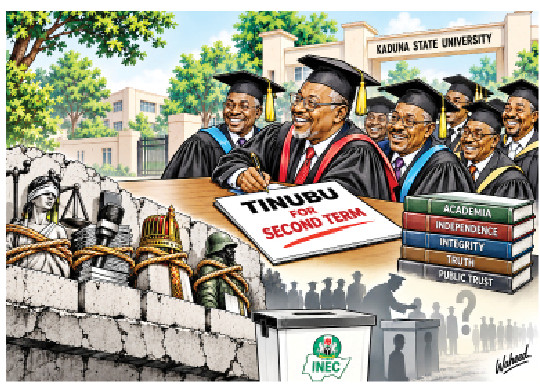
In a chilling escalation of political capture, the nation’s academic independence is facing a devastating blow. The latest evidence of this creeping authoritarianism? A massive, highly controversial endorsement of President Bola Ahmed Tinubu by a coalition of nearly 600 academics. Critics say the move signals the total collapse of intellectual resistance and the final surrender of the country’s most sacred independent institutions.
The recent endorsement of President Tinubu by about 600 North-West academics clearly demonstrates how deeply politicians have penetrated the ivory tower. The president’s political adviser, Ibrahim Masari, along with some Northern governors, reportedly met with senior academics from various tertiary institutions in the region. Following the meeting, the president was endorsed for a second term.
After the closed-door meeting, Prof Abdullahi Musa, the Vice Chancellor of Kaduna State University, said that the academics, impressed by the president’s performance, had unanimously endorsed him for another term.
Unsurprisingly, the endorsement prompted a flurry of reactions, with many questioning the decision amid a deteriorating security situation in the North-West.
I tried to speak to one of the lecturers who was said to have played a facilitating role in the meeting and to comment on the controversy, but my efforts hit a brick wall. “I am not ready to talk to journalists about the matter”, was his response.
Why was I so interested in speaking with this lecturer, whom I will simply refer to as Professor D? I learnt from a source that, as the point man between the lecturers and the meeting organisers, Prof D had been given N350 million to share among the lecturers.
I do not know whether this claim is true, what the money was intended for, or whether any money was given. However, the controversy surrounding the meeting raises a more fundamental question.
There is nothing wrong with academics holding political meetings with politicians or even joining political parties as registered, card-carrying members. It is clearly their constitutional right.
However, the decision to publicly endorse any candidates needs to be made after extensive, broad consultations. When such an endorsement comes at a time when ASUU, the umbrella body of university lecturers, is threatening industrial action over unresolved issues, and when it is made by lecturers from the region bearing the greatest burden of insecurity, one begins to wonder.
It is not surprising that the endorsement has continued to generate reactions. Essentially, the endorsement has implications beyond the immediate political controversy.
Has INEC’s playbook been narrowed?
INEC has, over the years, relied on senior academics, including vice-chancellors and professors, to serve as Returning and Collation Officers during elections. The rationale is understandable. The commission needs people whose professional standing and presumed neutrality can inspire confidence in the electoral process.
But what happens when academics publicly align with one of the major contestants? Can the 600 academics who reportedly endorsed President Tinubu for another term still be trusted to serve as election officials in an election involving him? People in positions that require public neutrality cannot wake up one day and endorse candidates.
INEC, therefore, has a question to answer. Should an academic who publicly endorsed a candidate or political party still be appointed as a Returning or Collation Officer in an election involving that candidate? The question becomes even more pressing when the number involved is reportedly as high as 600. But the fact is that, with the Kaduna endorsement, INEC’s choice has become narrower than anyone imagines.
If INEC decides to screen out academics who have openly taken partisan positions, will it still have enough qualified and credible lecturers to serve as Returning and Collation officers? I don’t have answers to this question, and I doubt INEC does either. That, perhaps, is what to expect when we turn academia into another battleground for political endorsements.
Politicians have already infiltrated too many institutions. The judiciary has suffered. Traditional institutions have not been spared. The media constantly struggles to preserve its independence. Even the security agencies often face undue political interference.
The academia should be careful not to lose what remains of its greatest asset: the confidence that, at critical moments, its members can rise above partisan interests.
Chinese Must Stay
Traders at the Lagos Trade Fair Complex are protesting against Chinese retailers. This madness about the Chinese Must Go has to stop immediately. It’s not in our character. China is one of Nigeria’s biggest trading partners.
The Chinese retailers entered the country legally and have the backing of Nigerian law to operate legal businesses, whether as wholesalers, retailers or otherwise. We cannot call South Africa out for xenophobia while doing almost the same thing. No.
We’ve got the edge. Get real-time reports, breaking scoops, and exclusive angles delivered straight to your phone. Don’t settle for stale news. Join LEADERSHIP NEWS on WhatsApp for 24/7 updates →
Join Our WhatsApp Channel