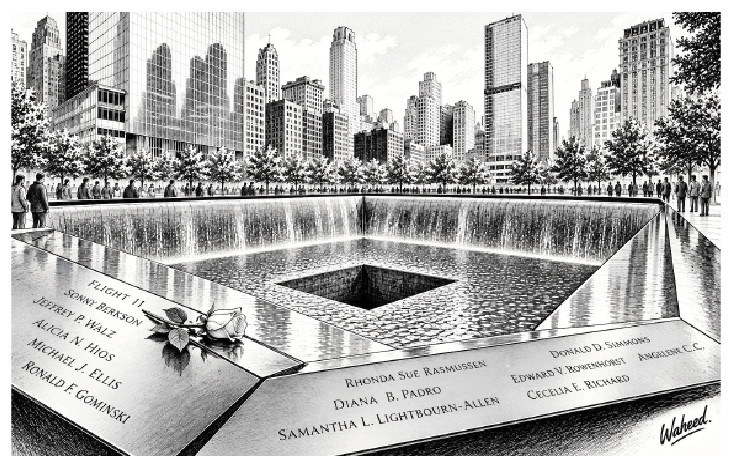
Twenty-five years ago, the world changed in a matter of hours. But perhaps the most enduring legacy of September 11, 2001, is not only what happened in New York, Washington or Pennsylvania; it is what happened afterwards, quietly and incrementally, to people all over the world who were nowhere near the World Trade Centre.
The 9/11 attacks killed 2,977 people, but their consequences reached billions. They changed how we travel, how governments watch us, how borders operate, how intelligence agencies share information, how Muslims are perceived, how nations define threats and, increasingly, how much privacy ordinary citizens are willing to surrender in exchange for the promise of security.
The anniversary coverage understandably remembers the victims and examines the wars that followed. Yet there is another story worth telling: the story of the ordinary citizen who gradually entered a world where security became a permanent condition of everyday life.
The world did not merely build stronger security systems after 9/11; it built a world organised around the expectation of danger.
The Day Security Came Home With Us
Before 9/11, airport security was something many travellers barely noticed. Today, the airport is a ritual of compliance. Remove your belt. Take out your laptop. Empty your pockets. Explain the bottle. Submit to scanning. Stand in line. Present identification. Repeat.
The changes were not irrational. The attacks exposed catastrophic weaknesses in aviation security and led to reinforced cockpit doors, universal checked-baggage screening, tighter passenger controls and the creation of the Transportation Security Administration in the United States.
But the bigger change was psychological. Security stopped being something governments provided in the background. It became something citizens experienced physically.
The same transformation spread beyond airports. Government buildings acquired barriers. Hotels installed scanners. Shopping centres introduced security checks. Major events became exercises in controlled entry. CCTV cameras multiplied. Identity documents became more important. Borders became more technologically sophisticated.
Even in countries far removed from the geography of 9/11, the language of security became embedded in everyday life.
In Nigeria, we know this world intimately. We queue to be searched before entering government offices, banks, hotels, airports, courts and sometimes places of worship. We accept checkpoints, guards, identification requirements and surveillance cameras as part of ordinary existence—not necessarily because each measure is effective, but because the possibility of danger has become normal.
That may be one of 9/11’s most enduring victories over the imagination: it taught the world to live permanently with the possibility of the next attack.
From Privacy as a Right to Privacy as a Bargain
The second transformation was less visible but perhaps more profound: the expansion of surveillance.
After 9/11, governments acquired new powers to collect, analyse and share information in the name of preventing terrorism. In the United States, the Patriot Act significantly expanded surveillance and investigative powers. Intelligence agencies became increasingly interested not simply in suspects, but in patterns: communications, travel, financial transactions and associations that might reveal a threat before it materialised.
The underlying logic was understandable: if terrorists could operate through networks, governments needed to understand networks. But technology did something else. It made mass observation increasingly cheap.
The post-9/11 security architecture therefore coincided with the explosion of the digital age. Smartphones, social media, cloud computing, facial recognition, biometrics, artificial intelligence and vast databases have created capabilities that intelligence agencies of 2001 could scarcely have imagined.
The irony is striking. We worry about government surveillance while voluntarily producing extraordinary quantities of personal information every day. We reveal where we are, whom we know, what we buy, what we believe, where we travel and what we search for. The security state does not always need to knock on the door. Sometimes, we have already opened it.
The question 25 years after 9/11 is therefore no longer simply whether governments should be allowed to watch citizens. It is whether societies have become so accustomed to surveillance that privacy itself is beginning to look suspicious.
The Cost of Suspicion
Another human consequence of 9/11 that deserves more attention is the transformation of suspicion.
For millions of Muslims and people of Middle Eastern, South Asian and African heritage, the post-9/11 world sometimes meant explaining an identity they had never previously been required to defend.
The distinction between Islam and terrorism had to be repeatedly asserted because, in practice, the two were often dangerously conflated. Muslim communities experienced profiling, discrimination and heightened scrutiny. The consequences extended beyond America, influencing immigration systems, policing and public attitudes elsewhere.
This is where security becomes complicated. A government may legitimately want to identify a terrorist. But when suspicion begins attaching itself to race, religion, nationality or appearance, security can become a generator of injustice.
And there is a broader lesson here for countries such as Nigeria. We know what happens when security institutions begin treating whole communities as threats. In our own context, entire regions, ethnic groups, religious communities or young people can become objects of suspicion because of the actions of a minority.
Good security distinguishes between a threat and a population. Bad security turns populations into threats. The distinction matters because alienating communities can make societies less secure, not more. People who feel watched, profiled or collectively blamed become less likely to trust the institutions that need their cooperation.
Security ultimately depends not only on intelligence, weapons and surveillance. It depends on legitimacy.
Are We Safer or Merely More Afraid?
Twenty-five years later, there is no simple verdict. Some things genuinely became safer. Aviation security changed dramatically. Intelligence cooperation improved, governments became more alert to terrorist networks, and many plots were disrupted. The architecture created after 9/11 has undoubtedly prevented attacks. But the response also carried enormous costs.
The US fought prolonged wars in Afghanistan and Iraq. Thousands of American service members died, while the human toll among Afghans and Iraqis was vastly greater. The post-9/11 era also brought controversies over torture, detention, surveillance and the erosion of civil liberties.
Meanwhile, the security challenge did not disappear; it fragmented. Terrorism now exists alongside cyberattacks, disinformation, drones, lone actors, domestic extremism, geopolitical rivalry and technologically enabled crime. The security problem has moved from the cockpit to the smartphone, from the battlefield to cyberspace, and from organised cells to individuals radicalised online.
The biggest lesson of 9/11: security is never finished. But neither should fear become a permanent organising principle of society.
A generation has now grown up without personal memories of September 11. For them, 9/11 is history, inherited through classrooms and documentaries. Yet they have also inherited its consequences: security checks, surveillance systems, wars, altered borders and suspicion.
That is why the 25th anniversary should ask not only what happened that morning, but what kind of world we constructed afterwards.
We cannot prevent every threat; no nation can. But we can decide what we refuse to sacrifice in preventing one. A society that is completely secure but has surrendered its freedom has not solved the security problem.
Perhaps that is the balance we are still learning: security without paranoia, vigilance without discrimination, technology without tyranny, and strong states without frightened citizens.
The greatest tribute to those who died may not be to remain permanently afraid of another September 11. It may be to build a world that is wiser because of it.
We’ve got the edge. Get real-time reports, breaking scoops, and exclusive angles delivered straight to your phone. Don’t settle for stale news. Join LEADERSHIP NEWS on WhatsApp for 24/7 updates →
Join Our WhatsApp Channel