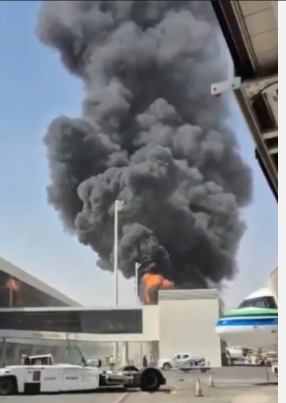
Houthi rebels have struck a passenger terminal at King Khalid International Airport in Riyadh, Saudi Arabia, a day after a missile attack killed at least 12 people and injured more than 300 others.
The latest attack by the Houthi rebels occurred on Sunday when a projectile hit the airport’s domestic terminal complex, killing one person and injuring 11 others, according to the Saudi-led coalition fighting the Iran-backed rebels in Yemen.
Saudi authorities identified the latest fatality as a Pakistani national.
India’s embassy in Saudi Arabia said one of its citizens died from injuries sustained in Saturday’s attack, potentially raising the death toll from that incident to 13.
The airport, which has reportedly been struck four times in five days, has remained closed since Saturday’s missile attack, described as the deadliest in a Gulf Arab nation since the Iran war began.
Saudi authorities also reported an attack on King Fahd International Airport in Dammam, near the Persian Gulf, but provided few details.
The renewed Houthi rebel attacks threaten to draw greater United States military involvement in the conflict. President Donald Trump has said he is considering joining the fight against the rebels, although the White House had not commented on Sunday.
Trump had also indicated plans to speak with Saudi Crown Prince Mohammed bin Salman, who has been seeking assistance against the Houthi rebels. However, there was no indication on Sunday that the planned conversation had taken place.
The Houthi rebels claimed responsibility for the attacks on Saudi Arabia and other strikes. The latest assault on Riyadh came shortly after the rebels said Sanaa International Airport, in the Yemeni capital under their control, had been struck again, blaming Saudi Arabia.
On Sunday night, the Houthi-run Al-Masirah television channel reported further strikes on Sanaa, also blaming Saudi Arabia. Riyadh had not commented on the reported attacks.
The escalation has raised concerns over global oil supplies, energy prices and commercial shipping through the Bab el-Mandeb Strait, a strategic waterway connecting the Red Sea to the Gulf of Aden.
The strait provides a crucial alternative route for shipping between the Persian Gulf and international markets, particularly as Iran threatens maritime traffic through the Strait of Hormuz.
A United States intervention against the Houthi rebels could prompt them to disrupt shipping through Bab el-Mandeb, further restricting the movement of oil from the Persian Gulf.
The rebels seized key areas along the strait last month. The Saudi-led coalition, which backs forces aligned with Yemen’s internationally recognised government, has been trying to recapture the territory.
The Houthi rebels’ attacks on Saudi airports, oil infrastructure and military facilities have also highlighted concerns about the kingdom’s air defence capabilities.
Regional officials told The Associated Press last month that Saudi Arabia was running low on missile interceptors and had asked France, Britain, Pakistan and Egypt to provide air defence support to the region.
One official also noted that the United States had seen its own stock of interceptors decline during the Iran war.
The latest Houthi rebel attacks have heightened concerns about the potential expansion of the conflict, with civilian casualties, regional aviation and international energy supplies increasingly at risk.
We’ve got the edge. Get real-time reports, breaking scoops, and exclusive angles delivered straight to your phone. Don’t settle for stale news. Join LEADERSHIP NEWS on WhatsApp for 24/7 updates →
Join Our WhatsApp Channel