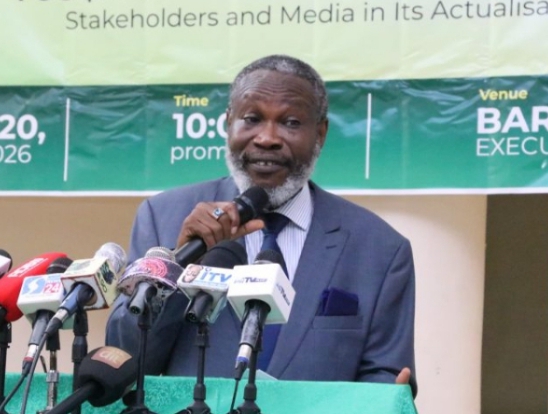
Nigeria attracted $10.37 billion in total capital inflows in the first quarter of 2026, but only $135.08 million went into foreign direct investment (FDI), the First Deputy President of the Abuja Chamber of Commerce and Industry (ACCI), Prof. Adesoji Adesugba, has said.
Adesugba said the low level of direct foreign investment raised concerns about Nigeria’s ability to attract the long-term capital needed to establish factories, expand production and create sustainable jobs.
He spoke while delivering the keynote address at the 20th anniversary conference of the Commerce and Industry Correspondents Association of Nigeria (CICAN) in Abuja.
Speaking on the theme: “From Ambition to Arithmetic: Actualising the Federal Government’s $1 Trillion Economy—The Roles of Policymakers, Stakeholders and the Media,” he said achieving the target would require consistent policy implementation, increased productivity and sustained investment in productive sectors.
According to him, foreign direct investment accounted for only about 1.3 per cent of total capital importation in the first quarter, indicating that Nigeria was attracting far less long-term investment than it needed to build factories, expand industries and create jobs.
Adesugba said Nigeria must move beyond macroeconomic stabilisation and strengthen its productive capacity to support the federal government’s $1 trillion economy ambition.
He noted that the country’s real Gross Domestic Product (GDP) grew by 4.43 per cent year-on-year in the second quarter of 2026, while growth in the first half of the year stood at 4.16 per cent, compared to 3.68 per cent in the corresponding period of 2025.
He also cited a decline in headline inflation to 14.63 per cent in September 2026 from 20.98 per cent a year earlier, as well as an increase in gross external reserves to $55.25 billion, as signs of improvement in the economy.
However, he warned that these gains had yet to translate into sufficient long-term investment, stronger manufacturing capacity and broad improvements in household welfare.
Adesugba said Nigeria needed to sustain annual real economic growth of at least six per cent and increase reliable electricity supply to at least 8,000 megawatts to support industrial expansion.
He noted that although the country had an installed electricity grid capacity of 13,625 megawatts, average available capacity stood at 4,758 megawatts in August 2026.
He said inadequate electricity forced businesses to rely on expensive alternative power sources, increasing production costs and weakening their competitiveness.
The ACCI deputy president also warned that Nigeria’s target of achieving a $1 trillion economy by 2030 was highly ambitious. He said the country would need to more than triple its estimated 2025 economic output of between $285 billion and $291 billion within five years, requiring annual expansion of about 28 per cent in dollar terms.
He cautioned against relying excessively on exchange-rate appreciation to achieve the target, insisting that sustainable growth must be driven by increased production and productivity.
Adesugba called on the federal government to ensure policy continuity, accelerate power-sector reforms, improve revenue transparency and implement tax reforms effectively to strengthen investor confidence.
He also urged financial institutions to increase lending to manufacturing, agriculture and infrastructure rather than concentrating on government securities.
We’ve got the edge. Get real-time reports, breaking scoops, and exclusive angles delivered straight to your phone. Don’t settle for stale news. Join LEADERSHIP NEWS on WhatsApp for 24/7 updates →
Join Our WhatsApp Channel