
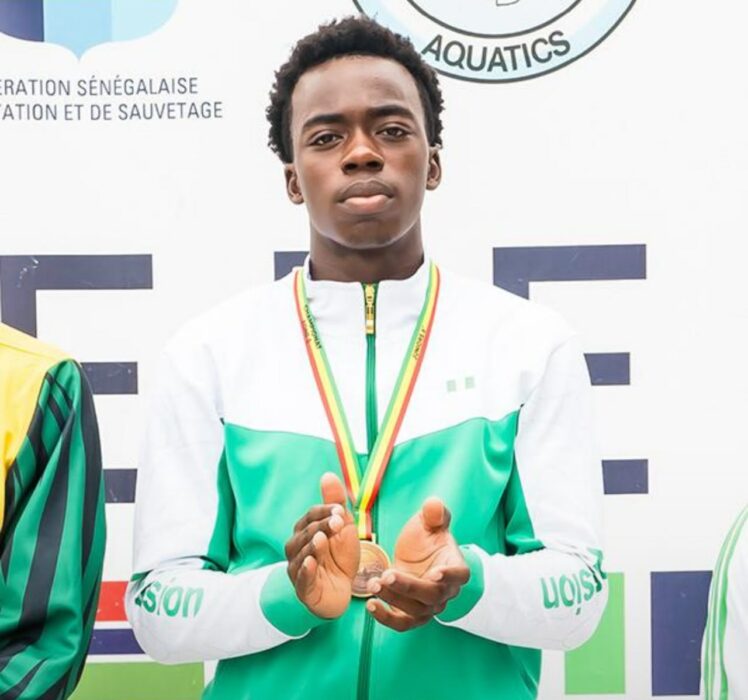
President of the Nigeria Aquatics Federation (NAqF), Lekan Fatodu, is confident that a 15-year-old Nigerian swimmer, Aidan Dumuje, can win a medal at the Youth Olympic Games, citing his natural talent, dedication and steady progress despite limited training facilities and competition opportunities.
Fatodu, who spoke through the federation’s Secretary-General, Taiwo Oriss, said the youngster, who has been shortlisted to represent Nigeria at the Games, had demonstrated the potential to compete with the best despite training in challenging conditions.
NAqF boss described the teenager as a product of determination and self-motivation, noting that his commitment had enabled him to make significant progress despite lacking the facilities and regular competition enjoyed by some of his rivals.
“He is training under a poorly equipped coach, yet he is better than those who have sound coaches. He is training in an environment where competitions do not take place every week. Instead, we have competitions quarterly,” Oriss said.
“Yet, he is better than those who compete week in, week out. The guy is just a natural talent.”
Oriss said the teenager’s dedication was evident in his daily routine, as he trains before and after school in pursuit of his Olympic ambition.
According to Oriss, the swimmer arrives at the pool as early as 6.30am and trains until 7am before heading to school. He returns in the evening for another two-hour training session.
Oriss said the youngster’s commitment was driven by a dream he had nurtured since the age of 12: to represent Nigeria at the Youth Olympic Games.
“From the age of 12, this young boy has said that one day he wants to make the Youth Olympic Games. Today, he has been shortlisted to represent Nigeria at the Youth Olympic Games,” he said.
“He is intrinsically motivated. He has a passion, he has a desire, and he is putting in so much work, drive and commitment to making a beautiful career for himself in swimming.”
The federation official expressed strong confidence in the teenager’s medal prospects, insisting that he would be his first choice if asked to identify a Nigerian swimmer capable of reaching the podium.
“Although he is 15, and you know the Youth Olympics is for 18-year-olds, I am that confident. If they ask me to pick one athlete who has the potential to give us a medal, I will pick him first,” Oriss said.
He attributed his optimism to the youngster’s performances against older competitors and the international experience he has gained in recent years.
The teenager has represented Nigeria at several international competitions, including the Africa Youth Games in Angola, an event in Egypt, the World Junior Championships in Romania and an Africa Zone Two competition in Senegal.
Oriss said the swimmer had continued to improve with each international outing, adding that competing against stronger opposition had helped him gain valuable experience ahead of future competitions.
At the last Africa Youth Games, the youngster won bronze behind two South African swimmers, a performance Orise believes has further strengthened his prospects of delivering another impressive outing on the international stage.
Beyond the teenager’s individual achievements, Orise said his emergence was helping to challenge perceptions that Nigerian swimming was not competitive enough to warrant greater investment from sports authorities.
He explained that concerns about the country’s competitiveness in swimming had previously made administrators reluctant to commit more resources to the sport.
However, the progress of the 15-year-old and other emerging talents has given the federation renewed confidence in its efforts to develop a stronger national team capable of competing internationally.
Oriss urged sports administrators to pay greater attention to swimming and invest in promising athletes, arguing that adequate support, regular competitions and improved training facilities could help Nigerian swimmers achieve more on the global stage.
He added that the teenager’s journey should inspire other aspiring swimmers to remain committed to their ambitions, even when faced with limited opportunities and inadequate facilities.
For the federation, the youngster’s development underscores the potential of Nigerian swimming to challenge established powers when natural talent is supported by dedication, international exposure and the necessary investment.
We’ve got the edge. Get real-time reports, breaking scoops, and exclusive angles delivered straight to your phone. Don’t settle for stale news. Join LEADERSHIP NEWS on WhatsApp for 24/7 updates →
Join Our WhatsApp Channel