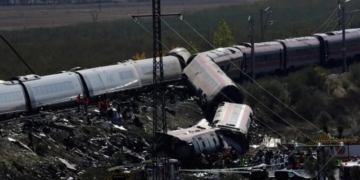
Spain’s Prime Minister, Pedro Sánchez, has declared three days of national mourning after at least 68 people were killed in a collision involving two high-speed trains south of Madrid.
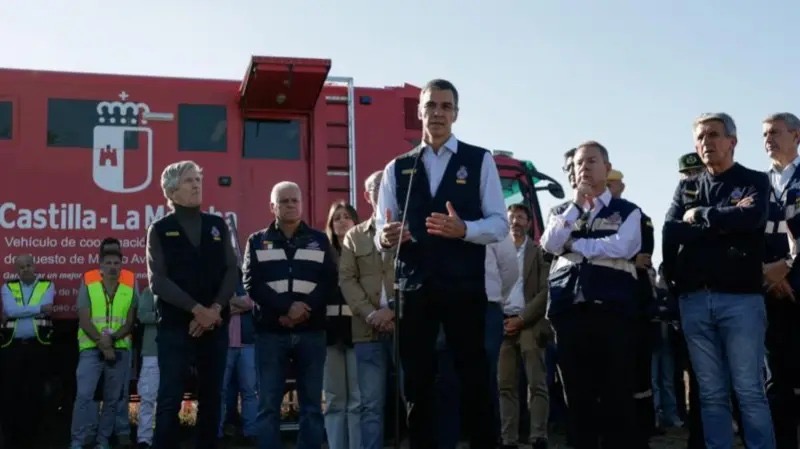
Sánchez announced the mourning period while visiting the crash site and an emergency response centre set up near the scene of the disaster.
“Today Spain is grieving, the whole of Spain is grieving, and we express all our solidarity and empathy with the relatives of the victims and the injured who are still in hospital, and whom we wish a speedy recovery,” he said.
“Behind each victims is… a destroyed family, pain, and anguish… which the people of Spain share.”
The updated death toll makes the crash the country’s deadliest rail disaster since 2013. More than 500 passengers were travelling on the two trains involved in the collision.
The crash has also prompted major political parties to suspend their campaigns for the general election.
Sánchez said the government’s immediate priority was to support the injured, victims and their families, while a full investigation would establish the circumstances surrounding the accident.
“The ministers of transport and interior are trying to determine what was the origin of this tragedy, of this terrible accident… and we will get to the bottom of this, and if there has been any negligence, it will come to light,” he said.
He added that any “failures in the security system” would be addressed.
The prime minister also called for efforts to restore public confidence in the country’s high-speed railway network, noting that Spain had experienced another fatal rail accident earlier in the year.
“At the moment it looks like the causes behind both crashes have nothing in common, but it’s not up to me but to the investigation to establish that,” Sánchez said.
“We will need to do everything in our power to restore public confidence in our high-speed railway network. It is unacceptable for a country like Spain to experience two high-speed rail accidents in the same year.”
Spain’s Transport Minister, Óscar Puente, said a computer failure initially caused six moving trains, including the two involved in the collision, to halt.
According to Puente, the control centre subsequently authorised the trains to resume movement without speed restrictions.
“In the event of a system failure, the control centre takes over,” he said.
However, he described the decision to allow the trains to move again as having been made under “inexplicable circumstances”.
The decision reportedly resulted in a Renfe train crashing into an Iryo train that was stationary further ahead on the tracks.
Puente described the accident as “truly unbelievable”.
The circumstances surrounding the control centre’s decision are expected to form part of the investigation into the disaster.
Rail operator Iryo said its train was “struck from behind” by a Renfe train, adding that the cause of the collision remained unknown.
In a statement published on X, the company said the affected train was carrying 147 passengers, three crew members, one barista and one driver.
Iryo said it was working with the other rail operators involved to “clarify the causes” of the crash.
Witnesses described the scenes at the accident site as terrible, with passengers experiencing confusion and distress following the collision.
Roberto Gómez, a Spanish journalist who was travelling on one of the trains, described the experience as “extremely chaotic and very distressing”.
Authorities are continuing efforts to support survivors and the families of the victims as investigations into the cause of the crash proceed.
We’ve got the edge. Get real-time reports, breaking scoops, and exclusive angles delivered straight to your phone. Don’t settle for stale news. Join LEADERSHIP NEWS on WhatsApp for 24/7 updates →
Join Our WhatsApp Channel