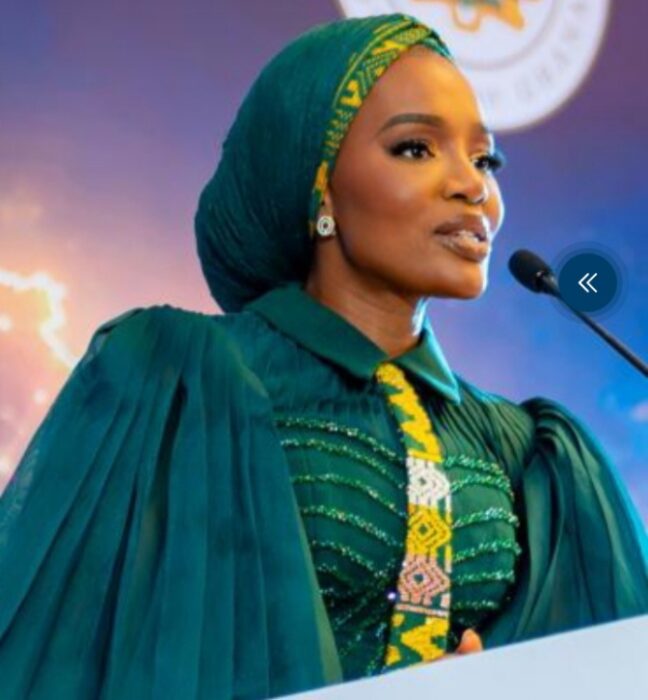
Olori Atuwatse III, wife of the Olu of Warri, has challenged African leaders, investors and business executives to prioritise ownership, investment and economic benefits in the continent’s creative industry, lamenting that Africa earns only about $1 from every $100 generated through global trade in creative goods.
She said the continent must move beyond celebrating its cultural influence to ensuring that African creators and their communities derive tangible economic benefits from their work.
The Warri Queen spoke on the second day of the Elevate Africa Convening 2026 in Accra, Ghana, where stakeholders gathered to deliberate on the continent’s leadership, trade, cultural influence and development under the theme, “Africa: Defining Her Future.”
“Our soft power should do more than make the world lean in. It should make the world buy in,” she said, stressing the need for Africans to own the brands, intellectual property and commercial platforms through which their creativity reaches global markets.
She identified Afrobeats, Nollywood and African fashion as examples of the continent’s growing global cultural influence, noting that African music attracts audiences worldwide, Nollywood continues to tell African stories to international audiences, while indigenous fabrics feature prominently on global fashion runways.
However, she questioned the economic returns accruing to African creators despite the growing international demand for their products.
“The rhythm is ours. The colour is ours. Too often, the receipt is made out to someone else,” she said, asking, “Who owns the label? Who holds the rights? Who takes the profit home?”
She added that Africa must ensure future generations inherit not only its cultural traditions but also the institutions and business structures required to generate prosperity from them.
Drawing comparisons with the United States and South Korea, Olori Atuwatse III said Africa could learn from countries that have successfully transformed cultural products into powerful economic assets.
She cited Hollywood, Korean skincare and Korean television dramas as examples of how cultural influence could stimulate consumer demand and generate commercial opportunities.
“We came to believe their stories, and our money followed our belief. That is soft power, and Africa has an abundance of it,” she said, calling for similar strategies to strengthen the global reach of Afrobeats, Nollywood and indigenous African fabrics.
She urged governments, investors and business leaders to develop platforms and business models that would enable African creatives to own, distribute and profit from their work rather than surrendering much of the value to external interests.
On youth development, the Olori expressed confidence in the capacity of young Africans to shape the continent’s economic future but challenged political and business leaders to match their ambition with adequate support.
She observed that young people were increasingly creating opportunities, building businesses and developing solutions despite limited access to resources.
Noting that the median age of Africa’s population was about 19, she said the continent’s youthful demographic presented enormous opportunities if properly harnessed.
“Our young people are moving. Are our institutions moving with them?” she asked, urging leaders to expand access to capital and markets while creating institutions that allow young people to participate meaningfully in decision-making.
She said the Elevate Africa Fellowship was among the initiatives working to advance opportunities for young Africans and called on other institutions to support the effort.
Olori Atuwatse III also called for stronger connections between Africans on the continent and those in the diaspora, including people of African descent in the Caribbean, the Americas and other parts of the world.
Referring to discussions on reparatory justice at the previous day’s Presidential Roundtable, she argued that restoring dignity to people of African descent must include confronting negative perceptions and strengthening relationships within the global African family.
Citing remarks by former Mauritian President Ameenah Gurib-Fakim on the loss of dignity associated with the transatlantic slave trade, she said the consequences remained visible in institutional practices, technology and everyday social interactions.
“That loss of dignity was built by a narrative. And what one narrative built, another can rebuild,” she said, insisting that Africans must begin by changing how they perceive and relate to one another.
She particularly criticised divisions between Africans on the continent and people of African descent abroad, warning against derogatory labels and attitudes that undermine a shared identity.
“When we reject each other, we reject ourselves. But when we accept each other, we accept ourselves. When we elevate each other, we elevate ourselves,” she said.
The Warri Queen advocated sustained engagement, cultural exchanges and business partnerships as practical ways to rebuild trust, noting that personal relationships could challenge stereotypes and expose shared experiences.
Recalling the first Homecoming organised in the Warri Kingdom two months earlier to mark the anniversary of the Olu’s coronation, she said the initiative had begun creating lasting partnerships between the Kingdom and members of the diaspora.
She further urged African governments to create an enabling environment for Black investors from the West, drawing inspiration from the historic Black Wall Street in Tulsa, Oklahoma, which was destroyed in a racially motivated massacre in 1921.
She said meaningful investment opportunities could help build stronger economic ties and institutions across the continent.
The Olori said Elevate Africa was established to build bridges between individuals, countries and networks, enabling Africans to collectively define and implement a development agenda that protects their dignity and advances shared prosperity.
She urged participants to look beyond celebrating African traditions and the global recognition of the continent’s creative talents to focus on ownership, investment and sustainable economic returns.
Also speaking, Ghana’s Minister of Tourism and Creative Arts, Abla Gomashie, said the convening was aimed at building a robust future for Africa and taking the continent to the next level.
She said that for generations, Africa had been portrayed globally as a source of raw materials, including cocoa, gold and other minerals, despite the value of its people and their contributions.
“For generations, the African narrative has been rich in history, but the world looks at our resources through a singular lens, which has culminated in a narrow global perception of Africa as merely a source of raw materials and commodities like cocoa, gold and other minerals,” she said.
Gomashie said the gathering should provide an opportunity to change that perception by recognising the value of Africa’s people and investing in their potential.
Other speakers included Nicole Asinugo, a board member of The Osahon Okunbo Foundation (TOOF), Ama Ofeibea Tetteh and Dr Slyleecia Thompson.
Highlights of the convening included the signing of the Accra Declaration by royal majesties and the presentation of a $25,000 cheque to Adekola Emmanuel, winner of the 2026 Thread of Africa.
We’ve got the edge. Get real-time reports, breaking scoops, and exclusive angles delivered straight to your phone. Don’t settle for stale news. Join LEADERSHIP NEWS on WhatsApp for 24/7 updates →
Join Our WhatsApp Channel