
| Every Nigerian now owes 8 times more than 10 years ago
Nigeria’s public debt has grown far faster than both its population and its revenue, a development that analysts have warned is mortgaging the future of generations yet unborn.
Behind the country’s rising debt figures are millions of citizens already struggling with high food prices, unstable incomes, poor public services and limited opportunities.
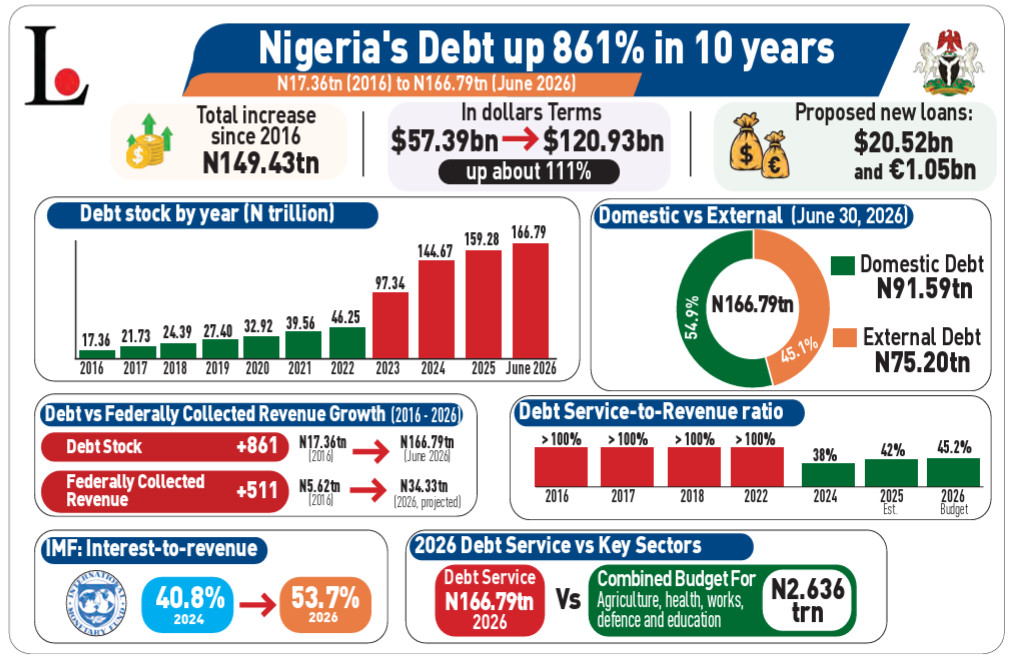
Data from the Debt Management Office (DMO) showed that Nigeria’s total public debt stock increased from N17.36 trillion in 2016 to N166.79 trillion as of June 30, 2026, as increased borrowing, currency depreciation, and rising debt-servicing obligations continued to constrain the country’s fiscal space. This represented an increase of 861 per cent in the last 10 years.
This showed that the country accumulated an additional N149.43 trillion in debt stock between 2016 and the first half of 2026, a position analysts say is becoming unsustainable given the country’s debt-servicing costs.
By this increase, debt per Nigerian has risen from about N88,800 in 2016 to about N716,800 in 2026, an increase of about N628,000, or roughly 707 per cent, within the 10 years.
For many households, the figures are not abstract statistics. They reflect a reality in which public resources that could have funded better hospitals, schools, roads and jobs are increasingly committed to servicing debt.
The 2026 figure is based on the World Bank’s latest population estimate for Nigeria of 232,679,478, while the 2016 figure is based on an estimated population of about 195.4 million.
Professor of Economics and Business Intelligence at Lagos Business School, Bongo Adi, said the burden was being shifted to citizens and the next generation.
“You are taxing people, squeezing them, and then you are also borrowing on their behalf. You are putting the burden of debt on future generations. That is quite inconsiderate, and they haven’t come out to explain what is going on or what they are using the money for,” he said.
Other analysts raised similar concerns. Professor of Law and developmental economist, Tayo Bello, warned that without adequate accountability, the increasing debt burden could amount to transferring fiscal obligations to future generations, while Head of Financial Institutions Ratings at Agusto & Co, Ayokunle Olubunmi, said borrowing without clear returns “creates more debt for future generations.”
The increase represents an additional N149.43 trillion in the country’s debt stock between 2016 and the first half of 2026, as increased borrowing, currency depreciation, and rising debt-servicing obligations continue to constrain the country’s fiscal space.
The rising debt profile comes amid fresh plans by President Bola Tinubu to secure additional external loans of $20.52 billion and €1.05 billion for the 2026 and 2027 development plans, a move that has renewed concerns among economic analysts about the country’s capacity to sustain further borrowing without worsening its debt service burden.
An analysis of the debt figures shows that Nigeria’s total public debt, according to data from the Debt Management Office (DMO), rose from N17.36 trillion in 2016 to N21.73 trillion in 2017, then to N24.39 trillion in 2018 and N27.40 trillion in 2019.
The debt stock further increased to N32.92 trillion in 2020, N39.56 trillion in 2021 and N46.25 trillion in 2022. However, the pace of accumulation accelerated significantly in 2023 when total debt jumped to N97.34 trillion from N46.25 trillion in the preceding year, representing an increase of 110.5 per cent.
The upward movement continued in 2024, with the debt stock rising to N144.67 trillion, representing a 48.6 per cent increase, before reaching N159.28 trillion in 2025. By June 30, 2026, Nigeria’s total debt had increased further to N166.79 trillion.
Nigeria’s public debt accelerated sharply from 2022, driven by fresh domestic and external borrowing, the securitisation of the Central Bank of Nigeria’s (CBN) Ways and Means Advances and the depreciation of the naira. The 110.5 per cent increase recorded in 2023, from N46.25 trillion to N97.34 trillion, was largely influenced by the conversion of about N22.72 trillion in outstanding CBN advances into government securities.
This brought previously accumulated liabilities into the officially recognised debt stock, rather than representing entirely new borrowing. Naira depreciation following the June 2023 foreign exchange reforms also increased the domestic-currency value of existing external debt. The trend continued in 2024, when public debt rose by 48.6 per cent to approximately N144.67 trillion, reflecting further exchange-rate effects, additional borrowing and the recognition of existing obligations.
In dollar terms, the country’s total debt increased from $57.39 billion in 2016 to $120.93 billion as at June 2026, representing an increase of approximately 111 per cent.
According to the DMO data, domestic debt as at June 30, 2026, stood at N91.59 trillion, equivalent to $66.41 billion or 54.9 per cent of the total debt, while external debt was N75.20 trillion, equivalent to $54.52 billion or 45.1 per cent. This compares with 2016, when domestic obligations accounted for more than 60 per cent of the total debt.
The increasing debt burden has intensified concerns about the country’s ability to meet its financial obligations without further constraining resources available for infrastructure, social services and other development priorities.
The rapid accumulation of debt has significantly outpaced revenue growth. While gross federally collected revenue increased from approximately N5.62 trillion in 2016 to the Federal Government’s 2026 revenue projection of N34.33 trillion, an indicative rise of about 511 per cent, public debt increased by 861 per cent, from N17.36 trillion to N166.79 trillion as of June 2026. This widening gap highlights Nigeria’s weak revenue-generating capacity and growing dependence on borrowing.
The pressure is particularly evident in debt servicing. World Bank data show that the debt service-to-revenue ratio exceeded 100 per cent in 2016, 2017, 2018 and 2022, before falling to 38 per cent in 2024. It is estimated at 42 per cent for 2025, while the 2026 budget projects debt servicing of N15.52 trillion against revenue of N34.33 trillion, approximately 45.2 per cent.
Separately, the IMF estimates that interest payments alone will consume 53.7 per cent of Federal Government revenue in 2026, compared with 40.8 per cent in 2024. Interest payments represent the cost of borrowing, while total debt servicing includes both interest and principal repayments.
Chief Executive of CFG Advisory, Tilewa Adebajo, said Nigeria’s rising debt profile was raising serious sustainability concerns, particularly as the government continued to borrow to finance recurrent expenditure and debt servicing instead of directing sufficient resources towards capital investment.
He projected that debt servicing would reach N16 trillion by the end of 2026, an amount exceeding the combined N12.636 trillion budgetary allocation for agriculture, health, works, defence and education.
Adebajo also projected that Nigeria’s external debt could reach $60 billion, while domestic debt would exceed N100 trillion by the end of 2026. He said the growing dependence on borrowing to meet recurrent obligations, pay salaries and service existing debt was becoming a major concern for fiscal sustainability.
More importantly, he argued that the rising debt burden could undermine the gains expected from the government’s economic reforms and limit the economy’s capacity to achieve inclusive growth.
In response to the proposed additional borrowing of more than $20 billion, the CFG Advisory Chief recommended an urgent compliance audit of the Fiscal Responsibility Act 2007, alongside the updating and publication of outstanding budget performance reports to establish a clearer picture of the Federal Government’s true fiscal position.
For Professor of Economics and Business Intelligence at Lagos Business School, Bongo Adi, Nigeria’s debt sustainability challenge is not necessarily reflected in its debt-to-Gross Domestic Product ratio but in the country’s capacity to generate sufficient revenue to service its obligations.
He argued that although Nigeria might still have some borrowing headroom when measured against its GDP, the debt service-to-revenue ratio was already excessively high and could exceed 100 per cent if additional borrowing was undertaken.
Adi noted that if the new borrowing planned by the president is added to the country’s debt stock, “everything the country is earning will be used to service debt. I think that’s where the challenge is.”
Questioning the rationale for additional borrowing at a time when the government had removed fuel subsidy, introduced tax reforms and reportedly increased revenue collection, Adi stressed the need for the government to explain why additional borrowing remained necessary despite the increased tax burden on individuals and businesses and the savings arising from the removal of fuel subsidy.
“You are taxing people, squeezing them, and then you are also borrowing on their behalf. You are putting the burden of debt on future generations. That is quite inconsiderate, and they haven’t come out to explain what is going on or what they are using the money for.”
Warning that additional borrowing could put pressure on inflation and the exchange rate if the funds were not matched by corresponding increases in productive capacity, he explained that borrowing without a corresponding increase in goods and services could increase the volume of money in circulation, putting pressure on prices and ultimately on the exchange rate.
Professor of Law and developmental economist, Tayo Bello, on his part, said although borrowing remained necessary for government to finance development projects, the increasing dependence on external loans could deepen the country’s fiscal vulnerability.
Bello warned that additional obligations would increase debt-servicing requirements and consume a larger share of national revenue, expressing concern about the country’s appetite for foreign-currency borrowing.
According to him, excessive reliance on foreign-currency borrowing could put pressure on Nigeria’s foreign exchange reserves, particularly when the naira depreciates.
“When you rely heavily on foreign currency-denominated loans, that becomes a problem because you have to service those loans with foreign currency, and the pressure on the country’s foreign exchange reserves will be too much.”
Bello further questioned the level of transparency surrounding the country’s debt stock and the utilisation of borrowed funds, insisting that the government needed to provide Nigerians with a clear account of its total indebtedness and the projects financed with the loans.
He warned that without adequate accountability; the increasing debt burden could amount to transferring fiscal obligations to future generations.
Meanwhile, Head of Financial Institutions Ratings at Agusto & Co, Ayokunle Olubunmi, said the increasing borrowing reflected the government’s difficulty in meeting its revenue targets. He explained that when government revenue falls short of expectations, the available options are to borrow more or sell assets to bridge the financing gap.
However, he cautioned that the country must ensure that additional borrowing does not reverse the gains already achieved through economic reforms. Olubunmi said the major concern was not necessarily the decision to borrow but the efficiency with which borrowed funds were deployed and the returns generated from such investments.
“The truth is that, in terms of the borrowing we have undertaken, you don’t really have much to show in terms of efficiency and the ability to deliver. You can’t even understand how much you owe,” he said, adding that the growing cost of interest payments raised questions about the value Nigeria was deriving from its borrowing activities.
“I think that creates more debt for future generations. For instance, they say that interest paid on borrowing exceeds government revenue. The question is: what are those borrowings being used for? Are we getting the best out of those borrowings? Those are the questions we have.”
According to him, borrowing is not inherently harmful to an economy, but the country’s ability to generate measurable economic returns from the resources raised remains critical. He argued that Nigeria should be getting better value from its borrowing when compared with the cost of financing similar projects in other countries.
The proposed additional external borrowing of $20.52 billion and €1.05 billion raises further questions about debt sustainability. Although the government says the loans will finance infrastructure, agriculture, healthcare, education and other productive sectors, their justification will depend on transparent project allocations, borrowing costs, repayment periods and measurable economic returns. Naira depreciation could further increase the domestic-currency cost of servicing foreign-denominated debt, while heavy domestic borrowing risks raising interest rates and restricting private-sector access to credit.
To reduce the pressure on public borrowing, Prof Bello called for greater use of public-private partnerships (PPPs) to finance major infrastructure projects, particularly roads and railways. He argued that the government should not shoulder the entire cost of large infrastructure projects through borrowing, when private investors and multinational companies could participate in their financing and recover their investments through agreed-upon concession arrangements.
He also recommended that government explore the domestic money market, treasury bills, bonds and the capital market as alternative sources of financing, while ensuring that borrowing remained within the country’s repayment capacity.
Bello, however, acknowledged that borrowing would remain necessary for the present administration, given the scale of Nigeria’s development financing requirements.
“The government would definitely borrow. But my recommendation regarding the borrowing pattern is based on the country’s borrowing capacity. Nigeria has a wide capacity to repay any loan it borrows if the money is utilised judiciously. But that does not mean the government should put everything together.”
Beyond the size of the debt, analysts said attention must also focus on how borrowed funds are utilised and the returns they generate. They added that a project-by-project assessment of investments in roads, railways, electricity, agriculture and industry is necessary to establish whether borrowing has improved productivity, employment, exports and government revenue.
According to them, ultimately, Nigeria’s debt sustainability will depend not simply on its ability to secure more loans, but on its capacity to generate sufficient revenue to repay them and that improved tax and non-oil revenue mobilisation, expenditure discipline, transparency and productive investment will be critical to preventing rising debt obligations from further constraining development spending and shifting an unsustainable financial burden to future generations.
We’ve got the edge. Get real-time reports, breaking scoops, and exclusive angles delivered straight to your phone. Don’t settle for stale news. Join LEADERSHIP NEWS on WhatsApp for 24/7 updates →
Join Our WhatsApp Channel