Economists and financial analysts have questioned President Bola Tinubu’s request for approval to borrow an additional $7.707 billion externally, demanding details of how the funds will be spent and warning that the facility could expose Nigeria to exchange-rate risks and impose a heavier debt burden on taxpayers and future generations.
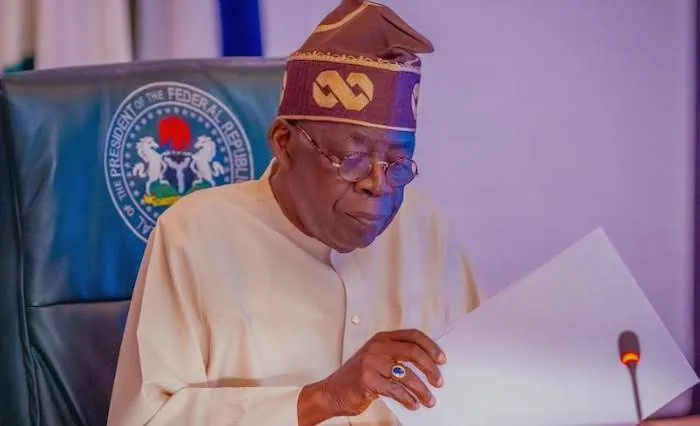
LEADERSHIP reports that Tinubu has formally withdrawn the previous external borrowing request of $20.5 billion and replaced it with a fresh proposal seeking approval for $7.707 billion to finance the national deficit and infrastructure.
In a letter read by Senate President Godswill Akpabio, the President explained that the newly submitted request of $7,707,404,882.49 effectively superseded the earlier $20.5 billion proposal.
In the letter to the National Assembly dated October 26, 2026, Tinubu sought approval for the loan to support the implementation of the 2026 Appropriation Act and finance priority sectors, including defence and security, transportation, agriculture, power, education and healthcare.
However, the experts said the government had not provided sufficient project-by-project details showing how much would be allocated to infrastructure, deficit financing and other expenditure. They also raised concerns about debt sustainability, the cost of servicing foreign loans and Nigeria’s capacity to generate enough revenue to meet its growing obligations.
At the budget exchange rate of N1,400 to the dollar, the proposed borrowing translates to approximately N10.79 trillion, a substantial addition to the country’s obligations at a time when debt servicing already consumes a significant share of government revenue.
Debt Servicing Raises Sustainability Concerns
Assessing the sustainability of the proposed loan, Professor of Economics and Business Intelligence at Lagos Business School, Prof Bongo Adi, said Nigeria’s debt-to-GDP ratio might suggest that the country still had borrowing capacity, but the more critical concern was its debt-service-to-revenue ratio.
According to him, the proportion of government revenue committed to debt servicing was already extremely high and could exceed 100 per cent if additional borrowing obligations were added.
“The real challenge we have today is that the debt service to revenue ratio is extremely high. If we add this one, I am sure it is going to cross 100 per cent, meaning that everything the country is earning will be used to service debt. I think that’s where the challenge is,” he said.
Adi argued that debt-to-revenue was a more important measure of sustainability than debt-to-GDP, warning that Nigeria had already exceeded a comfortable borrowing threshold.
Similarly, the Chief Executive of CFG Advisory, Tilewa Adebajo, warned that rising deficits and increasing borrowing to finance recurrent expenditure and debt servicing raised serious concerns about the country’s fiscal sustainability.
He projected that debt servicing could reach N16 trillion by the end of 2026, exceeding the combined 2026 budgetary allocations of N12.636 trillion for agriculture, health, works, defence and education.
Adebajo expressed concern that borrowing was increasingly being used to fund salaries, recurrent expenditure and existing debt obligations rather than capital projects.
“The levels of debt in the capital structure of the FGN is becoming a threat to consolidation on reform gains and inclusive growth,” he said.
The head of Financial Institutions Ratings at Agusto & Co, Ayokunle Olubunmi, also questioned the efficiency of government borrowing, saying Nigeria had not demonstrated sufficient returns from previous loans.
“Borrowing is not bad, but from what we see, it doesn’t really feel as if we have been efficient in using those borrowings. If you compare the cost of what we are using with that of other countries, we should be getting better results from the borrowing we are undertaking,” he said.
Cost Of Borrowing Could Exceed $13bn
Beyond the government’s intention to raise additional funds, the proposed facility raises questions about the eventual repayment cost, the projects it will finance and whether the expected economic returns will justify the financial burden.
Nigeria’s previous Eurobond issuances provide an indication of the relatively high interest rates the country has had to pay to attract international investors.
In March 2022, Nigeria raised funds through a seven-year Eurobond at an interest rate of 8.375 per cent. In December 2024, it raised $2.2 billion through two tranches carrying interest rates of 9.625 per cent and 10.375 per cent.
The country returned to the international capital market in November 2025, issuing a 10-year Eurobond at 8.63 per cent and a 20-year instrument at 9.13 per cent.
Using these rates as illustrative benchmarks, borrowing the entire $7.707 billion at 8.63 per cent would translate into annual interest payments of approximately $665.15 million. At 9.13 per cent, the annual interest obligation would rise to about $703.69 million.
Over 10 years, this would amount to between $6.65 billion and $7.04 billion in interest payments alone, assuming the entire principal remained outstanding throughout the period.
These figures are illustrative, not the confirmed terms of the proposed facility. The government has indicated that the final interest rates and maturities will depend on prevailing international market conditions at the time of pricing.
The actual cost would also include underwriting and arrangement fees, legal and financial advisory expenses, credit rating charges, listing costs and other transaction expenses.
The repayment structure is another important consideration. If the facility is raised through Eurobonds with a bullet repayment arrangement, Nigeria could be required to pay periodic interest throughout the maturity period before settling the entire principal when the bonds fall due.
This could create significant refinancing pressure if the country fails to accumulate sufficient foreign exchange to meet the obligation at maturity.
An amortised repayment structure, on the other hand, would allow the government to repay portions of the principal alongside interest over an agreed period, spreading the financial burden.
For instance, if the entire $7.707 billion were borrowed for 10 years at eight per cent, with annual interest payments and the principal repaid at maturity, Nigeria would pay approximately $616.56 million annually in interest.
Cumulative interest over the period would reach about $6.17 billion, bringing the total principal and interest obligation to approximately $13.87 billion, excluding fees and other charges.
Questions Over Utilisation Of Funds
Beyond the cost of borrowing, questions have emerged over how the proposed funds will be utilised.
Although the government has identified six priority sectors, it has not provided sufficient project-by-project details showing how much will go to infrastructure, budget deficit financing and other government expenditure.
The central issue is whether the borrowing will finance productive investments capable of generating economic returns or largely support general government expenditure without creating corresponding revenue-generating assets.
The government is expected to provide details of the projects to be financed, their locations, contract values, implementing ministries and agencies, expected completion dates and the specific amounts to be disbursed.
It must also clarify whether any portion will be used to finance recurrent expenditure, settle outstanding obligations or refinance existing debts.
Naira Depreciation Could Increase Repayment Cost
The ability to generate foreign exchange is equally important because the proposed facility is denominated in dollars. Any depreciation of the naira would increase its repayment cost in local currency.
For instance, a 15 to 20 per cent depreciation from the budget exchange-rate assumption of N1,400 to the dollar would increase the naira equivalent of the full $7.707 billion principal from approximately N10.79 trillion to between N12.41 trillion and N12.95 trillion.
This represents an additional N1.62 trillion to N2.16 trillion before interest and other charges. The actual additional liability would depend on the amount outstanding and the exchange rate prevailing when repayments are made.
Professor of Law and developmental economist, Prof Tayo Bello, warned that reliance on foreign currency-denominated borrowing would expose the country to additional pressure on its foreign exchange reserves.
“When you rely heavily on foreign currency denominated loans, that becomes a problem because you have to service those loans with foreign currency, and the pressure on the country’s foreign exchange reserves will be too much,” he said.
Bello added that the value of the naira was an important consideration in determining the eventual cost of servicing external debt.
“The more the naira loses value, the greater the burden of servicing foreign currency denominated loans,” he said.
Adi also warned that additional borrowing could put further pressure on the naira, arguing that borrowing without a corresponding increase in the production of goods and services could fuel inflation and weaken the exchange rate.
“Whenever you borrow money, what does it mean? You borrow money that you don’t have, and you are not matching it with goods and services. So, that is the nominal. It creates inflation, and once inflation goes up, your exchange rate is nudged up as well,” he said.
Nigeria’s dependence on crude oil exports further complicates the foreign exchange outlook. Although the country earns foreign exchange from oil and gas exports, non-oil exports, diaspora remittances and foreign investments, fluctuations in oil prices, production disruptions and changes in capital flows could affect the stability of these earnings.
Recent improvements in external reserves and the current account position provide some relief. However, the government must demonstrate that projected foreign exchange earnings will be sufficient to meet existing and proposed external debt obligations without putting additional pressure on reserves and the naira.
Higher Revenue, But More Borrowing?
Adi also questioned the rationale for additional borrowing despite increased tax collections and savings from the removal of fuel subsidy.
He argued that the government needed to explain why it was seeking more loans despite claims of improved revenue generation and higher oil earnings.
“You are taxing people, squeezing them, and then you are also borrowing on their behalf. You are putting the burden of debt on future generations. That is quite inconsiderate, and they haven’t come out to explain what is going on or what they are using the money for,” he said.
Following reforms in the Nigerian tax system, the Nigeria Revenue Service said tax collections had surged by 113 per cent, rising from N12.3 trillion in 2023 to N27.1 trillion as of July 2026.
The fiscal implications are also significant. Nigeria’s 2026 budget provides for expenditure of approximately N68.32 trillion against projected revenue of N36.87 trillion, leaving a deficit of about N31.46 trillion.
Although the Federal Government has identified borrowing as a major source of deficit financing, questions remain about actual revenue performance and the extent to which additional borrowing is necessary.
The Federal Ministry of Finance indicated that the Nigeria Revenue Service generated approximately N28.3 trillion in 2025 against a target of N25.2 trillion. However, aggregate revenue collections do not automatically translate into equivalent revenue available to the Federal Government because revenues are shared among the three tiers of government.
The International Monetary Fund has also projected Federal Government interest payments at approximately 53.7 per cent of revenue in 2026, highlighting the pressure existing debt obligations already place on public finances.
This means a substantial proportion of government revenue could be committed to interest payments, leaving limited fiscal space for infrastructure, healthcare, education, security and other essential public services.
Future Generations Face Heavier Burden
The long-term implications of additional borrowing for taxpayers and future generations have also become a major concern among analysts.
Adi warned that continued borrowing would transfer a heavier financial burden to future generations, particularly when the government had not adequately explained the purpose of the loans and their expected returns.
Olubunmi also cautioned that rising debt obligations could create additional liabilities for future generations, especially if the funds were not deployed efficiently.
Bello urged the government to consider alternative financing arrangements, including public-private partnerships, rather than relying excessively on public borrowing to finance large infrastructure projects.
He, however, acknowledged that borrowing remained necessary for government operations, stressing that the critical issues were whether loans were consistent with the country’s repayment capacity and deployed judiciously.
Meanwhile, borrowing externally rather than relying entirely on domestic financing could reduce competition between the government and private businesses for available credit. However, this potential benefit must be weighed against foreign exchange exposure, international interest rates and refinancing risks.
To protect public resources, the National Assembly and the Debt Management Office must ensure that the borrowing is supported by transparent disbursement arrangements, independent audits, procurement safeguards and periodic reports showing how the funds are being utilised.
Adebajo also called for an urgent compliance audit of the Fiscal Responsibility Act 2007 and the publication of outstanding budget performance reports to provide a clearer picture of the Federal Government’s actual fiscal position.
Ultimately, the economic justification for the proposed $7.707 billion borrowing will depend on whether the funds generate measurable returns through infrastructure development, employment creation, higher productivity, increased exports and improved government revenue.
For Nigerians, the central question is not simply how much the Federal Government can borrow, but how much taxpayers will eventually have to repay, what tangible economic benefits the country will receive and whether future generations will inherit productive assets or a heavier debt burden.
The government must therefore demonstrate that the proposed borrowing is affordable, economically justified and supported by a credible repayment strategy that reduces Nigeria’s vulnerability to exchange-rate shocks and excessive dependence on fresh loźźźans.
We’ve got the edge. Get real-time reports, breaking scoops, and exclusive angles delivered straight to your phone. Don’t settle for stale news. Join LEADERSHIP NEWS on WhatsApp for 24/7 updates →
Join Our WhatsApp Channel