
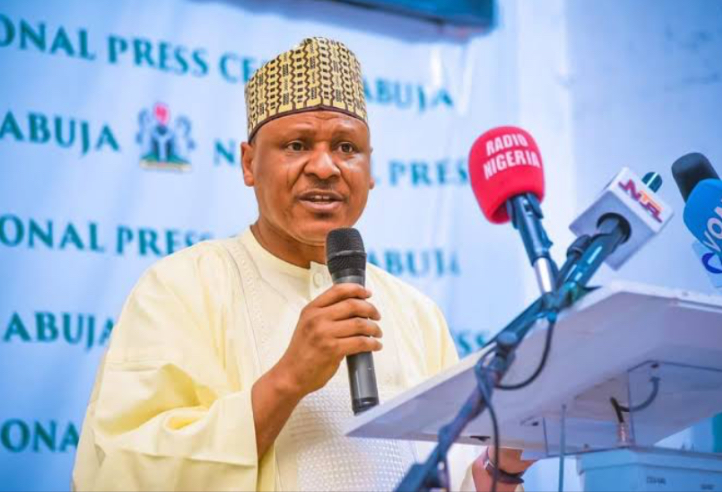
The Minister of Information and National Orientation, Mohammed Idris, has said the economic and institutional reforms introduced by President Bola Tinubu’s administration are benefiting Nigerians across different social and economic backgrounds.
Idris said the reforms were laying the foundation for national prosperity, insisting that their benefits were not restricted to members of the ruling All Progressives Congress (APC) or wealthy Nigerians.
The minister spoke at a media pre-sensitisation ahead of the official launch of the APC manifesto for the 2027 presidential election.
He cited ongoing road projects, improved security, student loans, declining inflation and improved international confidence in Nigeria’s economy as evidence of the impact of the administration’s policies.
Addressing concerns that only a few Nigerians were benefiting from the reforms, Idris said public infrastructure projects were accessible to everyone, irrespective of political affiliation or economic status.
“When the road between Abuja to Kano is being put together, I’m not aware that anybody needs to show his ID card that he needs to belong to the APC or he is a rich man or he belongs to a particular class before he plies it,” he said.
On security, the minister recalled the insecurity that previously characterised the Abuja-Kaduna highway, saying travellers can now use the road without constantly worrying about attacks by bandits and kidnappers.
He said the improved security situation was evidence of the government’s efforts to address the country’s security challenges.
Idris also cited the Nigerian Education Loan Fund (NELFUND), which he said had provided support to about 1.6 million students, as another example of how the reforms were improving the lives of ordinary Nigerians.
He explained that the student loan scheme was designed to ensure that qualified young Nigerians were not denied access to higher education because of their parents’ inability to pay tuition fees and other expenses.
“What President Bola Ahmed Tinubu sought to say is that there is no reason why any young man or woman who has the credentials to go to school, who indeed has made it to get admission to any higher institution, is unable to do that simply on account of the inability of his parent or guardian to pay for not just his tuition, but also for his upkeep,” he said.
The minister added that beneficiaries did not need to belong to the APC or come from wealthy families to access the government-supported scheme.
On the economy, Idris said Nigeria’s removal from the Financial Action Task Force (FATF) grey list had strengthened the country’s international standing and ability to conduct business with the rest of the world.
He also cited improved ratings by international agencies, including Fitch, Moody’s and Standard and Poor’s, as signs of growing confidence in the Nigerian economy.
According to him, inflation, including food inflation, is declining, while the country’s Gross Domestic Product (GDP) is recording growth.
Idris recalled that foreign airlines and other investors previously experienced difficulties repatriating funds from Nigeria, but said the Tinubu administration had addressed the challenge by providing assurances that investors could transfer their funds through legitimate channels.
“These are all examples. When people say that, ‘Yes, reforms are working, but we don’t know who is benefiting,’ and I say every Nigerian is benefiting,” he said.
He maintained that the administration had laid the foundation for economic reforms and was gradually moving the country towards prosperity.
The minister also stressed the importance of leadership in driving national development, saying the prosperity of any society depended largely on the policies and reforms introduced by its leaders.
Addressing journalists, Idris urged the media to balance criticism of government policies with the responsibility to report positive developments in the country.
He acknowledged that holding government accountable and pointing out areas requiring improvement were important responsibilities of journalists.
However, he argued that good journalism should not be defined solely by adversarial reporting.
“It is important to criticise, it is important to point out areas of correction for any government. Indeed, that is your role as a journalist. But it is also important that you know that it is not only when you are adversarial that you can lay claim to good journalism or good media. If you see anything good, please also say it,” he said.
Idris urged Nigerians to distinguish between criticism of government officials and negative portrayals of the country, insisting that citizens should remain united in promoting Nigeria’s image.
“You don’t have to like the administration of President Bola Ahmed Tinubu. You don’t have to like it. But all of us must like Nigeria. We love our country,” he said.
He cited his recent visit to Istanbul, Turkey, where he said citizens criticised their leaders but remained united in defending their country’s image.
The minister called on Nigerians to support the administration’s reform agenda, expressing optimism that the country would record greater prosperity in the coming years.
He said the Tinubu administration was progressively moving Nigeria towards that goal and urged citizens to give the government another four years to deliver on its promises.
We’ve got the edge. Get real-time reports, breaking scoops, and exclusive angles delivered straight to your phone. Don’t settle for stale news. Join LEADERSHIP NEWS on WhatsApp for 24/7 updates →
Join Our WhatsApp Channel