
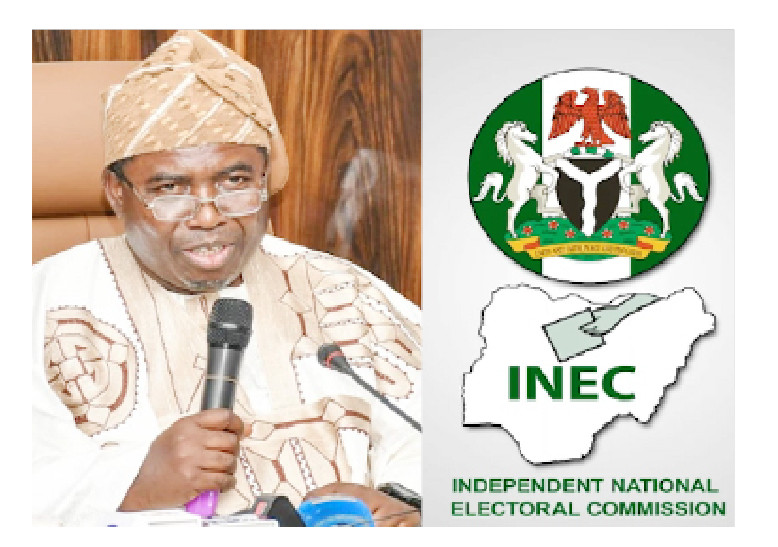
The Independent National Electoral Commission (INEC) has come under fresh criticism from the African Democratic Congress (ADC), which accused the electoral umpire of overstepping its constitutional boundaries in its handling of the party’s internal affairs.
The party was reacting to comments made by the INEC Chairman, Joash Amupitan, during an interview on ARISE NEWS on Friday morning, where he warned the ADC against proceeding with its congresses and national convention, citing possible violations of existing court orders.
However, in a swift response issued by its National Publicity Secretary, Bolaji Abdullahi, the ADC dismissed the warning and insisted it would go ahead with its planned activities.
The party described INEC’s position as a “wilful distortion” of the Court of Appeal’s directive to maintain the status quo, arguing that such interpretation amounts to contempt of court.
According to the statement, INEC has gone beyond its supervisory role by attempting to halt lawful internal party processes.
The ADC maintained that internal disputes do not suspend democratic functions and reaffirmed its commitment to proceed in full compliance with the law.
“ADC finds it necessary to respond in order to correct several legal and factual misrepresentations. While the Commission seeks to present its position as one anchored in law and neutrality, the substance of the Chairman’s statements reveals a fundamental misapplication of both constitutional principles and judicial directives,” the statement read.
The party further argued that the Chairman’s repeated reference to Nigeria’s multi-party constitutional order was a deflection from the real issue.
“The question before Nigerians is not whether the country remains a multi-party state in theory, but whether INEC’s actions in practice are undermining the ability of opposition parties to freely organise and function.
“The ADC has not alleged the abolition of multi-party democracy in form; rather, it has raised concerns about actions that, in effect, weaken it. The Chairman’s reliance on the existence of multiple parties as proof of neutrality does not address the specific conduct under scrutiny.”
On the Court of Appeal’s order, Abdullahi faulted the Chairman’s reliance on the doctrine of status quo ante bellum, saying the interpretation was selective and legally flawed.
“The preservation order is intended to prevent actions that would irreversibly alter the subject matter of litigation, not to paralyze the internal functioning of a political party.
“The Chairman’s attempt to define the ‘status quo’ by tracing the controversy to internal party developments in July 2025 is an administrative interpretation that INEC is not empowered to make. That determination lies strictly within the jurisdiction of the courts.”
The ADC also rejected the claim that holding congresses or a convention would render ongoing legal proceedings nugatory, describing the position as an overreach.
“Internal party processes conducted in line with the party’s constitution and the Electoral Act do not extinguish or prejudice pending judicial proceedings. Democratic continuity within a political party is presumed under the law unless expressly restrained by a competent court.
“No such explicit order prohibiting congresses or conventions has been cited. What exists are general preservation directives, which cannot be expanded into a blanket prohibition on party governance.”
The statement emphasised that INEC’s role is not to arbitrate disputes or freeze party activities but to maintain neutrality and allow due process to run its course.
It also dismissed comparisons with past judicial precedents such as the Zamfara case, describing them as misplaced.
“Those cases involved clear failures to comply with mandatory legal requirements for primaries. In contrast, the ADC has demonstrated its commitment to conducting its processes in strict accordance with its constitution and the Electoral Act.
“Pre-emptively warning of hypothetical judicial consequences amounts to speculation and cannot serve as a legal basis to restrict lawful party activities.”
The party further argued that INEC’s justification, avoiding potential future judicial invalidation of elections, does not excuse what it described as present administrative overreach.
“The law does not permit administrative bodies to curtail constitutional rights based on speculative future outcomes. The proper course is to allow parties to act within the law and for the courts to adjudicate disputes as they arise.”
In conclusion, the ADC reaffirmed its constitutional right to organise congresses and hold its national convention, insisting that no court has lawfully suspended those activities.
“The interpretation advanced by the INEC Chairman stretches judicial directives beyond their meaning and risks setting a dangerous precedent where regulatory caution becomes a tool for democratic suppression.
“The ADC will therefore proceed with its activities in full compliance with the law and urges INEC to confine itself strictly to its constitutional and statutory mandate.”
We’ve got the edge. Get real-time reports, breaking scoops, and exclusive angles delivered straight to your phone. Don’t settle for stale news. Join LEADERSHIP NEWS on WhatsApp for 24/7 updates →
Join Our WhatsApp Channel