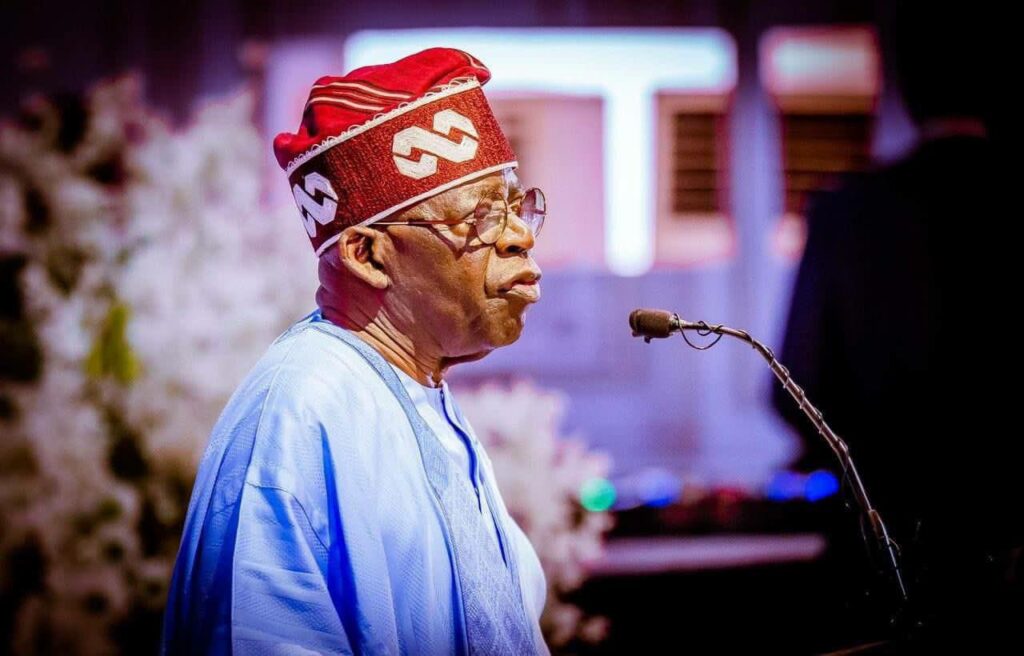
President Bola Ahmed Tinubu has called on African nations to urgently transform their vast natural resources into industrial strength, warning that the continent must stop exporting raw wealth and importing poverty.
The president made this call during his speech at the opening ceremony of the fifth edition of the African Natural Resources and Energy Investment Summit (AFNIS) held at the Presidential Banquet Hall in Abuja, where African leaders, investors, and development partners gathered under the theme “One Africa, One Resource Vision.”
“Africa must turn wealth into power”
In the presidential address, Tinubu, who was represented by the Minister of Solid Minerals Development, Dr Dele Alake, said Africa’s natural endowments—ranging from gold, lithium, cobalt, iron ore, copper, and rare earth elements- must no longer remain symbols of potential, but drivers of prosperity.
“We have been called resource-rich, strategic, and indispensable but the question before us is whether Africa will finally turn its wealth into power—power for our roads, industries, young people, and economies,” he said.
Tinubu warned that Africa’s historic role as a raw material supplier must end.
“That era is over. Africa will no longer export the future in raw form and import it in finished form,” Tinubu declared. “We must build value chains, train our engineers, and ensure that wealth taken from African soil creates prosperity on African soil.”
Call for unity: “One Africa, one vision”
The President stressed that Africa’s fragmented approach to development must give way to coordinated action across borders.
“Our template breaks negotiation from isolated positions,” he said. “Africa must think together, plan together, build together, and rise together.”
He added that the African Continental Free Trade Area (AfCFTA) must move from policy to practical impact.
“We cannot build strong economies if we trade more with distant partners than with ourselves,” he said. “One Africa, one resource vision is not a slogan—it is a declaration of intent.”
Tinubu also highlighted energy as the backbone of Africa’s industrial future, warning that no modern economy can grow without reliable power.
“We cannot industrialise without electricity. We cannot create modern jobs without energy,” he said.
He called for a “just and balanced energy transition” that recognises Africa’s developmental needs while embracing renewables.
Addressing global investors, Tinubu insisted that Africa welcomes only responsible and value-creating capital.
“African governments are open for serious business,” he said. “But we welcome investments that build industries, create jobs, transfer technology, and respect our communities.”
He warned against extractive models that leave host nations poorer.
“The future will not belong to those who extract the most, but to those who create the most value,” he said.
Reforms Have Yielded Fruit – Alake
In his own address, the minister of solid minerals development, Dr. Dele Alake, highlighted Nigeria’s ongoing reforms in the solid minerals sector, describing them as part of a broader strategy to reposition the country as a global mining destination.
He noted that from N6bn annual income from the solid minerals sector in 2023 when President Tinubu assumed office, the bold reforms of his administration had catapulted earned revenue to N38bn in 2025 and N70bn in 2025.
He said the government had revoked over 10,000 dormant mining titles to eliminate speculation and attract serious investors.
“We are restoring discipline to the sector,” Alake said. “Nigeria will no longer tolerate idle mineral assets.”
He disclosed rising investments in lithium and other strategic minerals, including projects worth hundreds of millions of dollars across several states, as well as new geological discoveries of gold, copper, nickel, and rare earth deposits.
According to him, these developments position Nigeria for what he described as a “new geological and industrial future.”
On his part, the Secretary-General of the Africa Minerals Strategy Group (AMSG), Moses Micheal Engadu, reinforced the call for continental unity, likening Africa to a baobab tree whose strength lies beneath the surface.
He urged African nations to shift from exporting raw materials to shaping global supply chains.
“Let us not merely export resources,” he said. “Let us export value, create industries, and define the future of global minerals markets.”
The event is being attended by Ministers and other officials from African countries such as the DR Congo, South Sudan, Somalia, and Liberia.
Similarly, both local and foreign firms are in attendance at the summit.
We’ve got the edge. Get real-time reports, breaking scoops, and exclusive angles delivered straight to your phone. Don’t settle for stale news. Join LEADERSHIP NEWS on WhatsApp for 24/7 updates →
Join Our WhatsApp Channel