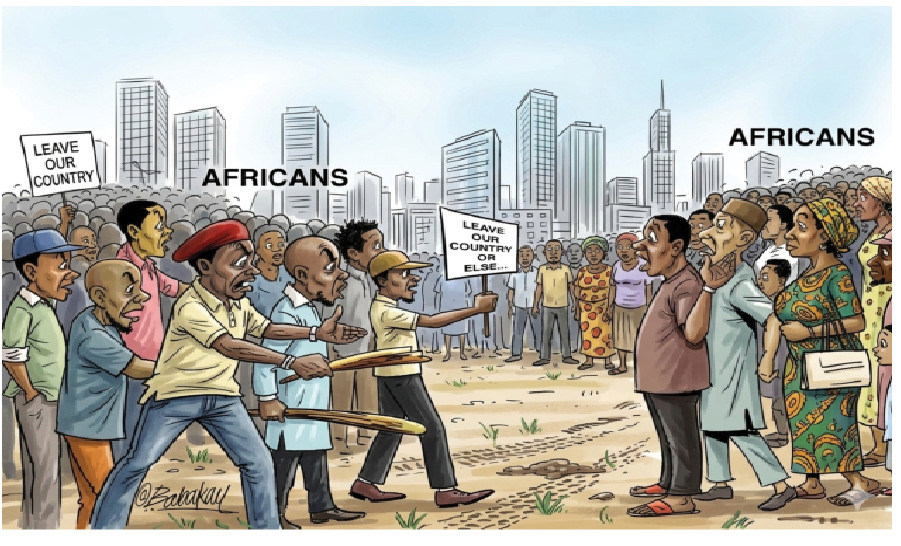
For a continent that proudly sings the anthem of Pan-Africanism, Africa is increasingly becoming hostile to Africans themselves. From the streets of Johannesburg to troubling incidents in Ghana, Kenya, Libya, Tunisia and counting, a dangerous tide of xenophobia is sweeping across the continent. Africans are turning against fellow Africans with alarming bitterness, violence, intimidation and exclusion. What once appeared as isolated incidents is now evolving into a troubling continental culture.
In recent weeks, diplomatic tensions have risen between Ghana and South Africa following reports and videos of Ghanaians and other African migrants being harassed in South Africa. Ghana summoned South Africa’s envoy over what it described as disturbing xenophobic incidents against its citizens. South African authorities themselves acknowledged the rise in anti-immigrant violence and promised crackdowns on perpetrators.
The Rise of a Dangerous Continental Culture
Yet perhaps the most disturbing development is that xenophobia is no longer confined to South Africa. Ghana itself — a country historically celebrated for Pan-Africanism and hospitality — has recently witnessed disturbing rhetoric targeting Nigerians. Videos and social media campaigns emerged in which some Ghanaians threatened Nigerians and demanded they leave the country. Reports of harassment and inflammatory language exposed an uncomfortable truth: the xenophobic bug is spreading.
South Africa may be the most visible theatre of this crisis, but it is certainly not the only one.
Across North Africa, migrants from sub-Saharan Africa have faced racial attacks, arbitrary detention and even slave-market conditions over the past decade. In parts of West Africa, resentment against foreign traders periodically erupts into hostility. In East Africa, political rhetoric increasingly blames outsiders for economic hardship. Even online spaces have become toxic battlegrounds where Africans attack one another based on nationality, language or ethnicity.
The painful irony is impossible to ignore: Africans who suffered centuries of slavery, colonialism, apartheid and racism are now reproducing similar patterns among themselves.
The contradiction is even deeper when one considers Africa’s liberation history. During apartheid, several African countries hosted South African exiles, funded liberation movements and paid enormous economic and diplomatic prices to support freedom struggles. Nigeria, Ghana, Zambia, Tanzania and others stood firmly with South Africans during some of their darkest years.
Today, many Africans feel betrayed by the erosion of that solidarity.
Why Xenophobia is Growing in Africa
The first driver of Africa’s growing xenophobia is economic frustration. Across the continent, unemployment, inflation, inequality and declining living conditions have created widespread anger and anxiety. In such difficult environments, migrants become convenient scapegoats. Politicians, populist movements and frustrated citizens blame foreigners for crime, job scarcity, pressure on social services and economic decline.
It is easier to accuse a Zimbabwean shop owner, a Nigerian entrepreneur, a Somali trader or a Ghanaian worker than to confront decades of policy failure, corruption and elite capture.
History shows that xenophobia thrives where governments fail to provide economic security and social justice. The foreigner becomes the visible target for invisible structural failures.
Second, Africa suffers from a growing crisis of nationalism without Pan-African consciousness. The dream of African unity championed by figures such as Kwame Nkrumah, Julius Nyerere, Thomas Sankara and Nelson Mandela has weakened significantly. Today, many Africans identify more strongly with narrow national interests than with continental solidarity.
Third, political opportunism is fuelling dangerous narratives. Anti-immigrant rhetoric is increasingly becoming a political tool. Leaders and activist groups gain popularity by presenting themselves as defenders of citizens against “foreign invasion.” Social media has worsened this problem, amplifying misinformation, hate speech and inflammatory propaganda.
Once xenophobia becomes politically profitable, it quickly normalises violence.
Weak institutions and poor migration governance have also deepened tensions. Many African states lack coherent immigration systems, regional labour agreements or social integration policies. Borders are porous, documentation systems are weak and migration flows are poorly managed. This creates public anxiety, suspicion and resentment.
There is also a deeper psychological contradiction at play. Africans routinely demand dignity and fair treatment abroad while denying the same to fellow Africans at home. Africans protest racism in Europe and America but sometimes reproduce tribalism, ethnic hatred and xenophobia within Africa itself.
We cannot credibly condemn global racism while nurturing local intolerance.
The consequences are severe. Economically, xenophobia damages African integration and trade. The African Continental Free Trade Area depends on mobility, cooperation and trust among African nations. Businesses cannot thrive where migrants fear violence and discrimination.
Diplomatically, xenophobia weakens regional relations. Repeated attacks on Nigerians in South Africa, and recent tensions involving Ghana, demonstrate how quickly citizen-targeted violence can escalate into interstate friction.
Socially, xenophobia destroys the moral fabric of African societies. It normalises mob violence, hate speech and exclusion. Children grow up learning suspicion instead of solidarity.
Most dangerously, xenophobia threatens Africa’s long-term political vision. A fragmented continent cannot effectively confront global economic inequality, geopolitical competition, climate crises or technological disruption. Africa’s strength has always depended on collective unity.
So how do we end this dangerous trend?
Rebuilding the Spirit of African Solidarity
First, African governments must stop treating xenophobia as isolated criminal incidents and recognise it as a structural political and social problem. Strong condemnation alone is insufficient. Governments must prosecute perpetrators consistently, dismantle violent extremist groups and enforce laws protecting migrants and minorities.
Second, Africa urgently needs economic reforms that address inequality and youth unemployment. Xenophobia feeds on desperation. Where millions feel economically abandoned, anger will always seek vulnerable targets. Governments must invest seriously in jobs, education, entrepreneurship and inclusive growth rather than symbolic politics.
Third, the African Union must take a more active role. Xenophobic violence should trigger continental accountability mechanisms, diplomatic mediation and coordinated policy responses. Pan-Africanism cannot remain ceremonial rhetoric spoken only during summits and anniversaries. It must become a lived political commitment.
The AU should also strengthen continental migration frameworks that protect migrants while supporting host communities.
Fourth, African education systems must intentionally teach Pan-African history and values. Many young Africans know little about the solidarity that shaped independence struggles across the continent. They are growing up in digital echo chambers filled with nationalist anger, stereotypes and misinformation.
Education must rebuild the consciousness that Africa’s liberation has always been interconnected.
Fifth, media organisations and digital platforms must act responsibly. Sensationalist reporting often inflames tensions by portraying migrants solely as criminals or economic threats. Social media algorithms reward outrage and hate. Responsible journalism and digital literacy are now essential tools against xenophobia.
Finally, Africans themselves must reject the politics of blame and fear. Ordinary citizens must resist the temptation to turn vulnerable migrants into symbols of frustration. A struggling Nigerian in Johannesburg, a Ghanaian trader in Pretoria, a Sudanese refugee in Tunisia or a Somali entrepreneur in Nairobi is not the cause of Africa’s governance failures.
The real enemies are corruption, inequality, weak leadership, underdevelopment and institutional decay.
Africa cannot build continental unity while Africans are hunted for being African.
The tragedy is not only that Africans are attacking one another. The deeper tragedy is that we are forgetting who we are supposed to become together.
Until Africa rediscovers the moral courage of solidarity, Pan-Africanism risks becoming merely a slogan repeated at conferences while fear, violence and division quietly define the continent’s future.
We’ve got the edge. Get real-time reports, breaking scoops, and exclusive angles delivered straight to your phone. Don’t settle for stale news. Join LEADERSHIP NEWS on WhatsApp for 24/7 updates →
Join Our WhatsApp Channel