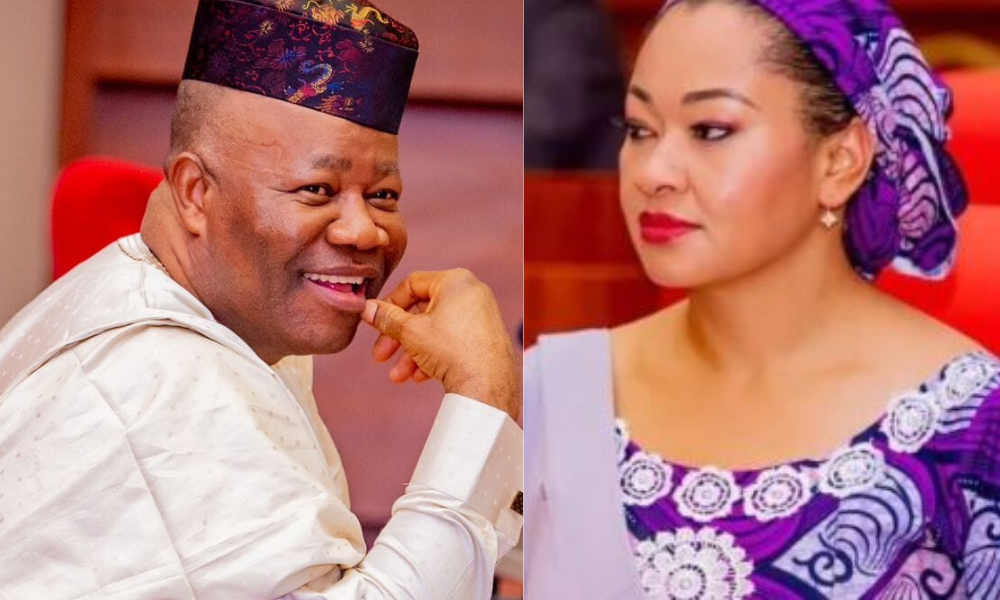
The legal and political storm surrounding the suspension case involving Senator Natasha Akpoti-Uduaghan has deepen following the decision of Senate President Godswill Akpabio to approach the Supreme Court of Nigeria, challenging the recent ruling of the Court of Appeal.
Akpabio’s move comes in the wake of a decisive judgement by the Court of Appeal, Abuja Division, which struck out the federal government’s brief of argument in the defamation-related appeal connected to Senator Akpoti-Uduaghan’s suspension.
The appellate court held that the government’s filing was incurably defective, having violated fundamental procedural and formatting requirements stipulated under the Court of Appeal Rules.
Despite Akpabio’s public assertion that the brief was struck out “illegally,” certified records of the appellate proceedings reveal that the decision was firmly grounded in law and procedure.
The panel of justices found that Akpabio’s legal team committed multiple infractions, including the use of an incorrect font size and line spacing, exceeding the mandatory 35-page limit, and failing to seek leave of court before departing from prescribed rules.
The court further observed that the federal government’s Notice of Appeal itself suffered from foundational defects, compounding the procedural lapses.
The justices ruled that these violations were not mere technicalities but substantive breaches that went to the competence of the processes before the court.
Consequently, the brief was struck out in its entirety, an outcome that has left the Senate President visibly dissatisfied and determined to seek redress at the Supreme Court.
Beyond the legal merits of the ruling, however, the intensity with which Akpabio has pursued the matter has attracted widespread public scrutiny.
Legal practitioners and political observers note that his level of personal involvement departs from what is customary for an official of his standing.
Sources within the National Assembly described his approach as unusually personal, with allegations yet to be proven that he has been closely monitoring judicial developments and exerting pressure on judicial officers.
These claims have raised concern across legal and civil society circles.
The controversy is further amplified by the strained political relationship between Akpabio and Senator Akpoti-Uduaghan.
Their rivalry, which has simmered for months, reflects broader tensions within the Senate. Akpoti-Uduaghan, a first-term senator, has gained national attention for her outspoken posture and willingness to challenge what she perceives as excesses in Senate leadership.
Insiders suggest that Akpabio views her growing influence and independent profile as a direct challenge to his authority within the chamber.
“This matter has clearly moved beyond the courtroom. It has become a political contest for relevance and dominance,” a National Assembly source remarked.
Analysts have also described the Appeal Court ruling as an embarrassing setback for the Senate President, noting that it arose not from strategic brilliance on the part of the respondent but from avoidable errors committed by the Federal Government’s own legal team.
The optics of losing a critical procedural battle over issues such as font size and page limits have fueled speculation that Akpabio’s decision to escalate the matter is driven by a desire to reclaim political stature and reshape public perception.
Within ruling party circles, murmurs persist that powerful interests expect the Senate President to rein in Senator Akpoti-Uduaghan’s rising profile.
Observers say this expectation may be contributing to the determination with which Akpabio is pressing the case.
A senior lawyer familiar with the proceedings described the situation bluntly: “What we are witnessing appears less like a principled legal contest and more like a political vendetta.”
In his Notice of Appeal before the Supreme Court, Akpabio argues that the Court of Appeal breached his constitutional right to fair hearing by refusing to grant leave to regularise the defective brief or permit him to exceed the statutory page limit.
He is asking the apex court to set aside the proceedings of 28 November 2025, nullify the appellate court’s decision, and allow him to refile his arguments in compliance with the rules.
Constitutional law experts, however, caution that the right to fair hearing does not absolve litigants of the obligation to obey court rules.
They note that Senator Akpoti-Uduaghan’s legal team complied strictly with the same procedural requirements, weakening claims of unequal treatment.
Many analysts therefore view Akpabio’s appeal as defensive and politically motivated, with its outcome far from certain.
“This looks more like an attempt to save political face than a genuine search for justice,” a constitutional scholar observed.
For her part, Senator Akpoti-Uduaghan has maintained a calm and restrained posture, expressing confidence in the judiciary and insisting that the rule of law must prevail.
Her legal team has characterised the appeal as a desperate effort to overturn a decision that was properly and lawfully reached.
Meanwhile, civil society organisations have raised alarm over allegations that a sitting Senate President may be seeking to influence judicial outcomes, warning that such conduct if proven, poses a grave threat to judicial independence and democratic governance.
What began as a procedural ruling at the Court of Appeal has now evolved into a broader national test of judicial integrity, separation of powers and tolerance for dissent within Nigeria’s democratic institutions.
As the Supreme Court prepares to weigh in, the case stands not merely as a legal dispute but as a defining moment in the ongoing struggle between power, accountability and the rule of law in Nigeria.
We’ve got the edge. Get real-time reports, breaking scoops, and exclusive angles delivered straight to your phone. Don’t settle for stale news. Join LEADERSHIP NEWS on WhatsApp for 24/7 updates →
Join Our WhatsApp Channel