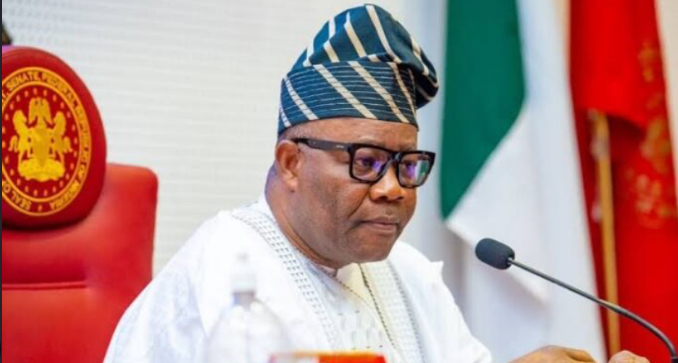
Senate President Godswill Akpabio has proposed a “Know Your Tenant” law requiring landlords to verify the identities of their tenants as part of efforts to curb kidnapping, child trafficking and other criminal activities in Nigeria.
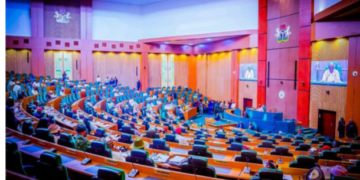
Akpabio proposed the bill in plenary on Tuesday in Abuja. At the same time, the Senate considered recommendations on the urgent need to protect Nigerians from trafficking, slavery and human rights abuses in Libya.
He called for stricter tenancy regulations, including measures to ensure that landlords keep verifiable records of occupants in their properties, arguing that the absence of reliable identification could make it difficult for security agencies to trace suspects after crimes are committed.
“This one we can say, know your tenant. Let’s make the necessary law for the FCT, for instance,” Akpabio said.
He also proposed tighter regulations for short-let apartments, insisting that occupants provide valid identification so authorities can trace individuals suspected of criminal activity.
The Senate President said the National Assembly should consider legislation for the Federal Capital Territory, while state governments and Houses of Assembly could adopt similar measures within their respective jurisdictions.
Akpabio’s proposal followed discussions on a joint report by the Senate Committees on Diaspora and Non-Governmental Organisations, Judiciary, Human Rights and Legal Matters, Foreign Affairs, and Special Duties on measures to protect Nigerians from human trafficking and exploitation, particularly in Libya.
The Senate subsequently approved recommendations to strengthen anti-trafficking legislation, investigate suspected trafficking networks, increase funding for relevant agencies and establish a national reintegration programme for rescued victims.
Explaining the need for stronger security measures, Akpabio recounted a case involving three children allegedly abducted in Akwa Ibom State and moved through several locations before being rescued by the police.
According to him, the children were taken to Aba, Katsina and Lagos as suspected traffickers allegedly attempted to sell them before arranging to move them to Ghana.
He said the children had been missing for about 93 days before the police traced their movements and rescued them.
Akpabio commended the Inspector-General of Police and the Akwa Ibom State Police Command for their roles in the operation.
He also disclosed that he had asked the police to arrange a meeting with the eldest child, who reportedly warned prospective buyers that the Senate President was searching for them.
“I’ve promised myself that when I see the child, I will give that child a scholarship to university level,” he said.
The Senate President said the case demonstrated the need for improved intelligence gathering, effective law enforcement and stronger measures to prevent children from falling into the hands of traffickers.
He warned that human trafficking was not limited to Nigerians being taken abroad, noting that children were also abducted and moved between states within the country.
Akpabio further urged lawmakers to strengthen existing laws and ensure that security agencies could investigate and prosecute offenders effectively.
Senator Aminu Tambuwal, representing Sokoto South Senatorial District, supported the need for improved regulation of tenancy arrangements, recounting his previous efforts to introduce legislation requiring the registration of tenants and rental properties.
Tambuwal told the Senate that, while serving as Speaker, he had drafted a bill on the subject and circulated it to state Houses of Assembly, but none passed it at the time.
He said a similar proposal was subsequently enacted in Sokoto State during his tenure as governor, establishing a Rent Control and Management Commission with provisions for registering tenants and properties available for rent.
Tambuwal said the Senate could examine the law and encourage other states to establish similar mechanisms.
He argued that proper registration could strengthen security checks and make it easier to identify individuals linked to criminal activities.
Akpabio welcomed the intervention, saying the proposed measures could help prevent criminals from using rented properties to facilitate kidnapping, trafficking and other offences.
He also urged the Senate leadership to consider legislation that would establish clear identification requirements for tenants and users of short-let accommodation in the FCT
Senator Neda Imasuen, representing Edo South Senatorial District, cautioned that introducing new laws would not be sufficient without effective enforcement.
He noted that some states already had tenancy laws but questioned whether the existing provisions were being adequately implemented.
“The issue for me, and I think that is the main issue, is enforcement of our laws,” Imasuen said.
He called for stronger accountability mechanisms to ensure that kidnapping, trafficking and other serious crimes were thoroughly investigated and that the public was informed of the outcomes.
Imasuen also expressed concern that some criminal cases attracted brief public attention but later disappeared from the news, with no clear information about investigations or prosecutions.
Senator Babangida Hussaini, representing Jigawa North-West, informed the chamber that Lagos State had operated a tenancy law since 2012, suggesting that existing legislation could provide a reference point for other jurisdictions.
Beyond the proposed tenancy reforms, the Senate approved recommendations to strengthen the country’s response to human trafficking and the exploitation of Nigerians abroad.
The recommendations followed a joint report presented by Senator Anthony Yaro, representing Gombe South and Vice Chairman of the Senate Committee on Diaspora and Non-Governmental Organisations.
Yaro said the committees had received memoranda from stakeholders, held consultations and examined the issues before making recommendations to the chamber.
The Senate called for stronger enforcement of existing anti-trafficking laws, including the Trafficking in Persons (Prohibition) Enforcement and Administration Act 2015 and the Child Rights Act 2003.
It also urged the National Agency for the Prohibition of Trafficking in Persons (NAPTIP), the Nigeria Police Force, the Nigeria Immigration Service, the Economic and Financial Crimes Commission and other relevant agencies to investigate suspected trafficking networks and travel agencies allegedly involved in recruiting and exploiting Nigerians.
The proposed investigations are expected to examine recruitment arrangements, financial transactions, travel records and other evidence that could help identify and prosecute those responsible.
The Senate further recommended increased funding for NAPTIP and other relevant agencies to improve their capacity to investigate trafficking cases, prosecute offenders and provide support for victims.
It also called on the Federal Government to establish a national reintegration and protection programme for returning victims, to be coordinated by the National Commission for Refugees, Migrants and Internally Displaced Persons in collaboration with NAPTIP.
On international cooperation, the lawmakers urged the Federal Government, through the Ministry of Foreign Affairs, to intensify diplomatic engagement with Libya to combat trafficking, modern-day slavery and irregular migration.
The proposed engagement would focus on intelligence sharing, border management, dismantling trafficking networks, protecting vulnerable migrants and facilitating the safe return of victims.
Akpabio also called on the National Orientation Agency and other relevant institutions to intensify public education on the dangers of human trafficking.
He warned that some Nigerians were lured abroad with promises of education, employment and better living conditions but subsequently subjected to exploitation.
He urged families to exercise caution when approached with overseas employment or educational offers that could expose their children to trafficking.
Senator Mohammed Adamu Aliero, representing Kebbi Central, said state governments should complement federal efforts by educating young people about deceptive recruitment schemes and expanding employment opportunities at home.
“The issue you talk about shall not be left to the National Orientation Agency alone,” Aliero said.
He maintained that state governments had an important role to play in sensitising young people and creating opportunities that could reduce the pressure to seek potentially dangerous employment abroad.
Senator Adams Oshiomhole also stressed the need for international cooperation, arguing that destination countries must take responsibility for addressing the demand that sustains human trafficking and sexual exploitation.
He said Nigeria should strengthen domestic enforcement while engaging foreign governments to dismantle networks involved in recruiting and exploiting vulnerable citizens.
We’ve got the edge. Get real-time reports, breaking scoops, and exclusive angles delivered straight to your phone. Don’t settle for stale news. Join LEADERSHIP NEWS on WhatsApp for 24/7 updates →
Join Our WhatsApp Channel