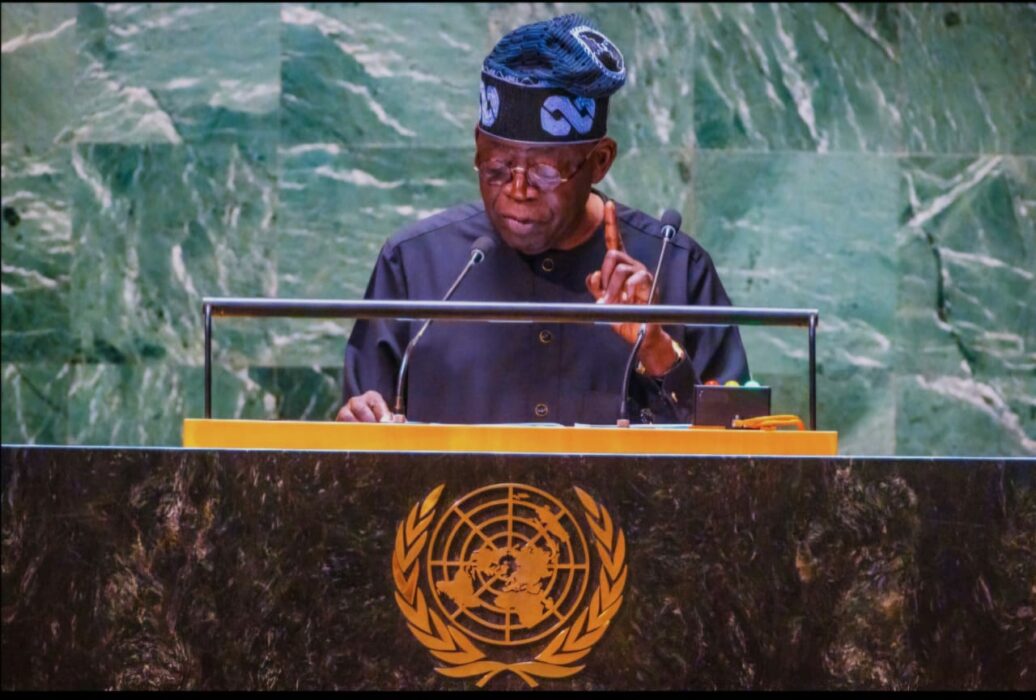
Nigeria’s Permanent Representative to the United Nations, Ambassador Jimoh Ibrahim, has said President Bola Tinubu and members of his family are protected from arrest or restrictions on their movement in the United States while attending the United Nations General Assembly (UNGA).
Ibrahim, who also chairs the UN Committee on Budget and Administration, said the Nigerian Mission in New York had not received any communication from the US government indicating that Tinubu would face restrictions during the UNGA.
In a statement issued by the Office of Nigeria’s Permanent Representative to the UN in New York, the envoy cited the 1947 UN-U.S. Agreement, particularly Section 11, which he said guarantees freedom of transit for representatives of member states and their families travelling to and from the UN headquarters district.
He explained that the agreement requires US federal, state and local authorities to avoid imposing restrictions on the movement of accredited representatives of member states, their families, UN officials, specialised agencies and individuals invited to the UN headquarters for official engagements.
Ibrahim’s comments come amid discussions and claims on social media concerning the possibility of President Tinubu facing legal action or arrest during his planned participation in the UNGA.
The ambassador dismissed such claims, saying any attempt to criminalise or engineer the arrest of the Nigerian president through social media campaigns would ultimately be unsuccessful.
He also distinguished between an allegation and an established criminal offence, stressing that accusations must be subjected to due process and proven before an individual can be convicted.
“An allegation does not constitute a crime,” Ibrahim said, noting that criminal accusations must be established through due process and proved beyond reasonable doubt before conviction.
The envoy recalled that a former Nigerian president whom he did not identify as Tinubu, had previously faced a restriction limiting his movement to a 10-kilometre radius from the UN headquarters in connection with a drug-related allegation.
He said the allegation against the former president was never established.
Ibrahim also explained that US law-enforcement agencies could invite individuals to provide information or statements as part of investigations.
According to him, investigators may request identifying information, including personal and family details, educational records and fingerprints, where relevant.
He said such information could help authorities establish relationships between individuals, organisations and networks being investigated.
However, Ibrahim stressed that information obtained during investigations involving financial or other alleged offences is protected and is not automatically made public.
The Nigerian envoy also noted that participation in the UNGA is ultimately determined by national priorities and that countries do not necessarily have to be represented by their presidents.
He said more than 60 per cent of the current speaking list comprises vice presidents and foreign ministers who are representing their respective countries.
According to him, this demonstrates that heads of government can delegate representation where circumstances require it.
Despite this, Ibrahim maintained that there was no indication from the US authorities that President Tinubu’s movement would be restricted during the UNGA.
He urged Nigerians to continue to respect the Nigerian flag and support what he described as the economic transformation agenda of the Tinubu administration.
We’ve got the edge. Get real-time reports, breaking scoops, and exclusive angles delivered straight to your phone. Don’t settle for stale news. Join LEADERSHIP NEWS on WhatsApp for 24/7 updates →
Join Our WhatsApp Channel