Africa is perhaps the only continent where the world can find almost everything it needs for its future, except the leadership required to secure that future for its people. We have the critical minerals powering the green transition, land to feed a hungry world, young people to drive the digital economy and markets global corporations seek. Yet we remain perpetually negotiating from a position of weakness.
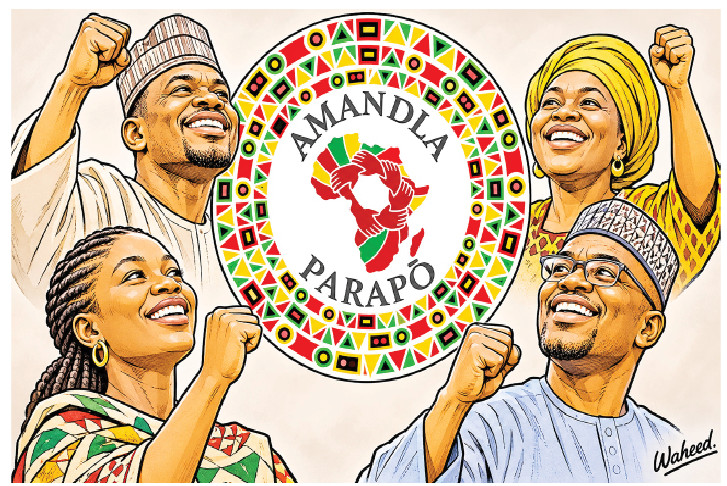
These were the sobering questions at the inaugural Amandla Parapọ 2026, convened by the Amandla Institute for Policy and Leadership Advancement, with support from the Open Society Foundations, from October 30 to November 1 at Amandla Conference and Resort, Ilisan-Remo, Ogun State. Under the theme, Policy and Leadership at a Time of Changing Global Geopolitics, African statesmen, scholars, researchers, Pan-Africanists and civil society leaders examined the continent’s place in an unsettled world.
The message was unmistakable: Africa cannot remain a passive spectator in the reordering of global power. It must rediscover the political courage, institutional capacity and collective ambition to shape its destiny. Africa must stop being the prize in the world’s games.
The African Renaissance We Abandoned
There was a time when Africa understood the power of collective ambition. The 1990s and early 2000s saw a resurgence of Pan-African ideals, culminating in the transformation of the Organisation of African Unity into the African Union. The AU Constitutive Act, NEPAD and the African Peer Review Mechanism represented more than institutional reforms; they signalled a determination to move beyond post-independence nationalism towards collective development and continental solidarity.
Algeria, Egypt, Ethiopia, Nigeria, Senegal and South Africa provided much of the political impetus. What happened to that ambition?
Today, Africa is fragmented, regional institutions weakened by competing national interests, and leaders often more preoccupied with domestic political survival than continental strategy. The emerging order is competitive, transactional and increasingly coercive. Trade, finance, technology and security have become instruments of geopolitical influence.
China, Russia, traditional Western powers and assertive middle powers are expanding their interests across the continent. Their engagement is not inherently problematic. The question is whether Africa has the institutional strength and negotiating capacity to ensure these relationships serve its development priorities.
As the conference communique observed, Africa risks becoming a strategic battleground for its arable land, critical and rare-earth minerals, and maritime corridors without the policy and leadership architecture to protect its interests. More partners do not automatically mean greater sovereignty. Negotiating separately with powerful actors on unfavourable terms may simply multiply dependencies.
Resources Without Power
Africa possesses extraordinary advantages: agricultural potential, minerals essential to green and digital transitions, a youthful population and opportunities for industrial development. Yet these assets have not translated into commensurate economic or geopolitical influence.
Africa continues to export raw materials while importing finished products, technology and expertise. It supplies resources powering global industrialisation but captures too little value along supply chains. This is not merely an economic failure; it is a leadership and policy failure.
The conference Grand Debate asked whether Africa was ready for the challenges and opportunities of geopolitical change. Interest in our resources is not proof of readiness. Readiness requires infrastructure, industrial capacity, strategic intelligence, coherent policies and institutions able to deliver beyond political cycles.
The communique calls for epistemic sovereignty: policies and solutions rooted in African realities, indigenous knowledge and development priorities rather than external prescriptions.
It also challenges governments to rethink the relationship between state and private sector. The informal economy is a critical, often under-acknowledged engine of livelihoods. Supporting African enterprise requires security, infrastructure, research and development, effective regulation and policies that enable indigenous businesses to compete. But Africa must reject the assumption that the private sector alone should drive development. The state cannot outsource its responsibility to a sector whose core purpose is business and profit.
The African Continental Free Trade Area must become more than an agreement on paper. It should underpin regional production, industrialisation and collective bargaining.
Leadership, Democracy and the Generational Question
A provocative conclusion of the deliberations was that Africa must confront its governance deficit. Disillusionment with democratic institutions, particularly among young people, cannot be dismissed as impatience or ignorance. For too many Africans, democracy means elections without accountability, political competition without development, and constitutions seemingly better at protecting officeholders than citizens.
The communique calls for governance models reflecting African histories, cultural realities and developmental aspirations. This debate must not legitimise military takeovers, authoritarianism or the erosion of fundamental freedoms. Failed leadership should prompt deeper democratic accountability, not its abandonment.
The generational divide makes this urgent. With approximately 60 per cent of Africa’s population below 35, young people cannot remain excluded from policy design and decision-making. Nor should the experience and institutional memory of older generations be dismissed.
A proposed Youth Charter, intergenerational mentorship and meaningful participation offer practical starting points. Africa needs the strategic memory of elders alongside the technological fluency, innovation and dynamism of younger citizens. Women and persons with disabilities must also have meaningful influence over national and continental decisions, reflecting their contributions to community resilience, livelihoods, peacebuilding and development.
Collective Sovereignty Is No Longer Optional
A central conclusion of Amandla Parapọ 2026 is that no African country, regardless of population, resources or economic size, can negotiate effectively with major geopolitical blocs alone.
This has particular implications for Nigeria. As Africa’s most populous country and one of its largest economies, Nigeria cannot treat continental leadership as an occasional diplomatic responsibility. Its influence must strengthen regional institutions, ECOWAS, AfCFTA implementation and a coherent African position on global economic and security questions.
The communique identifies Nigeria, South Africa and Algeria as a potential troika for continental renewal, while calling on Nigeria, South Africa, Ethiopia, Kenya, Algeria and Egypt to reclaim their responsibilities as anchor countries. This ambition requires political commitment. Solidarity cannot survive summit declarations while individual countries pursue bilateral deals that undermine collective interests.
Africa must also invest in its intellectual and institutional infrastructure. As international development funding contracts and philanthropic priorities shift, think-tanks, universities, leadership institutes and civil society need stronger domestic financing and homegrown philanthropy. A continent unable to finance its own policy thinking remains vulnerable to the priorities of those who can.
The same urgency applies to artificial intelligence. AI is becoming a determinant of economic competitiveness, national security and global influence. Africa must invest in education, regional infrastructure and indigenous innovation, and bargain collectively for knowledge transfer in critical minerals and technology.
Amandla Parapọ 2026 offered a timely reminder: Africa’s greatest vulnerability may not be external ambitions, but its failure to organise its strengths into collective power.
The continent needs more than declarations of potential. It needs leaders prepared to act, institutions that work, economies that produce, citizens whose rights are protected and regional partnerships that put African interests first.
The world is not waiting for Africa. It is negotiating the continent’s future through mineral concessions, military agreements, infrastructure loans, technology partnerships and trade corridors. The question is whether African leaders are negotiating that future or merely signing the paperwork.
We’ve got the edge. Get real-time reports, breaking scoops, and exclusive angles delivered straight to your phone. Don’t settle for stale news. Join LEADERSHIP NEWS on WhatsApp for 24/7 updates →
Join Our WhatsApp Channel