In this piece, FELIX IGBEKOYI, OKEM MBAH, JOSHUA DADA, AZA MSUE, FRANCIS OKOYE, NONYE EKWENUGO, NNAMDI MBAWIKE, ABDULLAHI OLESIN, INIOBONG EKPONTA, RICHARD NDOMA and ATTAH ANTHONY write on how some Nigerian women and girls are challenging the long-standing status quo, breaking barriers and making an impact by carving a niche in male-dominated fields.
It is uncommon to see women drive trailers, heavy trucks, commercial buses, or tricycles, popularly called Keke NAPEP. Female welders, bricklayers, carpenters and painters are also rare. However, LEADERSHIP Weekend reports that passion, pressure and career drive have pushed some women and girls into such professions and skills development.
In Osun, the stories of Mrs Bimbo Ademuyiwa, Mrs Kemi Bolatito and Titilayo Fapounda, who ventured into male-dominated fields, were born of competition, passion and a fight for survival.
Mrs Bimbo Ademuyiwa ventured into bricklaying because of disparities in daily wages, which she considered a form of male gender cheating their female counterparts due to a lack of professional competence among females and not because of the labour involved.
Ademuyiwa, a mother of three, in a chat with LEADERSHIP Weekend in Osogbo, said she always felt cheated when, at the end of daily labour, her male fellow workers, who are professionals, earned higher wages than she, which prompted her to learn the art of bricklaying, graduated and today feels proud employing men as workers to execute her projects when necessary.
She noted that she was discouraged at the point of apprenticeship, but persisted, and today, she has become a reference point for others who are looking up to her for mentorship
But Mrs Kemi Bolatito became a shoemaker out of passion for the job. According to her, she developed an interest in shoemaking after watching her uncle, a professional, perform the task seamlessly.
Bolatito, a wife and mother of two kids, said she never regretted venturing into shoemaking and noted that shoemakers never lack money. She maintained that the income might be meagre, but when managed well, one could compete with other professionals in life achievements.
She noted that she enjoys patronage more than her male counterpart in the profession due to her competence, availability, commitment, honesty and charisma.
Mrs Titilayo Fapounda, a retired teacher in Osogbo, became a commercial bus driver to survive.
Speaking with LEADERSHIP Weekend in Osogbo, Osun State, Mrs Fapounda, who retired from the teaching service in 2021, said she has not been paid or received her gratuity from the government since her retirement.
According to her, the burden of sponsoring her children as a widow forced her to look for an alternative to meet her needs, which landed her on the road since she possessed the document that could guarantee her survival.
Regarding commuters’ reactions, she remarked that society is getting used to seeing women behind the wheel at a commercial level, adding that her children initially discouraged her but have since got used to it.
Similarly, at the busy Ekeki Motor Park in Yenagoa, Bayelsa State, where commercial minibuses are mostly driven by men, one woman is quietly challenging the norm.
Chinwe Nwafor, a native of Anambra State, has taken up driving a commercial minibus, becoming one of the few women in the park operating in a field long dominated by men.
For Chinwe, driving is more than just a job; it is something she genuinely enjoys. Although she only recently started operating at the motor park, her presence has already drawn attention from both passengers and fellow drivers.
She said her decision to become a commercial driver was driven by passion rather than necessity.
“Personally, I have a passion for driving. I love driving, and that is why I am doing this work,” she said.
Chinwe, who owns the mini bus she operates, explained that despite enjoying the work, she has had to deal with resistance from some male drivers who feel uncomfortable seeing a woman doing the same job.
She said their reactions sometimes come in the form of constant comments and attempts to discourage her. Despite the challenges, she insists that she has no regrets about choosing the job.
She said, “The challenge is that the men feel intimidated a lot. If you do not truly love the work, their intimidation can chase you away. They keep talking to you at every point in time.”
According to Nwafor, she is not new to business, stressing that the key to staying in the profession is to remain focused and not allow criticism to discourage you.
She runs several other ventures, including food storage and the sale of red oil, as well as a wine business that operates both wholesale and retail.
She explained that she decided to become a commercial driver partly to relax while still earning money.
“I have been into buying and selling for a long time. So, I decided to do this and rest a bit. This is my way of resting. I do not see it as difficult work. You just sit down and drive,” she said.
Nwafor also revealed that she has many years of driving experience, adding that she has been driving since 2004 and even operated a transport business after graduating from the university.
“Yes, I have been driving since 2004. I also worked in transport after I finished university in 2010. After my youth service, I had a green one-door Honda Civic here in Bayelsa, and I drove it for a while,” she added.
Beyond her personal journey, she hopes more women will venture into the transport sector, saying it can provide financial support for families and help women become more independent.
She believes that women should not wait to become dependent on others when they can also contribute financially.
“If your husband brings N100,000 home, you can contribute N20,000 and support. It should not always be ‘bring, bring, bring.’ Contribution is important, and everything will go well,” she said.
Nwafor encouraged women interested in the business not to be discouraged by societal expectations or criticism, noting that even small daily earnings from such work can gradually grow into something meaningful.
“You can earn at least N5,000 every day. If you are making N5,000 daily and nobody is taking it from you, you are doing well. From that N5,000, you can save and eventually build something bigger,” she stated.
While encouraging women to always focus on their goals, Nwafor said women should remain confident and pursue what they love without allowing fear or intimidation to hold them back.
“I support every woman and encourage every woman not to be afraid of people’s bullying. They are only intimidated. Encourage yourself and do it,” she concluded.
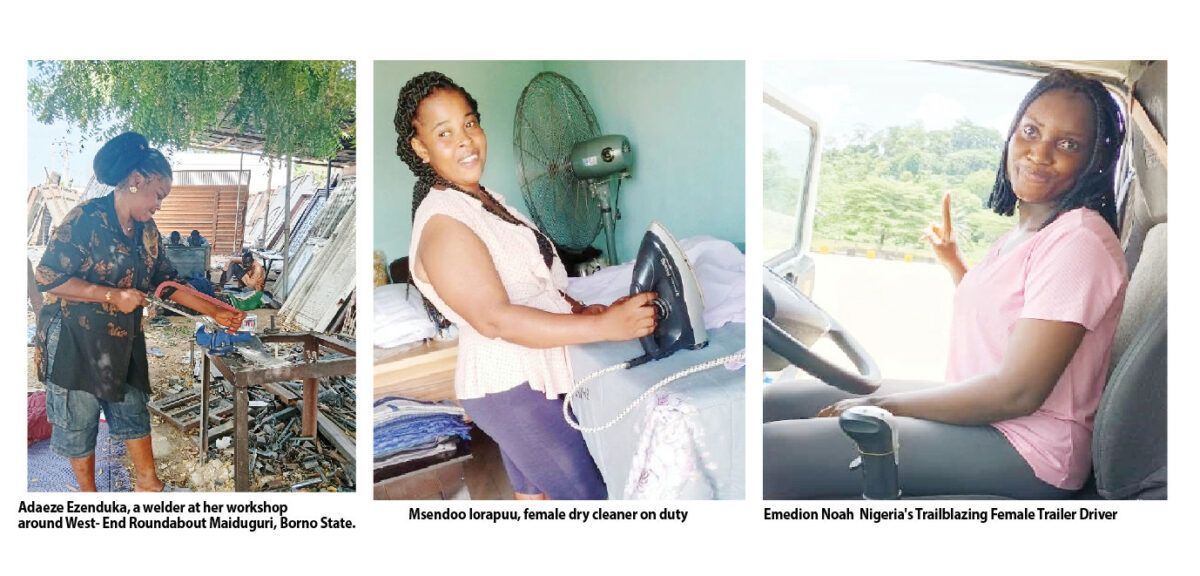
In Benue State, a Makurdi-based female celebrity dry cleaner, Msendoo Iorapuu, said her passion pushed her into the dry-cleaning business, which is dominated by men.
Msendoo, who is the managing director of Simak Engagements Laundry and Dry Cleaning Services, said she has spent over 10 years in the business. She maintained that she earns enough money to pay her bills and provide for her family.
She appealed to the government to provide grants or loans to women competing in male-dominated businesses or professions.
“I’ve spent over 10 years in this laundry and dry cleaning service business. I’ve never had issues with my customers; I deliver as I promise. I have a lot of patronage, and I thank God for that. I am using the proceeds from my business to support myself and my family. The money is coming in small but I am grateful. I need to expand my business,” she said.
She added that she has no regret venturing into the business, “No regret at all. I went to school, and after ‘no-job’ experiences, I ventured in. As I said earlier, I have a passion for the business, and I am happy doing it. I have staff who work with me, and I don’t leave them with my work. I am always working to meet deadlines.”
Msendoo identified erratic power supply as the major challenge affecting the business. “We rely on a generator whenever there is no light. Power outages are a major problem affecting the dry cleaning business. The high cost of fuel is also affecting the business,” she said.
23-year-old Emedion Noah, a resident of Calabar, hails from the Oruk Anam Local Government Area of Akwa Ibom State. She is a trailblazing trailer driver with Marchaggyl Transport Co. Ltd., a subsidiary of LafargeHolcim.
Born and raised in a society with traditional expectations, Emedion defied norms to pursue her passion for driving heavy-duty trucks.
Her motivation stemmed from a desire to be a value-add to her future home, rather than relying on her spouse.
Emedion believes that the times have changed, and women should be able to contribute financially to their households.
Many see her career choice as unusual, but she prefers earning her living through hard work and not leaning on anyone.
Emedion’s driving journey began as a mini-bus driver before she transitioned to trailer driving.
An old friend introduced her to Lafarge Holcim, where she underwent rigorous training to become a trailer driver.
For her, steering a trailer for the first time was a mix of excitement and nervousness.
Emedion isn’t afraid of challenges and sees herself as a daring individual. She has been driving trailers for three years, delivering cement products across South-South and South-East Nigeria.
Her routes include Mfamosing to Aba, Abakaliki, Port Harcourt, and Owerri, among others.
The young female trailer driver, who refused to disclose her monthly and annual pay, stated that with the job, she can now afford to pay her bills without running helter-skelter to find someone to help her offset them.
“With the job, I now extend a hand of fellowship to some of my associates and relatives,” she maintained.
Driven by a passion for teaching, Emedion is also a part-time student of Education Administration at the University of Calabar. She prefers male conductors because they are more agile than their female counterparts.
Emedion said she lost her father at a young age and only told her mother about her career choice after completing training for fear that her mother wouldn’t let her embark on the journey to become a trailer driver.
She advised young girls to be courageous and pursue their dreams and passions despite societal expectations.
She said that, with what she earns as a trailer driver, she can become self-reliant by distributing cement products.
Adaeze Ezenduka is a native of Anambra State, but was born and raised in Maiduguri, the Borno State capital.
In an interview with LEADERSHIP Weekend, the mother of five children who obtained a bachelor’s degree in History with a second class upper from the University of Maiduguri said her passion for adventure led her into welding, a field dominated by men.
The only known female welder in Borno and the Northeast in general added that she is very happy doing what she is doing, saying that she had not incurred any loss in the job, except for success all through.
On her impact on society through her welding work, Adaeze said she has trained so many people, too numerous to remember, including people from Adamawa, Yobe, and even some from the Chad Republic.
“I have impacted so many that I cannot remember. At times, when I am passing on the road, some of the people I trained would call out to me and say they once learnt welding from me. I have a lot of them in Adamawa, Borno, Yobe and even Chad,” she stated.
She said that the welding profession is dominated by men, at times when customers visit her workshop, they would be surprised that she is a woman, they would call her ‘woman like a man.’
“At times when a customer comes and my workers bring them to me, they would be expecting to see a man, but when they come in and see me, they would ask the boys in surprise; is this your ‘Oga’, meaning boss? Most of them are happy when they see me,” she enthused.
On the experiences she has gathered in the welding profession as a woman, Adaeze said, “I have gathered experience on this work, but one thing is that there is nothing one determines to do that he or she would not achieve or succeed in doing.
“As a woman, you must have negative experiences because it is a work dominated by men. I think in the whole of the Northeast, I am the only woman in welding work. So, there must be challenges, especially when men in the business think you are doing better than they are. But that is not challenging to me. So, I have learnt both the good and the bad in the job.
” I have no regrets doing the job, and I can only give glory to God,” Adaeze added.
On what she would have done differently if she were not into welding work, she said, as a degree holder with a second class upper, she actually wanted to further study International Relations and Diplomacy, for which she was offered admission at the University of Maiduguri for her Master’s degree before the eruption of insurgency.
“And being someone who has family, as well as the backbone of the family, I have to drop the ambition for a Master’s. If I had the opportunity, I would have pursued my discipline towards becoming an international diplomat.
“That was what I had in mind, but God has a way of channelling one to the other side of life, and I am happy doing that,” Adaeze stated.
In Kaduna, commercial tricycle riding, popularly known as keke, is widely regarded as a man’s job. The city’s busy roads are largely dominated by male riders shuttling passengers from one location to another.
However, a few women are gradually challenging that long-standing norm, stepping into spaces traditionally occupied by men in order to earn a living and support their families.
One such woman is Mary Akpos, a mother of three who once worked in accounting before circumstances pushed her into the transport business.
Akpos said she ventured into riding a tricycle after losing her job, explaining that she needed a means of survival rather than remain idle.
According to her, the decision was also influenced by her long-standing interest in taking on difficult and unconventional tasks.
“I love challenging jobs. Growing up and during my university days, most of my friends were men, and I admired the kind of work they did. I felt salon work or similar jobs were things almost anyone could do, but I preferred jobs people consider difficult,” she said.
Although her family initially questioned her decision to ride a tricycle despite being a university graduate, Akpos said she remained resolute because she had children to care for.
Operating mostly around Sabon Tasha and parts of Kaduna metropolis, Akpos said working in a male-dominated environment has exposed her to mixed reactions.
While many passengers express surprise and admiration at seeing a woman behind the wheel, she said some male riders are reluctant to give female drivers equal consideration on the road, often insisting that they must pick up passengers only at designated bus stops.
Beyond the social challenges, Akpos also battled with the condition of the tricycle she operated, which she obtained through a hire-purchase arrangement.
The tricycle was old and frequently developed faults, forcing her to spend a significant portion of her daily earnings on repairs.
Despite these challenges, she said the experience strengthened her confidence and proved that women can also succeed in fields widely regarded as men’s territory.
She recalled one of her most frightening experiences when the tricycle’s brakes failed while she was on the road, forcing her to quickly divert into a nearby street to avoid colliding with an oncoming vehicle.
Despite the risks and challenges associated with the job, Akpos said she enjoys the business and has no regrets venturing into it, adding that she would gladly continue riding a tricycle and would not trade it for another job if she had access to a newer one.
Similarly, in Enugu, tricycle operation, popularly known as Keke NAPEP, is dominated by men. However, many women are now venturing into the sector as female tricycle operators transport passengers, goods, and schoolchildren within Enugu.
A popular tricycle operator in the metropolis, Mrs Augustina Agbo, said that though she feels shy when people try to make a mockery of her for doing the job, she has no regrets driving a keke.
On why she chose the job, Mrs Agbo, a graduate of Mass Communication, said limited white-collar jobs pushed women to seek alternative income sources.
She added that driving a tricycle allows her to control her working hours.
Mrs Agbo, popularly known along Gariki-Agbani Road, said despite the opportunities, she faces challenges, such as harassment from passengers who continue to maintain that women cannot drive well.
A female mechanic who repairs vehicles for people close to Owerri Road, Enugu, Miss Uchenna Amuta, said she was happy doing the job, but said she was facing harassment from people who have continued to insist that women cannot be good auto technicians.
Mrs Risikat Adisa is the pioneer female commercial tricycle operator in Ilorin, Kwara State.
The mother of four started her operation as a commercial tricyclist in 2011.
Popularly known as ‘First Lady’ among her colleagues, Risikat said she started riding a tricycle to help her husband make provisions for the family.
“I discovered that if you want to succeed as a woman and you want to train your children to the level you want in Nigeria today, you cannot rely on your husband’s provision alone. That is what made me have a second thought on what I can do to support my husband, and I decided to give riding a tricycle a trial,” she said.
Risikat, who operates on the Gaa-Akanbi-Agbabiaka-Danialu route in Ilorin, said she persevered with her husband’s backing, despite disparaging comments from friends and even some family members.
She disclosed that she started her operation with a tricycle acquired through hire-purchase, but has since acquired her own tricycle, which she entrusted to another person.
Reflecting on her accomplishments, Risikat highlighted that her four children can now attend school thanks to the earnings from her business.
In addition, she manages a store that sells provisions and beverages to supplement her income from the transportation business.
Risikat, however, said that the prevailing harsh economic situation was posing a challenge, as there was little or nothing left to take home after buying fuel and eating.
”Riding a tricycle used to be profitable compared to what is obtainable now. In the first five years that I started, I went home with almost N10,000 daily after my contributions in three different places. But now, after all deductions, it is difficult to go home with N3,000 which is not encouraging,” she said.
For 37-year-old Abasifreke Akpan from Ika local government area, a young widow with two kids in basic schools, “life could have been an embarrassment since I lost my husband to a ghastly motor accident three years ago” if not for the commercial bus driving she took at her husband’s demise.
“I learnt the art of driving my late husband’s car while he was alive. However, at his death in an accident in which the car was wrecked, the family was rewarded with a minibus as an empowerment by a politician he worked for during the election season.
“To pay the kids’ school fees and feeding, I handed over the bus to a driver who appeared nice at first, but later could not keep to terms, reneging on the usual balance.
“I had to retrieve the bus after learning the ropes of driving again at the driving school. I became popular with it, with many passengers patronising me as a woman, especially with the bus still clean and new.
“I started making good money, with an average daily earnings of between N15,000 and N25,000. So, this job has become my regular one now because my needs and the children’s have been routinely addressed. So I don’t think there’s any other business that can pay me this much as a widow,” she explained.
In a construction industry largely dominated by men, Laroba Bulus David, a 21-year-old painter from Jalingo, Taraba State, is steadily redefining stereotypes and carving out a place for herself through determination, resilience and skill.
While many young women are often encouraged to pursue careers considered more conventional for their gender, Laroba chose a different path: one that has placed her on construction sites, with paint buckets in hand, turning walls into colourful expressions of craftsmanship.
From humble beginnings to national recognition, the Theatre Arts and Film Studies graduate of Taraba State University (TSU), has transformed what began as a childhood interest into a growing business and a symbol of inspiration for other young women interested in technical trade.
According to Loraba, painting has always been more than just a job to her.
“I feel very happy and excited about what I do. Painting gives me joy and satisfaction. It is something I truly enjoy and consider my happy place. If I am not doing this, I probably wouldn’t have found something else that brings me the same fulfilment,” she said.
Laroba explained that she began learning the craft long before gaining admission into the university, but became more professional while pursuing her degree.
“I started painting before I went to the university, but when I got into school, I became more professional in my work,” she said.
Now with six years of experience, the young artisan has built a reputation that has taken her beyond the borders of Taraba State and connected her with different clients across the country.
Her growing profile was further boosted earlier this year when she travelled to Abuja, where she received national recognition at the Construction Artisan Awards.
At the event, Laroba emerged as the Best Senior Painter, the Best Senior Artisan, and the Second Overall Artisan in Nigeria, achievements she described as both surprising and motivating.
“The recognition encouraged me to keep improving in my craft. My plan is to establish my own company called Hela Paint Limited and grow it to a global level,” she said.
However, the journey to recognition was not without challenges. Like many women who ventured into male-dominated professions, Laroba faced criticism and scepticism, especially in the early stages of her career.
“There was a lot of discrimination when I started. Some people discouraged me because painting is not considered a typical job for women. ”
Even some of my male friends wondered why I chose painting instead of things like makeup or hairstyling,” she recalled.
The pressure was not limited to outsiders; she also faced reservations within her family and social circle. But over time, with persistence and visible results, perceptions of her critics gradually changed.
“People used to compare me with other ladies and question my choice. But I focused on what I love doing. Today, many of the same people appreciate my work,” she said.
Her progress has also created employment opportunities for others.
Laroba currently works with five to six assistants, whom she supervises on different painting projects, a modest but promising start toward building her own company.
“It is still a small business, but I am working towards registering my company soon,” she said.
Beyond house painting, Laroba has also ventured into paint production, producing various types of paint to support her projects and ensure quality delivery to clients.
At just 21, Laroba Bulus David’s journey is still unfolding, but with each brushstroke on a wall and each project completed, she continues to prove that courage, skill and persistence can paint a new narrative, one that challenges conventions and inspires a new generation of women to dream beyond limits.
In Asaba, Delta State, a particular woman is making profits from managing waste, popularly known as “iron condemn” a profession known to be dominated by the male gender. She claimed that after she graduated, things became quite uneasy for her.
Knowing that an idle hand and mind is the devil’s workshop, Dorcas Nnamdi was a trader before she ventured into commercial waste gathering (scavenging). Her little business stalled due to the challenges she faced after the state government marked her shop for demolition.
She was inspired to take up waste collection to earn a daily income to cover her everyday bills, especially when her independent lifestyle could not keep her idle. So, she needed to work. Unlike her former business, where she could not separate her profits from her expenditures, she reiterated that things are better now. “The payments that I do receive from sales in my shop weren’t enough to cover my expenses. So, the assurance of a better daily income prompted me to start ‘iron condemn.’
“Even my friends know that I don’t like being a liability; depending on others to survive. That was why I gave ‘Iron Condemned’ a trial. Although while learning the scavenging, as a woman, I felt threatened, but as time went on, I was able to overcome it,” she stated.
Apart from fear factors, she explained that she was able to overlook the prejudice that arose after people had seen her scavenging.
“Most times, people gathering waste are often rejected, especially women. Just like when I started, someone saw me on the street and asked, ‘has the situation gotten worse to the extent of resorting to scavenging?’
“I never mind. I saw ‘iron condemn’ as a thing of just going out in the morning, getting waste, and coming back home. We even have graduates among us who are major marketers to earn a living, and that hasn’t taken away their certificates from them,” Dorcas remarked.
Luckily, Dorcas found the courage to scavenge because her husband has a tricycle that he has converted into a truck.
“Doing this job, I now have time for myself. There is no pressure or query from the boss. When it’s time to work, I work, and when it’s time to rest, I rest, and I am relieved, allowing my husband to do the rest.
“Although people usually show some kind of attitude towards us for picking up waste, I didn’t let that affect me. My personal goal is what I am: a waste manager. After all, I am not after what people have to say.
“The challenges we face as women on this job are what we cannot put away. Challenges like oppression from male ‘iron condemn’ who sometimes negotiate before me. The stress of body pain and rejection from sellers who don’t want to deal with women,” she narrated.
Reacting to the situation, the chairman of the Association of Scavengers, Asaba Unit, Usman Adamu, commended the courage of young ladies and women entering the business, especially as their numbers increase.
“Female waste managers in our midst are trying, and we have always been encouraging them. Before we start buying goods from them, we give them proper training for them to overcome fear and other circumstances,” he said.
He recounted that it is not a crime for women to scavenge for a daily income. “Some women have extraordinary strength and can do what men can do. For me, it’s a fantastic and welcome idea. At least, we have seen women driving trucks and as builders. So, if we see women dealing in metals to make money, I think that shouldn’t be a problem,” Adamu said.
We’ve got the edge. Get real-time reports, breaking scoops, and exclusive angles delivered straight to your phone. Don’t settle for stale news. Join LEADERSHIP NEWS on WhatsApp for 24/7 updates →
Join Our WhatsApp Channel