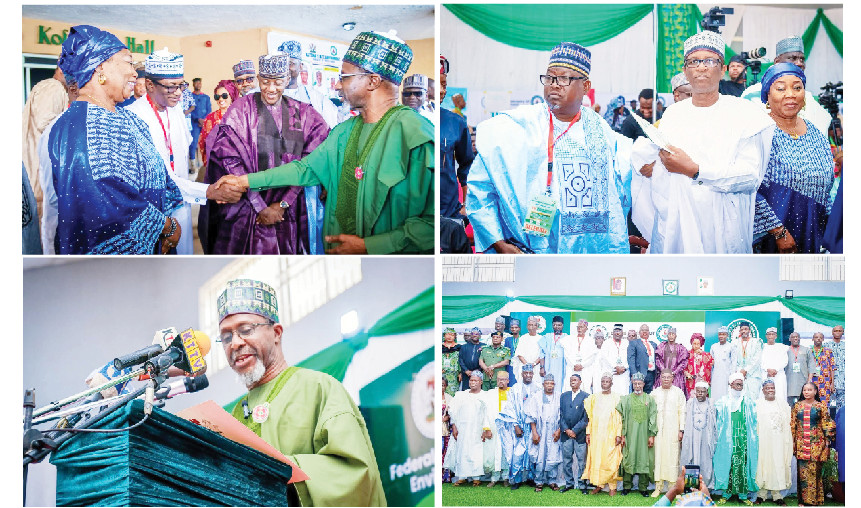
The successful conclusion of the 18th National Council on Environment (NCE) in Katsina State marked more than the end of a high-level policy gathering; it signaled a renewed national commitment to tackling climate change, biodiversity loss, and Nigeria’s triple planetary crisis. For the National Agency for the Great Green Wall (NAGGW), the outcomes of the Council carry far-reaching implications for its mandate of restoring degraded landscapes, strengthening climate resilience, and improving livelihoods in frontline communities.
As Nigeria’s apex environmental policy forum, the NCE provides a platform for aligning federal and state priorities. Resolutions adopted in Katsina emphasized integrated approaches to climate adaptation, ecosystem restoration, and sustainable land management. These decisions reinforce NAGGW’s core interventions, particularly in combating desertification, restoring degraded drylands, and promoting nature-based solutions across the Great Green Wall corridor.
The Council’s recognition of land degradation, desert encroachment, and biodiversity loss as national development challenges elevates the visibility of NAGGW’s work and strengthens the policy backing needed to scale up restoration efforts in affected states.
One of the most significant takeaways from the Katsina NCE was the emphasis on collaboration between federal agencies, state governments, and local communities. For NAGGW, this presents an opportunity to deepen partnerships with state Ministries of Environment and align project implementation with state climate action plans, green economy roadmaps, and environmental regulations.
Enhanced cooperation will enable the Agency to mainstream Great Green Wall initiatives into subnational development frameworks, ensuring greater ownership, sustainability, and impact at the community level.
The Council call for innovative financing mechanisms, such as green bonds, public-private partnerships, climate funds, and carbon markets open new pathways for resource mobilization. These financing options will align with NAGGW’s long term objective of scaling landscape restoration while creating green jobs and supporting climate resilient livelihoods.
By positioning its programmes within the broader national climate and green economy agenda highlighted at the NCE, NAGGW is better placed to attract more resources, engage corporate partners, and leverage development finance to expand its interventions.
Discussions at the NCE underscored the need for science-based, data-driven solutions to address environmental challenges. This reinforces the importance of monitoring, evaluation, and evidence-based planning within NAGGW’s operations. Incorporating research, indigenous knowledge, and innovative technologies into land restoration efforts will further enhance the effectiveness and credibility of the Agency’s programmes.
Beyond Katsina, the key lesson for NAGGW is the growing national consensus that environmental sustainability is inseparable from economic development and human security. The outcomes of the 18th NCE reaffirm that addressing desertification and land degradation is not only an environmental necessity but also a pathway to food security, job creation, and social stability.
Moving forward, NAGGW is expected to leverage the momentum generated by the NCE by strengthening partnerships, aligning its programmes with national and subnational priorities, and advocating for increased investment in landscape restoration. In doing so, the Agency will continue to play a central role in Nigeria’s collective response to the triple planetary crisis—turning policy resolutions into tangible benefits for ecosystems and communities across the Great Green Wall region.
We’ve got the edge. Get real-time reports, breaking scoops, and exclusive angles delivered straight to your phone. Don’t settle for stale news. Join LEADERSHIP NEWS on WhatsApp for 24/7 updates →
Join Our WhatsApp Channel