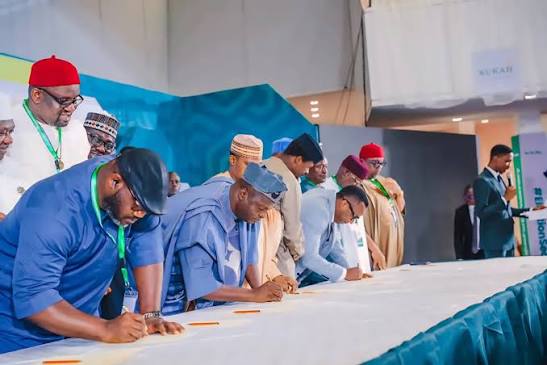
Last week, the parties in the 2027 general polls gathered in Abuja to sign a peace accord. Of the three main candidates in the last presidential election in 2023, only Mr Peter Obi was present to sign the document. President Bola Ahmed Tinubu and former Vice President Atiku Abubakar sent representatives. Some other presidential candidates who signed the accord, especially African Action Congress (AAC) candidate, Mr Omoyele Sowore, expressed diffidence in the ability of the initiative to ensure peaceful electioneering and free and fair elections.
Perhaps those who are not sold on the effectiveness of the Peace Accord have good reasons to be.
The signing of election Peace Accords has gradually become a familiar ritual in Nigeria’s electoral calendar. As each major election approaches, presidential or governorship candidates gather before religious leaders, elders, statesmen, diplomats, civil society actors and election stakeholders to pledge that they will play by the rules, shun violence and accept the outcome of a credible contest.
However, 12 years since this practice began, Nigerians are wont to ask whether it is fulfilling its stated purpose.
The National Peace Committee (NPC) itself was borne out of the recognition that elections could threaten national stability if political actors were allowed to pursue victory without restraint. The idea emerged in 2014, ahead of the 2015 general elections, when fears were mounting that the contest between then-President Goodluck Jonathan and Muhammadu Buhari could degenerate into violence. Those fears were not far-fetched, considering the post-election violence that attended the previous election between both men in 2011.
The peace body was the brainchild of former United Nations Secretary-General Kofi Annan and former Commonwealth Secretary-General Chief Emeka Anyaoku. At the January 14, 2015 Abuja Accord ceremony, they advocated a mechanism that could monitor compliance with the agreement and help prevent election-related violence. Following the signing, Anyaoku and Annan approached Bishop Matthew Hassan Kukah and asked him to help constitute the proposed committee with eminent Nigerians.
Former Head of State, General Abdulsalami Abubakar, was unanimously adopted as its chairman, and the body was inaugurated on January 25, 2015. Its mission was to provide a credible moral and civic mechanism for ensuring that political actors respected their commitments to violence-free and credible elections.
Henceforth, Peace Accords have become almost a norm before major Nigerian elections, not just presidential contests but also off-cycle governorship elections. The Edo governorship election had a Peace Accord on September 12, 2024, nine days before the September 21 poll. In Anambra, the accord was signed on November 3, 2025, five days before the November 8 election. Osun followed the pattern, with the NPC’s Peace Accord signed on July 30, 2026, 16 days before the August 15 governorship election.
However, the pre-election violence in Osun, which left dozens dead and dozens more injured, has left many doubting whether the signatories had any regard for the peace process. Osun had documented 29 deaths from 73 election-related violent incidents before the poll. And in 2023, despite the peace accord, supporters of some candidates freely intimidated and attacked rival supporters, even threatening them to abandon their voting rights if they would not vote for their preferred candidates. These cases were documented without their principals calling them to order or disowning their actions. And the electoral umpire, INEC, failed to execute a credible and transparent process, leading to the two main opposition presidential candidates claiming they won the poll.
Since then, and despite the intervention of the Peace pacts, Nigeria’s electoral landscape continues to be characterised by violence, intimidation, vote buying, hate speech, threats, destruction of campaign materials, manipulation of institutions and attempts to undermine the electoral process. Political actors may sign an accord in the morning and, in the heat of the campaign, support or tolerate conduct that contradicts the very letter and spirit of what they had signed.
Nevertheless, the Peace Accords have their uses and can achieve more than just a ritual with no force of execution. First, they remind candidates that an election is a contest for political authority, not a war. They also give traditional rulers, religious leaders, civil society organisations and other stakeholders a basis for demanding restraint from politicians. They can also create a moral obligation on candidates to accept legitimate results and pursue grievances through lawful channels.
So, the Peace Accord should not be abandoned altogether. Rather, Nigeria should move beyond the accord.
The first step is to transform the document from a symbolic pledge into an enforceable political compact. Every signatory should be required to nominate an authorised representative responsible for compliance. Alleged violations should be documented, investigated and publicly reported before, during and after the election.
Second, the NPC needs a stronger monitoring architecture. Its moral authority is significant, but it should be complemented by a permanent mechanism involving the Independent National Electoral Commission (INEC), security agencies, civil society organisations, political parties and relevant professional bodies. Early warnings of violence should trigger immediate intervention rather than waiting until violence occurs.
Third, political parties must bear greater responsibility. It is not enough for party leaders and candidates to sign agreements while supporters engage in intimidation or inflammatory rhetoric. Parties should be expected to discipline members who breach agreed standards. Where appropriate, evidence of criminal conduct should be handed over to the relevant law-enforcement agencies.
Fourth, enforcement must be impartial. Nothing destroys public confidence in a Peace Accord faster than the perception that powerful politicians can violate it without consequences while weaker opponents are punished. The same standards must apply to the ruling party and opposition parties, incumbents and challengers.
Most importantly, the Peace Accord must be connected to the rule of law.
The responsibility for peaceful elections cannot rest exclusively on General Abdulsalami Abubakar, Bishop Kukah and the members of the NPC. A committee can appeal to the conscience of politicians, but it cannot substitute for strong institutions. INEC must conduct credible elections. The election management body and the security agencies must at all times not only demonstrate their impartiality, but also single out and punish their staff who collude with desperate politicians to undermine the masses’ quest for free and fair elections. The Judiciary must also come on board. It must shed its current reputation for questionable judgments that take away the mandate of the people.
Ultimately, the Peace Accords must now go beyond the ceremonial and symbolic to a culture of electoral accountability.
We’ve got the edge. Get real-time reports, breaking scoops, and exclusive angles delivered straight to your phone. Don’t settle for stale news. Join LEADERSHIP NEWS on WhatsApp for 24/7 updates →
Join Our WhatsApp Channel