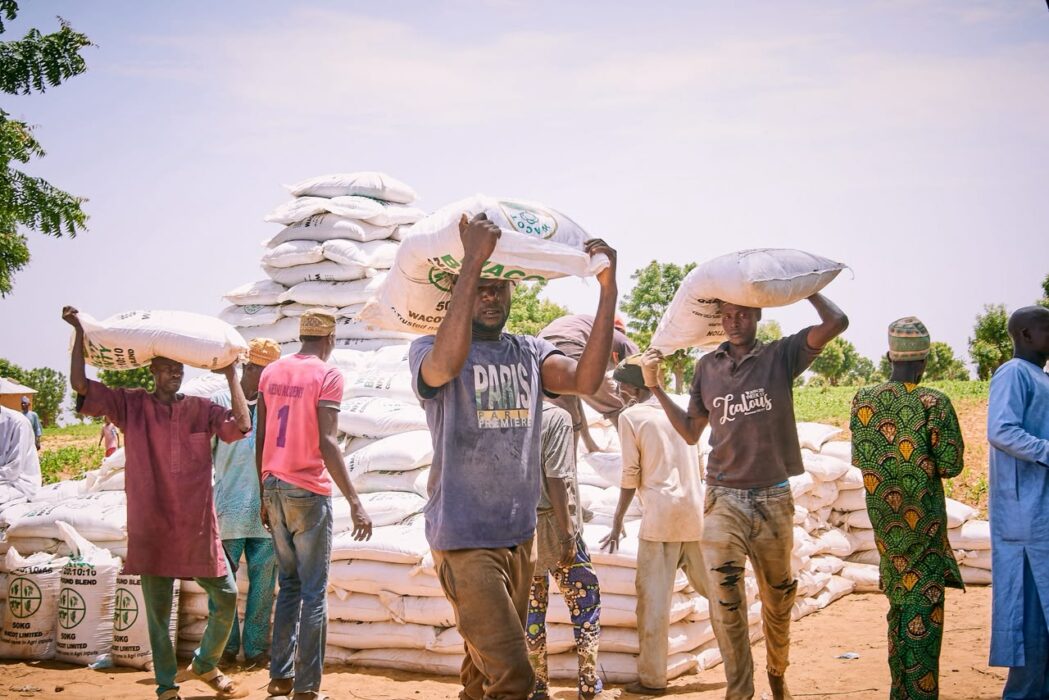
The Bank of Agriculture (BOA), in partnership with WACOT Limited, has commenced the distribution of farm inputs to smallholder farmers in Jigawa State under the Federal Government’s Renewed Hope Smallholder Farmer Support and Value Chain Programme, with a focus on raising productivity, strengthening food security and increasing farmers’ incomes.
Speaking at the flag-off ceremony in Jigawa, the executive director, Operations and Technology of BOA, Tosin Salami, who represented the bank’s managing director Ayo Sotinrin, said the intervention represented a new approach to agricultural financing through collaboration among government, financial institutions and the private sector.
He said the programme integrates input distribution with financing, extension services, agronomic support and market access to improve farmers’ productivity and profitability.
Implemented in partnership with WACOT Limited, the programme provides beneficiaries with improved seeds, fertilisers, agrochemicals, technical support and structured market opportunities through guaranteed off-take arrangements.
In a statement on Wednesday, Salami said the nationwide intervention was expected to reach more than two million smallholder farmers through the distribution of over 10 million bags of fertiliser, improved seeds and structured financing across more than 20 states, with women accounting for over one-third of beneficiaries.
He said about 200,000 farmers would benefit during the current farming season, with the target expected to increase to 500,000 by the dry season.
“Our goal is not only to provide inputs but also to double and even triple farmers’ yields. Many farmers currently harvest between one and one-and-a-half tonnes per hectare. With hybrid seeds, proper agronomic support and quality inputs, we expect yields to increase to between three and five tonnes per hectare,” he said.
The BOA executive said the bank was also working to expand irrigation support to promote year-round farming, allowing farmers to cultivate three or four times annually rather than depending solely on the rainy season.
Each beneficiary, he said, would receive improved seeds, two to three bags of fertiliser and about 20 litres of agrochemicals. The intervention is structured as a loan rather than a grant, with a single-digit interest rate of nine per cent, supported by Federal Government intervention funds.
Salami said each input package was valued at about N500,000, while farmers were projected to earn about N1.5 million at the end of the farming season. The loans have a nine-month repayment period and are disbursed through accredited farmer aggregation companies, including WACOT, rather than directly to individual farmers.
He urged beneficiaries to repay promptly to sustain the revolving fund and allow more farmers to access the facility in subsequent seasons.
Salami commended the administration of Governor Umar Namadi for investments in extension services, irrigation and climate-smart agriculture, while also praising President Bola Ahmed Tinubu’s Renewed Hope Agenda for prioritising food security and agricultural financing.
WACOT Managing Director, Mr Naveen Chaurasia, said the company remained committed to supporting farmers through quality inputs, improved agronomic practices and structured out-grower schemes covering sesame, rice and soybean production.
He identified poor-quality inputs and inadequate farming practices as major constraints to agricultural productivity and urged farmers to adopt modern production methods.
“Our objective is to provide quality inputs and ensure farmers use them correctly. We believe that with improved farming practices and proper application of inputs, farmers’ yields and incomes will increase significantly,” he said.
Also speaking, a representative of the Gumel Emirate Council, Alhaji Musa Ayuba described the programme as a major boost to the predominantly agrarian communities in the emirate.
He said Gumel had a long history of farming, particularly sesame production, and expressed confidence that the intervention would strengthen the local economy and enhance Nigeria’s foreign exchange earnings through increased sesame exports.
The traditional council appealed to the Bank of Agriculture to sustain the provision of affordable credit and consider expanding agricultural insurance to cushion farmers against losses arising from natural disasters.
We’ve got the edge. Get real-time reports, breaking scoops, and exclusive angles delivered straight to your phone. Don’t settle for stale news. Join LEADERSHIP NEWS on WhatsApp for 24/7 updates →
Join Our WhatsApp Channel