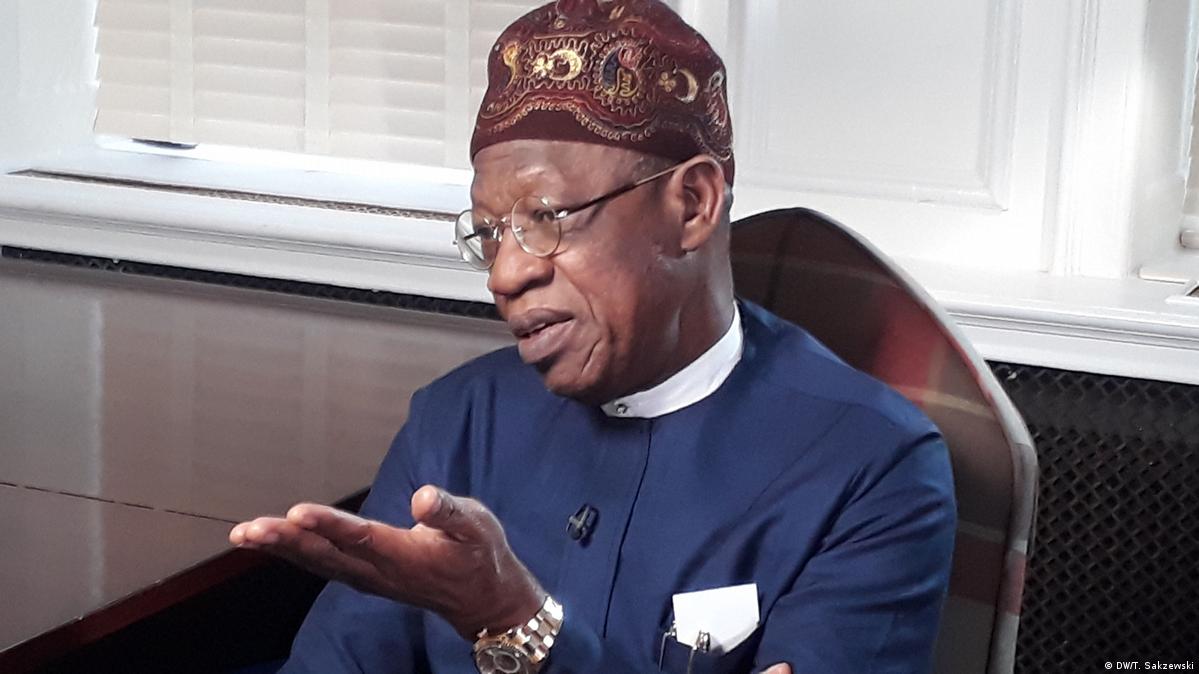
Former Minister of Information and Culture, Alhaji Lai Mohammed, has again faulted claims of a massacre at the Lekki Tollgate during the October 2020 #EndSARS protests, describing the narrative as fake news.
Mohammed also defended the suspension of Twitter operations in Nigeria under former President Muhammadu Buhari as an action taken strictly in the national interest.
The minister made the assertions while speaking on ARISE Prime Time during an interview tied to the launch of his new book, ‘Headlines and Sound Bites: Media Moments that Defined an Administration’, which chronicles media flashpoints and communication challenges faced by President Muhammadu Buhari’s administration between 2015 and 2023.
Reacting to the controversy surrounding the October 20, 2020, Lekki Tollgate incident, the former minister said his disagreement with international media reports, particularly CNN’s coverage, was based on what he described as a lack of firsthand verification.
“Nobody ever said nobody died during #EndSARS,” Mohammed said. “People died in Abuja, they died in Lagos, they died in Kano. But what we said was that CNN was not at the toll gate. CNN relied on secondhand and third-hand information,” Alh Mohammed said.
Using a metaphor to drive his point, he added, “If a man has a goat and the goat does not come home one night, he will go out to look for that goat. Five years on, nobody has come forward to say, ‘My son went to the toll gate and didn’t return.”
According to him, while the protests were “unfortunate and tragic,” branding the Lekki incident a massacre was misleading.
“Massacre is fake news,” he insisted, noting that security personnel were also casualties during the protests. “Thirty-seven policemen were killed, six soldiers were killed. This is what I kept saying.”
Mohammed also used the platform to revisit the controversial suspension of Twitter operations in Nigeria in 2021, a decision that attracted widespread criticism locally and internationally.
He maintained that the move was not triggered by the deletion of President Buhari’s tweet, as widely believed, but by broader security concerns.
“Honestly, that was not the reason,” he said. “I went to President Buhari and told him, ‘Sir, we need to suspend the services of Twitter.’ He asked me why. He even asked if it was because they deleted his tweet. I said no, and I gave him instances and examples.”
He further argued that Twitter had become “The platform of choice for those who were destabilising the country,” stressing that the decision was taken reluctantly but in the interest of national stability.
“You won’t be popular as Minister of Information,” he noted. “Some decisions you take not because you like them, but because you must take them in the national interest.”
He explained that his push for regulating social media predated the ban, recalling years of advocacy and engagement with media organisations on the dangers of unregulated digital platforms. “I am not trying to stifle free press,” he said, “but an unregulated social media could be a disaster.”
The former minister said his book offers an insider’s account of how the Buhari administration managed national narratives amid crises, including the #EndSARS protests, terrorism, banditry, and international litigation, such as the $9.6 billion P&ID arbitration case.
“One of the jobs of a communicator is to prevent fake news and misinformation from overshadowing the real facts,” Mohammed said, adding that national interest always guided his actions. “No government or person sets out to have a bad government or to stifle the freedom of people.”
He disclosed that the pressure and hostility at the height of the #EndSARS protests took a personal toll, revealing that members of his family once urged him to resign. “They were bullied online and offline. Their businesses were affected. They had had enough,” he said.
‘Headlines and Sound Bites’, which Mohammed described as part memoir and part historical record, is scheduled for launch on December 17, chosen to coincide with what would have been President Buhari’s 83rd birthday.
The former minister said the book was written to provide context, preserve history and allow future leaders to learn from both the successes and failures of governance.
“Nigerian contemporary history will not be fully understood unless those who were inside are allowed to tell their own stories,” he said.
We’ve got the edge. Get real-time reports, breaking scoops, and exclusive angles delivered straight to your phone. Don’t settle for stale news. Join LEADERSHIP NEWS on WhatsApp for 24/7 updates →
Join Our WhatsApp Channel