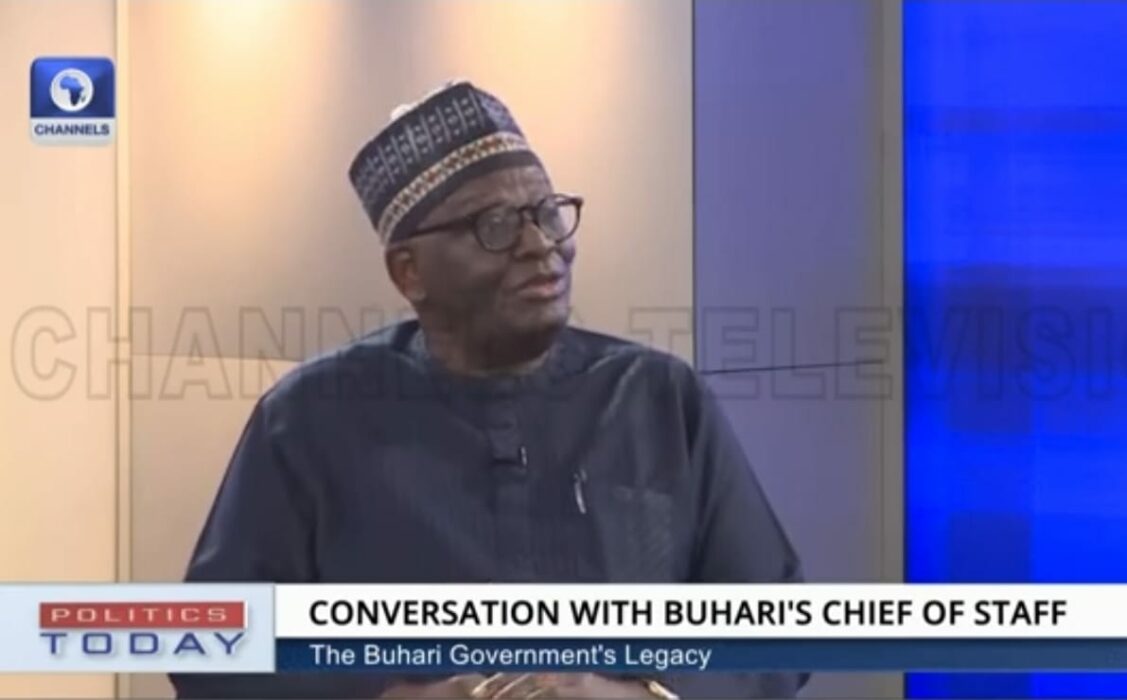
Former Chief of Staff to the late President Muhammadu Buhari, Professor Ibrahim Gambari, has revealed that the former Nigerian leader was deeply troubled by his inability to fully resolve the country’s security challenges before leaving office.
Gambari disclosed this while speaking on Channels Television’s current affairs programme, ‘Politics Today’, on Monday, where he reflected on Buhari’s years in office and his struggles with Nigeria’s persistent insecurity.
“One of the things that pained him the most is that he was unable to do more about the security situation in the country before he left,” Gambari said. “He did a lot by making sure that no territory of Nigeria was under Boko Haram.”
According to him, although Buhari’s administration succeeded in degrading Boko Haram and reclaiming territories previously held by insurgents, the resurgence of violent attacks and banditry in the North-West and North-Central remained a source of frustration for the late president.
“The situation in the North-West, in the North-Central, even in banditry, it pained him a lot,” he added. “And he felt, ‘I’ve done everything I can for these people.’ He even said at some point that maybe the base was not good enough.”
Gambari also addressed reports of alleged coup plots before Buhari’s exit from office, following claims by the Minister of Defence that such threats existed prior to President Bola Tinubu’s inauguration.
“Honestly, I’m not aware of that,” he said. “The president had many sources of information. The Chief of Staff is probably a principal one, but not the only one. He could have received information that I was not privy to.”
The former diplomat described Buhari as a disciplined leader who respected constitutional boundaries despite his military background. “He maintained strong ties with the armed forces but operated within constitutional limits,” Gambari noted.
On Buhari’s leadership style, Gambari portrayed him as a loyal figure who valued those who contributed to his political journey, but lamented that “those who benefited most from Nigeria are often the least committed to its stability.”
He also admitted that every administration has a power bloc, saying, “Every president has a cabal. The cabal under Buhari knew their limitations.”
Speaking on the 2023 general election, Gambari revealed that Buhari refused to impose a successor, insisting that Nigerians should freely choose their leader. “He did not believe in imposing a successor,” he said. “He felt the choice should be left to party members and the electorate.”
Buhari, who led Nigeria from 2015 to 2023 and earlier as military head of state between 1983 and 1985, died on July 13, 2025, at the age of 82 after an illness.
His eight-year civilian presidency was defined by early gains against Boko Haram but also by the spread of insecurity to other parts of the country, including rampant banditry, kidnappings, and communal violence.
Despite his administration’s efforts, insecurity remained one of Buhari’s most unresolved challenges, something that, according to Gambari, “pained him deeply till the end.”
We’ve got the edge. Get real-time reports, breaking scoops, and exclusive angles delivered straight to your phone. Don’t settle for stale news. Join LEADERSHIP NEWS on WhatsApp for 24/7 updates →
Join Our WhatsApp Channel