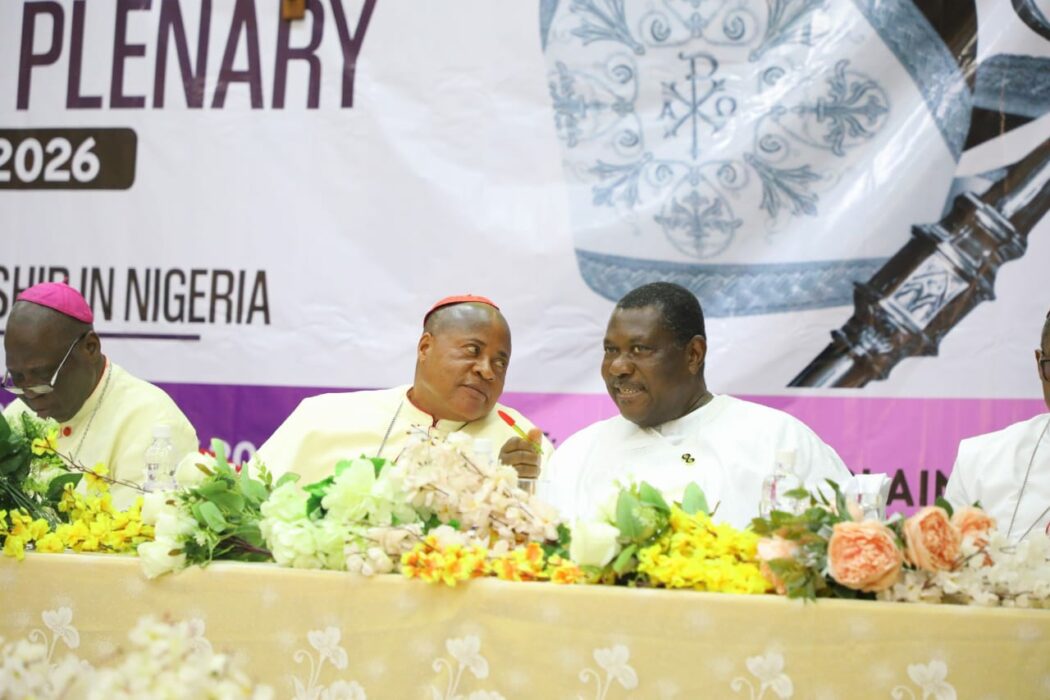
Catholic Bishops of Nigeria under the auspices of Catholic Bishops’ Conference of Nigeria (CBCN) have lamented the nation’s escalating security crisis, describing Nigeria as a country that continued to bleed endlessly while gunmen operate boldly, freely and unchallenged.
Airchbishop of Owerri and President of CBCN, Bishop Lucius Iwejuru Ugorji, who made this known while delivering his final presidential address at the opening session of the 2026 First Plenary Meeting held at the Catholic Secretariat of Nigeria (CSN) in Abuja, announced that he would step down at the conclusion of the plenary session.
Ugorji painted a harrowing picture of insecurity across Nigeria, drawing attention to recent mass atrocities that have shocked the nation’s conscience.
“Our country has continued to experience rising security challenges. We continue to hear sad tales of senseless massacres, mass burials, endless tears and grief,” he said.
He specifically highlighted the new wave of mass kidnapping incidents by gunmen in Kwara, Kebbi, Niger, Kaduna, and Kogi States, involving many students, pupils and worshippers.
The CBCN president said that the nation remained outraged by recent mass murders in different communities, particularly in Woro and Nuku villages in Kwara State, where over 200 Muslims were gruesomely massacred by scores of Islamist jihadists for refusing to embrace extremist version of Islam.
“The killing spree lasted all night without any resistance from security agents. The jihadists torched houses, abducted some persons and left the villages in ruin. Many of the dead were later found with hands and feet tied; some were burnt alive, some others had had their throats slit,” he said.
The Catholic Bishops’ president did not mince words in his assessment of the government’s security response, criticising what he described as a largely reactive approach that has failed to protect vulnerable communities.
“Sometimes, they travel long distances on motorcycles with deadly weapons to attack defenceless communities. They exploit the longstanding intelligence, operational and capacity deficiencies of our national security architecture to wreak havoc on defenceless communities,” he stated.
Ugorji said that despite kidnappers brazenly brandishing collected ransoms on social media without disguising themselves, yet, they were not arrested through their digital footprints.
While acknowledging President Bola Tinubu’s declaration of a national security emergency on November 26, 2025, and subsequent stepped-up military operations, the Archbishop argued that more fundamental changes were required.
“To effectively tackle insecurity, government must go beyond declaring a national emergency on security and reactive interventions to invest more in modern technological equipment for surveillance; strengthen the intelligence and technological capacities of security agents to enable them act proactively in detecting and preventing terrorist attacks,” he said.
The Archbishop described the current reactive approach as akin to administering medicine after death.
He also called for swift prosecution of arrested terrorists, expressing concern that delaying the prosecution of arrested terrorists or pardoning and reintegrating perceived ‘repentant Boko Haram members’ through the ‘Operation Safe Corridor’ gives the impression of complicity on the side of government.
The CBCN president also drew attention to what he described as large-scale economic sabotage through illegal mining, which he said is inextricably linked to funding terrorism and organised crime.
“Despite Nigeria’s Mineral and Mining Act 2007, which vests ownership of all mineral resources in the country to the federal government and regulates exploration and exploitation of resources, our nation, as reported, continues to lose about $9 billion annually to illegal mining which is strongly linked to the rise and sustenance of banditry, kidnapping and other organised crimes,” he revealed.
He named Zamfara, Kaduna, Kebbi, Katsina, Sokoto, Niger, Kwara, Benue, and Osun States as hotspots where criminal groups use proceeds from mineral sales to buy weapons and fund terrorist activities, alleging the involvement of foreign nationals in this illegal enterprise.
“It is notable that foreign nationals, especially Chinese, in collaboration with criminal networks exploit weak regulations and enforcement to participate in illegal mining and cart away our national wealth, while citizens watch with seeming helplessness,” he stated.
He further added that hazardous chemicals used by unlicensed miners result in severe environmental degradation and public health crises.
The Archbishop called for a more aggressive approach to combating illegal mining, suggesting that the Mining Marshals deployed by government should be complemented by drone technology and artificial intelligence for monitoring remote and high-risk mining sites.
Ugorji also expressed grave concern over declining voter turnout in general elections, which has fallen from 69% in 2003 to a mere 23% in 2023.
“This decline says a lot about citizens’ trust in the electoral process and calls into question the legitimacy of elected officials in a democratic dispensation with the mandate of an ever decreasing minority of citizens of voting age,” he warned.
He called on the National Assembly to review its recent stand on Electoral Reform, urging that the Electoral Act provide for the mandatory transmission of election results in real-time from the Bimodal Voter Accreditation System (BVAS) at polling units to the INEC Result Viewing (IReV) portal to prevent human tampering with the expressed will of the electorate.
In a pointed critique of the National Assembly’s apparent inconsistency, he noted that while members passed the 2025 Tax Bill demanding digital filing and record-keeping, they seem reluctant to apply similar digital integrity to electoral processes.
“The honourable members of the NASS should not allow themselves to be perceived as talking out of both sides of the mouth, expressing inconsistent and contradictory positions in the process of passing bills. The world is watching! Above all, God is also watching,” he said.
The plenary also heard from Dr. Mike Omeri Agbo-Omeri, Obowu of Keana, who delivered a speech titled “The Power of Leadership and Upscaling of the Common Good in Nigerian Spiritual and Public Spaces.”
Omeri confessed his initial trepidation at speaking before the bishops, revealing that his friend Professor Anthony Kila had cautioned him to tapper it a little to avoid causing chaos.
However, he said a gentle whisper of ‘Courage, Son, Courage’ emboldened him to speak.
“Courage is a value of leadership, one that inspires and motivates others to strive for greatness. Leadership is influence, and influence is a value of character defined by purpose.
“Leadership of purpose is courageous and does not seek power. Rather, it seeks to serve. It inspires, motivates, and ultimately delivers change or prioritizes it,” he said.
The plenary assembly continued at the CSN Resource Centre in Durumi, Abuja, with bishops expected to deliberate further on the pressing issues affecting the Church and nation.
We’ve got the edge. Get real-time reports, breaking scoops, and exclusive angles delivered straight to your phone. Don’t settle for stale news. Join LEADERSHIP NEWS on WhatsApp for 24/7 updates →
Join Our WhatsApp Channel